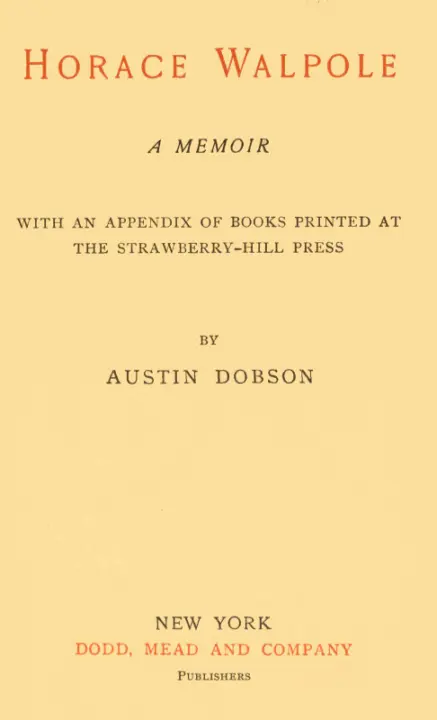
Horace Walpole: A memoir With an appendix of books printed at the Strawberry Hill Press
Austin Dobson

THE CLASSIC COLLECTION · 1903
"Fanny Burney (Madame D’Arblay)" by Austin Dobson is a biographical memoir written in the early 20th century. The book explores the life and literary contributions of Fanny Burney, focusing on her upbringing, family background, and the social circles she inhabited. As a prominent figure of her time, Burney is celebrated for her novels, particularly "Evelina" and "Cecilia," which provided insight into the lives and experiences of women in the 18th century. The opening of the memoir begins with an introduction to the Burney family's heritage and upbringing. It details the lineage of Fanny Burney, highlighting her father, Charles Burney, a well-known musician and musicologist. The narrative describes Fanny's childhood, character traits, and family dynamics, revealing her gradual development into a keen observer of society, despite her initial shyness and reticence. The detailed account sets the stage for her eventual rise as an influential writer and commentator on the social and cultural norms of her time, paving the way for further exploration of her literary journey in subsequent chapters.
Introduction adapted from the source catalogue; source summaries may be automatically generated.
Free to read · English · 60,984 words · No account needed
MAKE TIME FOR A GOOD BOOK
On by default. Untick to stop anonymous reading totals. Each page counts after 10 seconds in view. How this works.
Anonymous counting is on unless you have switched it off.
After a short time Fanny is again summoned, and her further attendance, transferred to the state dressing-room (“if any room in this private mansion can have the epithet of state”), lasts until about three, after which she sees no more of the Queen until bed-time. At five, dinner en tête-à-tête with Mrs. Schwellenberg follows in the eating-room, after which coffee in that lady’s apartment takes until eight. At eight, descent once more to the eating-room, when the Equerry in Waiting, together with any friend invited by the King or Queen, arrives for tea, which takes till nine. “From that time,”—continues Fanny—“if Mrs. Schwellenberg is alone, I never quit her for a minute till I come to my little supper at near eleven. Between eleven and twelve my last summons usually takes place, earlier and later occasionally. Twenty minutes is the customary time then spent with the Queen: half an hour, I believe, is seldom exceeded. I then come back and after doing whatever I can to forward my dress for the next morning, I go to bed—and to sleep, too, believe me: the early rising, and a long day’s attention to new affairs and occupations, cause a fatigue so bodily, that nothing mental stands against it, and to sleep I fall the moment I have put out my candle and laid down my head.” To these details, it is only necessary to add that the summonses in question were made by a bell (which seems at first to have given Fanny a good deal of annoyance); and that it was also a part of her duties to mix the Queen’s snuff,—a task which she is recorded to have performed extremely well.
From the above account, it may be gathered that attendance on Queen Charlotte was by no means the most onerous of Miss Burney’s functions. Occupying chiefly the middle of the day, it could only have been on Wednesdays and Saturdays (when there were special duties) that it extended to more than four hours, besides which Her Majesty seems to have been laudably solicitous, at all times, to spare her new and very untried attendant. But in Fanny’s carte du jour there is decidedly an “intolerable deal” of Schwellenberg. Six mortal hours of daily intercourse with this estimable lady, in addition to collaborating with her in what Fanny calls “the irksome and quick-returning labours” of the royal toilette, must have been a cruel penance, only made bearable by Mrs. Schwellenberg’s frequent absences on sick leave. Had Mrs. Schwellenberg been a Mrs. Delany, it would not have mattered so much. But she was simply a peevish old person of uncertain temper and impaired health, swaddled in the buckram of backstairs etiquette, captious, arrogant, ignorant, and accustomed—like Mrs. Slipslop—to console herself for her servility to her betters by her rudeness to those beneath her. She was blindly devoted to the Royal Family; but of taste and education she had nothing. Novels and romances she professed to regard as “what you call stuff”;[59] and the only book she was known to favour was Josephus, which was “quoted to solve all difficulties.” Her chief enthusiasm was for a pair of pet frogs which croaked when she tapped her snuff-box. “When I only go so . . . knock, knock, knock, they croak all what I please,” she would cry in an ecstasy; and she never wearied of dilating upon their “endearing little qualities” and their healthy appetite for the live flies caught for them by M. de Luc. Although she had been a quarter of a century in England, she still spoke a broken jargon, irresistible to the mimic. She was without conversational gifts, yet she could not endure a moment’s silence; she was without resources or power of attraction, yet she was furious at the least suspicion of neglect. Moreover, she seems to have lived in perpetual apprehension of obscure impending spasms, which could only be dissipated by cards. And Fanny hated cards. In moments of irritation, the old lady was capable of the meanest petty tyrannies; in her hours of ease, her amiability to her “good Miss Bernar” was as profuse as it was unpalatable. Several of her objectionable acts are narrated in the Diary; but it is needless to recall them; and the situation was obviously complicated by a perhaps intelligible jealousy on the part of the elder woman. Years afterwards, when the Diary was first published, the Duke of Sussex thought that its writer was “rather hard on poor old Schwellenberg”; and it is not impossible that Miss Burney may have somewhat heightened her delineation of a character which afforded so many inviting aspects of attack. Yet, though “Cerbera” or “La Présidente”—as Fanny calls her—may not have been as black as she is painted, it would be hopeless to attempt to decorate her with wings; and there can be little doubt that the happiest hours of the Junior Keeper were those when her untuneable colleague was safely laid up in London or Weymouth with the gout.
Your reading position is saved on this browser. Take it to another device with a library code. Reading pages adapt to text, rather than matching a printed edition.
Austin Dobson
Austin Dobson
Austin Dobson
Austin Dobson
BEHIND THE BOOK
This eBook is for the use of anyone anywhere in the United States and most other parts of the world at no cost and with almost no restrictions whatsoever. You may copy it, give it away or re-use it under the terms of the Project Gutenberg License included with this eBook or online at www.gutenberg.org. If you are not located in the United States, you will have to check the laws of the country where you are located before using this eBook. Read the source licence.
The original source file, including credits and licence, is retained by this library. Request an original-format copy at no charge. Please include the book title and Project Gutenberg identifier #48806.
KEEP YOUR CURIOSITY GOING
John L. Ransom

Herman W. Mudgett

Harriet Monroe
Daniel Dulany Addison
Charles Lanman

Harold Rosher