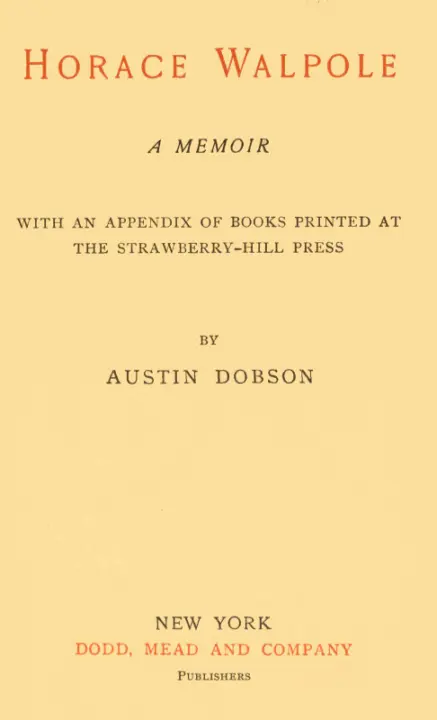
Horace Walpole: A memoir With an appendix of books printed at the Strawberry Hill Press
Austin Dobson
THE CLASSIC COLLECTION · 1903
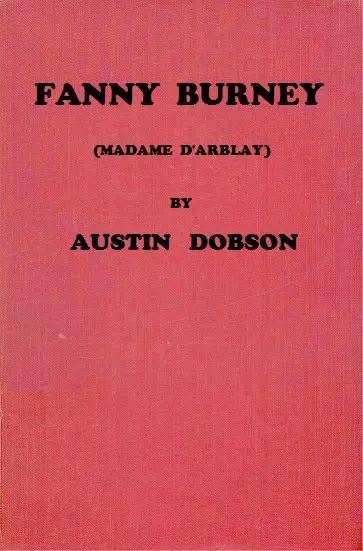
"Fanny Burney (Madame D’Arblay)" by Austin Dobson is a biographical memoir written in the early 20th century. The book explores the life and literary contributions of Fanny Burney, focusing on her upbringing, family background, and the social circles she inhabited. As a prominent figure of her time, Burney is celebrated for her novels, particularly "Evelina" and "Cecilia," which provided insight into the lives and experiences of women in the 18th century. The opening of the memoir begins with an introduction to the Burney family's heritage and upbringing. It details the lineage of Fanny Burney, highlighting her father, Charles Burney, a well-known musician and musicologist. The narrative describes Fanny's childhood, character traits, and family dynamics, revealing her gradual development into a keen observer of society, despite her initial shyness and reticence. The detailed account sets the stage for her eventual rise as an influential writer and commentator on the social and cultural norms of her time, paving the way for further exploration of her literary journey in subsequent chapters.
Introduction adapted from the source catalogue; source summaries may be automatically generated.
Free to read · English · 60,984 words · No account needed
MAKE TIME FOR A GOOD BOOK
On by default. Untick to stop anonymous reading totals. Each page counts after 10 seconds in view. How this works.
Anonymous counting is on unless you have switched it off.
At the beginning of 1778, English Literature, and especially that branch of it which consists of fiction, seems to have been suffering from a kind of sleeping sickness. The great masters who had followed upon Richardson’s success with Pamela, were gone,—as was Richardson himself. Fielding, whose last novel of Amelia had appeared in 1751, was dead; and his far younger rival, Smollett, whose Humphry Clinker came twenty years later, was also dead. Sterne was dead; Goldsmith was dead; and both Tristram Shandy and the Vicar of Wakefield had been a considerable time before the public. Johnson, whose Rasselas dated from 1759, and Horace Walpole, whose Castle of Otranto dated from 1764, were the only living writers of fiction of any eminence, for it is impossible to give a very high place to the Julia de Roubigné of Sterne’s tearful imitator, Henry Mackenzie, or to the Champion of Virtue, which Walpole’s disciple, Miss Clara Reeve, afterwards re-named The Old English Baron. Both of these, however, belong to 1777. Apart from them, there is nothing that rises above the average level of the
“books in marble covers
About smart girls and dapper lovers,”
which formed the staple product of the Circulating Library,—those “Ventures of Jack this, and the History of Betsy t’other, and Sir Humphrys, and women with hard Christian names,” which exercised the Nurse in Colman’s Polly Honeycombe. “And then”—says the Author in his Prologue—
“And then so sentimental is the Stile, So chaste, yet so bewitching all the while! Plot, and elopement, passion, rape, and rapture, The total sum of ev’ry dear—dear—Chapter.”
Of these latter and minor performances, perhaps the only one which—for the moment—deserves a passing mention is the Excursion of Mrs. Frances Brooke, already referred to in Chapter I. as the popular author of Lady Julia Mandeville. The Excursion has a certain faint interest from the fact that, preceding Evelina only by a few months, it deals, to some extent, with a similar theme, since the heroine is described as “a young lady of family but small fortune, with a mind sensible and improved, but totally ignorant of the world,” who “launches out from the country, steering, without a pilot or compass, through the rocks and shelves of a London life.” One of her perils is, of course, a heartless young nobleman, educated by his father “upon the detestable plan” of my Lord Chesterfield, whose Miscellaneous Works had then just been issued by Dr. Maty. Fanny Burney knew Mrs. Brooke’s books, and had indeed made her personal acquaintance, both in the studio of Miss Catherine Reid, the “English Rosalba,” and at the Opera House in the Haymarket, of which Mrs. Brooke was co-lessee with the actress, Mary Ann Yates. “Mrs. Brooke is very short and fat, and squints”—writes Fanny of their first interview, “but has the art of showing agreeable ugliness. She is very well bred, and expresses herself with much modesty upon all subjects; which in an authoress, a woman of known understanding, is extremely pleasing.” But save and except the very superficial resemblance referred to above, there is no trace of any connection between the Excursion and Evelina. Indeed, as for the Excursion, although Sylvanus Urban contrives to give it a review of two or three columns,—a far longer notice than he afterwards, and very tardily, accorded to Evelina,—it is not more readable to-day than the same author’s Lady Julia Mandeville, or her translations from the French,—that is to say, it is not readable at all.
Your reading position is saved on this browser. Take it to another device with a library code. Reading pages adapt to text, rather than matching a printed edition.
Austin Dobson
Austin Dobson
Austin Dobson
Austin Dobson
BEHIND THE BOOK
This eBook is for the use of anyone anywhere in the United States and most other parts of the world at no cost and with almost no restrictions whatsoever. You may copy it, give it away or re-use it under the terms of the Project Gutenberg License included with this eBook or online at www.gutenberg.org. If you are not located in the United States, you will have to check the laws of the country where you are located before using this eBook. Read the source licence.
The original source file, including credits and licence, is retained by this library. Request an original-format copy at no charge. Please include the book title and Project Gutenberg identifier #48806.
KEEP YOUR CURIOSITY GOING
John L. Ransom

Herman W. Mudgett

Harriet Monroe
Daniel Dulany Addison
Charles Lanman

Harold Rosher