THE CLASSIC COLLECTION✦PoemsCLASSIC FREE BOOKS
Poems
Marie Van Vorst
THE CLASSIC COLLECTION · 1920
"Fairfax and His Pride: A Novel" by Marie Van Vorst is a fictional work written in the early 20th century. The story begins in January 1880, chronicling the experiences of Antony Fairfax, a young artist arriving in New York from New Orleans. The novel explores themes of ambition, familial relationships, and the social challenges faced by the protagonist as he seeks recognition and belonging in a new and often unfriendly city. The opening portion introduces Antony Fairfax as he grapples with the harsh winter climate of New York and reflects on his hopes for a bright future as an artist. He feels out of place as a stranger in the North while contemplating the warmth he left behind in the South. Shortly after his arrival, Antony visits his relatives, the Carews, but is met with indifference and a lack of hospitality, amplifying his sense of isolation. The narrative then shifts to the enchanting yet complicated relationship he begins to form with his young cousins, Bella and Gardiner, who initially bring him joy amidst his struggles. Their innocent interactions provide depth to the story, hinting at the significance of familial connections and the challenges of navigating adulthood and artistic aspirations in a bustling urban landscape.
Introduction adapted from the source catalogue; source summaries may be automatically generated.
Free to read · English · 110,049 words · No account needed
MAKE TIME FOR A GOOD BOOK
On by default. Untick to stop anonymous reading totals. Each page counts after 10 seconds in view. How this works.
Anonymous counting is on unless you have switched it off.
Fairfax had placed the boy before his drawing board, and confiscated a long piece of kitchen bread, telling Bella that less than a whole loaf was enough for an eraser, extracted the rubber from Gardiner's mouth, and sat down by the little boy's side.
"There's not much money in this house, Cousin Antony," Bella informed him when the seance opened. "Please let me use the soft pencils, will you? They slide like delicious velvet."
Fairfax made an equal division of the implements, avoiding a scene, and made Bella a straight line across the page.
"Draw a line under it."
"But any one can draw a straight line," said Bella, scornfully, "and I don't think they are very pretty."
"Don't you?" he answered; "the horizon is pretty, don't you think? And the horizon is a straight line."
"Yes, it is," said Gardiner, "the howizon is where the street cars fall
over into the sunset."
"Gardiner's only six," said Bella, apologetically, "you mustn't expect much of him, Cousin Antony."
She curled over the table and bent her head and broke her pencils one by one, and Fairfax guided Gardiner's hand and watched the little girl. She was lightly and finely made. From under her short red skirt the pretty leg in its woollen stocking swung to and fro. There was a hole in the stocking heel, visible above the tiny, tiny slipper. Through the crude dark collar of the gingham apron came her dark head and its wild torrent of curling hair, wonderful hair, tangled and unkempt, curling roundly at the ends, and beneath the locks the curve of her cheek was like ivory. She was a Southern beauty--her little red mouth twisted awry over her drawing.
"I thought dwawing was making pictures, Cousin Antony; if I'd have known it was lines, I wouldn't have taken," said his youngest cousin.
"You have to begin with those things, old man. I'll wipe your hands off
on my handkerchief."
"Please do," said the little boy; "my hands leak awful easy."
His sister laughed softly, and said to herself in an undertone--
"I've drawn my lines long--long--ago, and now I'm making...."
"Don't make anything, Bella, until I tell you to," commanded her teacher, and glanced over her page where she had covered the paper with her big formless handwriting, "Dramatiss personi, first act."
"Why, I had a lovely idea for a play, Cousin Antony, and I thought I'd just jot it down. We're the company, Gardiner and I, and we give plays here every now and then. You can play too, if you like, and say 'Spartacus.' Ah, say it now."
Trevelyan felt the appealing little hand of the boy stealing into his.
Your reading position is saved on this browser. Take it to another device with a library code. Reading pages adapt to text, rather than matching a printed edition.
Marie Van Vorst
Marie Van Vorst
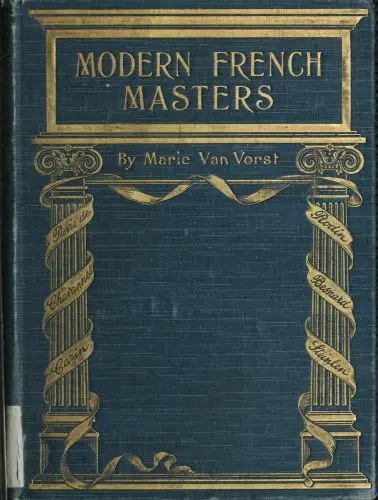
Marie Van Vorst
Marie Van Vorst
BEHIND THE BOOK
This eBook is for the use of anyone anywhere in the United States and most other parts of the world at no cost and with almost no restrictions whatsoever. You may copy it, give it away or re-use it under the terms of the Project Gutenberg License included with this eBook or online at www.gutenberg.org. If you are not located in the United States, you will have to check the laws of the country where you are located before using this eBook. Read the source licence.
The original source file, including credits and licence, is retained by this library. Request an original-format copy at no charge. Please include the book title and Project Gutenberg identifier #32826.
KEEP YOUR CURIOSITY GOING
Coulson Kernahan

Maurice Baring
Frances Wright
Cécile Tormay

Frederic Jesup Stimson

W. H. P. (William Henry Pope) Jarvis