
Last letters from the living dead man
David Patterson (Spirit) Hatch
THE CLASSIC COLLECTION · 1900
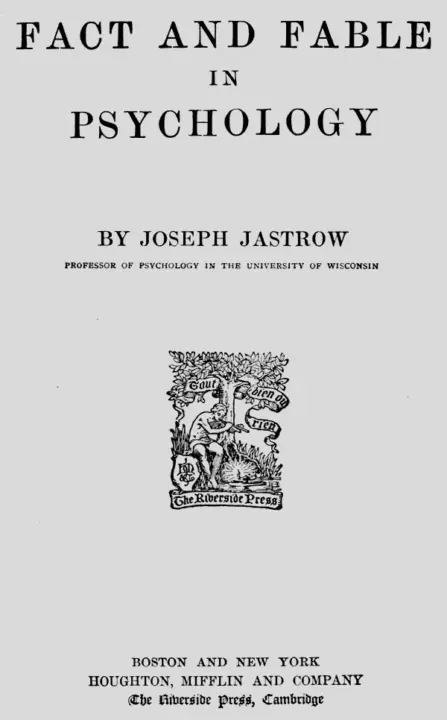
"Fact and Fable in Psychology" by Joseph Jastrow is a collection of essays written in the late 19th century. The work explores various psychological phenomena and the misconceptions that surround them, particularly those related to the occult and pseudoscience. Jastrow aims to highlight the importance of critical thinking and scientific rigor in understanding human mental processes, emphasizing the need to distinguish between fact and belief. The opening of the book sets the stage for Jastrow's examination of the public's fascination with unusual and often erroneous concepts in psychology, including occult beliefs and spiritualism. He discusses the challenges faced by psychologists in combating widespread misconceptions fueled by sensationalism and superstition. Jastrow argues for a grounded view of psychology that prioritizes normal mental functions over more obscure psychic phenomena, proposing that a deeper understanding of common psychological processes can illuminate the irregularities that captivate popular interest.
Introduction adapted from the source catalogue; source summaries may be automatically generated.
Free to read · English · 100,833 words · No account needed
MAKE TIME FOR A GOOD BOOK
On by default. Untick to stop anonymous reading totals. Each page counts after 10 seconds in view. How this works.
Anonymous counting is on unless you have switched it off.
Psychical Research, the programme of, 50;
the trend of, 51, 62, 75-77;
interests contributing to, 56-58, 63, 65, 66;
the problems of, 67;
relation to Psychology, see Psychology.
Psychology, scope of, 51;
relation to Psychical Research, 52-56, 58-61, 64, 65, 76;
difficulties in teaching, 298.
Puységur, Marquis A. M. J. Chastenet de, 194;
his discovery of somnambulism, 194, 195;
his views and status, 196, 197.
Quackery, 25.
Reichenbach, Baron, 225.
Rydberg, ----, 266, 267.
Salpêtrière, 202, 228, 231.
Scherer, ----, 366.
Science, the spirit of, 48;
the nature of, 49;
and error of, 69.
Sensation, and perception, 106, 107.
Seybert Commission, 140, 141, 158.
Sidgwick, Mrs., 141, 157.
Sight; see Vision.
Signatures, doctrine of, 264.
Sinnett, A. P., 10, 11.
Slade, Henry, 139, 140, 141.
Somnambulism, artificial, 197, 198.
Spiritualism, 12, 27, 44, 125;
manifestations of, 13, 128, 131;
origin of, 14, 15, 137, 166, 167;
doctrines of, 15, 161, 165;
present status of, 16, 18, 169;
fraud disclosed in, 140, 141, 142-145, 146, 157, 159.
Spiritualists, temper of, 16, 17.
Statistics, in relation to mental problems, 84-86.
Subconscious, 70, 79, 92, 108, 128, 129, 308.
Suggestion, 230;
unconscious, 68, 174, 186, 199, 211, 233.
Sully, James, 111, 345.
Supernatural, divergence between report and fact, 153, 155, 158; conflict with science, 174.
Superstition, 252, 254, 258;
in relation to analogy, 253;
in medicine, 259.
Survivals, 240, 248, 269, 274.
Symbolism, in relation to analogy, 248, 249, 270.
Sympathy; see Magic, sympathetic.
Telepathy, 72, 73, 78;
logical status of, 74;
evidence for, 96-98, 103;
validity as an hypothesis, 99;
inclination toward, 104.
Theosophy, 7, 27;
Mr. Hodgson's investigation of, 8, 9;
alleged miracles of, 9, 10;
doctrines of, 11, 12.
Thought-habits, in children and savages, 251, 271, 272.
Triplett, Norman, 117, 123.
Tylor, ----, 167, 240, 242, 250, 253, 256, 267, 270, 273.
Tyndall, ----, 135.
Unconsciousness of defects, 79, 80;
see also Subconscious.
Unknown, attitude toward the, 49.
Unusual, in relation to analogy, 250, 260.
Vision, its nature, 276, 337;
subjective and objective, 276;
subjective factor in, 277, 279, 280, 283, 288-295;
interpretation in, 285, 286-295;
education of the visual centre, 341, 345-347, 369, 370;
its function in dreams, 339.
Visualizing power, 338.
Zöllner, ----, 139.
The Riverside Press
Electrotyped and printed by H. O. Houghton & Co.
Cambridge, Mass., U. S. A.
Transcriber's Note:
Obvious typographical errors were repaired, but period spellings and hyphenation inconsistencies were retained.
End of Project Gutenberg's Fact and Fable in Psychology, by Joseph Jastrow
Your reading position is saved on this browser. Take it to another device with a library code. Reading pages adapt to text, rather than matching a printed edition.
BEHIND THE BOOK
This eBook is for the use of anyone anywhere in the United States and most other parts of the world at no cost and with almost no restrictions whatsoever. You may copy it, give it away or re-use it under the terms of the Project Gutenberg License included with this eBook or online at www.gutenberg.org. If you are not located in the United States, you will have to check the laws of the country where you are located before using this eBook. Read the source licence.
The original source file, including credits and licence, is retained by this library. Request an original-format copy at no charge. Please include the book title and Project Gutenberg identifier #48869.
KEEP YOUR CURIOSITY GOING
David Patterson (Spirit) Hatch

David Patterson (Spirit) Hatch

David Patterson (Spirit) Hatch

Ralph Waldo Emerson

Maurice Baring

Oscar Wilde & James McNeill Whistler