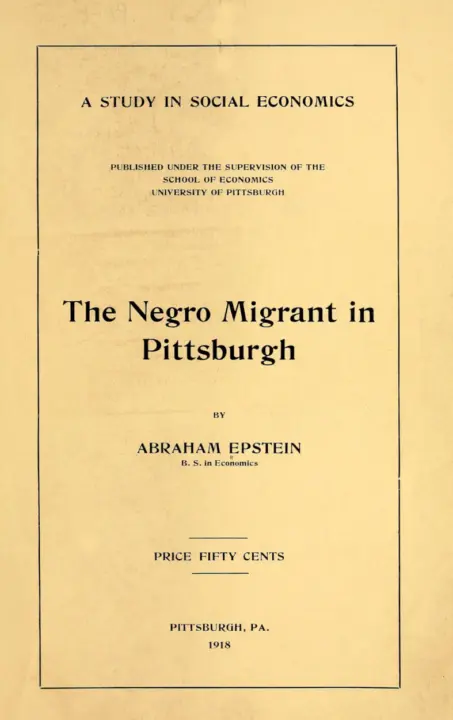
The Negro Migrant in Pittsburgh
Abraham Epstein
THE CLASSIC COLLECTION · 1922
"Facing old age" by Abraham Epstein is a social policy study written in the early 20th century. It argues that modern industrial life, inadequate wages, and weakened family support leave many Americans unable to sustain themselves in later years, and it evaluates charity, savings, and pension schemes—domestic and foreign—to press for a constructive public solution.
The opening of the study is an explicit call for social action: Epstein, drawing on intensive work in Pennsylvania, concludes that only organized social insurance or public pensions can meet the problem that private charity and employer plans fail to solve. An introduction by John B. Andrews situates old age alongside accident, sickness, and unemployment, noting America’s recent progress on compensation and mothers’ aid while stressing that old-age poverty remains largely hidden and untreated outside public-employee systems. The first chapters contrast earlier social orders—where elders retained roles or support—with the modern factory system that “scraps” older workers, shows why most cannot save amid rising living costs and fractured families, and traces the almshouse as the all-too-common end. Epstein then marshals data: the elderly share of the population is growing even as employment after 55 drops sharply, disability days climb steeply with age, and hazardous trades (steel, mining, railroads) force many out before 60; union rolls contain few members over 60. He distinguishes three groups in old age (secure, struggling but “non-dependent,” and dependent) and, using commission and census findings, shows that most institutional entrants arrive after 60, men are overrepresented, the single and widowed without children are most at risk, health impairments are widespread, prior work is largely unskilled, and home ownership and incomes are thin.
Introduction adapted from the source catalogue; source summaries may be automatically generated.
Free to read · English · 104,442 words · No account needed
MAKE TIME FOR A GOOD BOOK
On by default. Untick to stop anonymous reading totals. Each page counts after 10 seconds in view. How this works.
Anonymous counting is on unless you have switched it off.
Monthly Labour Review, June 1818, pp. 307–14.
Footnote 183:
Ibid, September 1820, p 180.
Footnote 184:
Combined from Bulletin of the Department of Labour and Industry Vol. 7, No. 1, Series of 1820, and Vol. 8, No. 3, Series of 1821, Harrisburg.
Footnote 185:
Labour Review, January 1821, p 222.
Footnote 186:
Massachusetts Report, p 58.
Footnote 187:
Ohio Report, p 241.
Footnote 188:
Penna. Report, pp 31 and 108.
Footnote 189:
Pp. 8–11–12–13–14
Footnote 190:
G. R. Miller, Social Insurance in U. S. p 111.
Footnote 191:
According to the New York Times of April 22, 1821, W. Jett Lauck, economist for the railway labour organizations, declared before the Railroad Labour Board that “authoritative government reports state that five million workers are idle, at least three million of them having been without work throughout the winter. It costs these five million workers nearly one billion dollars a month to supply their families with the barest necessities of existence. This situation means acute distress to approximately 25,000,000 persons. The cost of maintaining these five million families would absorb each month approximately one-fifth of the total savings deposits of the country. The entire savings bank deposits of the country could support them only five months, as they amount to only $5,186,845,000.”
Footnote 192:
Report of the Comptroller of the Currency, vol. 2, p 807, 1820.
Footnote 193:
Abstract of Reports of Condition of National Banks No. 125, p 11, Aug. 30, 1820, Treasury Department, Washington.
Footnote 194:
House Document No. 460, Sixty-sixth Congress 2nd Session.
Footnote 195:
Mabel Louise Nassau, Old Age Poverty in Greenwich Village, pp 16–17.
Footnote 196:
Rubinow, Social Insurance, p 313.
Footnote 197:
Mass. Report, p 58.
Footnote 198:
Ohio Report, p 288.
Footnote 199:
A recent inquiry addressed to corporations who have established pension systems is of interest. Of 58 answers to the question “Have your workers shown appreciation of benefits of pension system?” fifty-one answered in the affirmative. To the question whether the pension system has had a material effect in promoting efficiency, “particularly in that it has eliminated their worries concerning their future,” 36 out of 58 returns replied in the affirmative. Thirty-three out of 57 replies also answered yes to the question, “Has your pension system increased the average permanency of employment of your employés, i. e. has it reduced labour turnover materially?” In regard to the questions whether industrial pensions have decreased industrial unrest on the part of employés, or prevented strikes, 20 of 44 replies stated that it did to a certain extent, while 23 others declared that it did not.
Footnote 200:
Report on Industrial Pensions, The Merchants’ Association of New York,
New York, 1820.
Footnote 201:
Bulletin No. 212 U. S. Bureau of Labour Statistics, 1817, p 736.
Footnote 202:
Ibid, p 758.
Footnote 203:
Industrial Pensions, Report of Special Committee, p 13, New York Merchants’ Association, 1820.
Footnote 204:
Ibid, p 24.
Footnote 205:
Illinois Pension Laws Commission Report, 1816, p 282.
Footnote 206:
American Economic Review, Vol. 3, 1813, pp 287–280–281.
Footnote 207:
New York Merchants’ Association, pp 6–7–8.
Footnote 208:
Your reading position is saved on this browser. Take it to another device with a library code. Reading pages adapt to text, rather than matching a printed edition.
Abraham Epstein
BEHIND THE BOOK
This eBook is for the use of anyone anywhere in the United States and most other parts of the world at no cost and with almost no restrictions whatsoever. You may copy it, give it away or re-use it under the terms of the Project Gutenberg License included with this eBook or online at www.gutenberg.org. If you are not located in the United States, you will have to check the laws of the country where you are located before using this eBook. Read the source licence.
The original source file, including credits and licence, is retained by this library. Request an original-format copy at no charge. Please include the book title and Project Gutenberg identifier #77562.
KEEP YOUR CURIOSITY GOING

Charles G. (Charles Griffith) Ross
Hannah Webster Foster

Emily Lawless
Edwin Hamlin Carr

Charles De Lano Hine
Andrew Ure