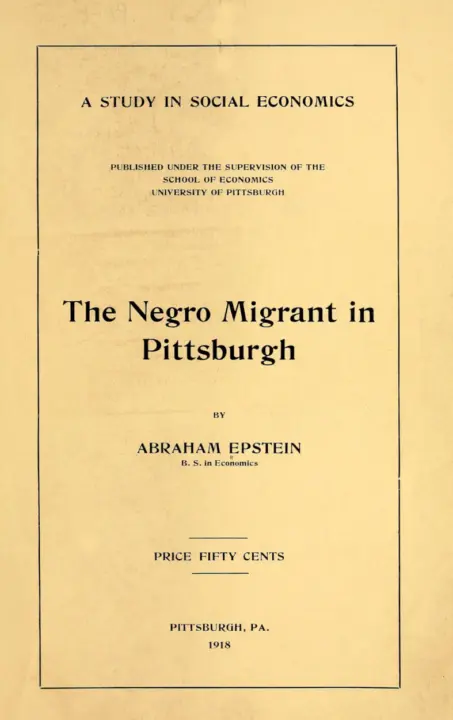
The Negro Migrant in Pittsburgh
Abraham Epstein
THE CLASSIC COLLECTION · 1922
"Facing old age" by Abraham Epstein is a social policy study written in the early 20th century. It argues that modern industrial life, inadequate wages, and weakened family support leave many Americans unable to sustain themselves in later years, and it evaluates charity, savings, and pension schemes—domestic and foreign—to press for a constructive public solution.
The opening of the study is an explicit call for social action: Epstein, drawing on intensive work in Pennsylvania, concludes that only organized social insurance or public pensions can meet the problem that private charity and employer plans fail to solve. An introduction by John B. Andrews situates old age alongside accident, sickness, and unemployment, noting America’s recent progress on compensation and mothers’ aid while stressing that old-age poverty remains largely hidden and untreated outside public-employee systems. The first chapters contrast earlier social orders—where elders retained roles or support—with the modern factory system that “scraps” older workers, shows why most cannot save amid rising living costs and fractured families, and traces the almshouse as the all-too-common end. Epstein then marshals data: the elderly share of the population is growing even as employment after 55 drops sharply, disability days climb steeply with age, and hazardous trades (steel, mining, railroads) force many out before 60; union rolls contain few members over 60. He distinguishes three groups in old age (secure, struggling but “non-dependent,” and dependent) and, using commission and census findings, shows that most institutional entrants arrive after 60, men are overrepresented, the single and widowed without children are most at risk, health impairments are widespread, prior work is largely unskilled, and home ownership and incomes are thin.
Introduction adapted from the source catalogue; source summaries may be automatically generated.
Free to read · English · 104,442 words · No account needed
MAKE TIME FOR A GOOD BOOK
On by default. Untick to stop anonymous reading totals. Each page counts after 10 seconds in view. How this works.
Anonymous counting is on unless you have switched it off.
Footnote 103:
The Standard of Living, pp 58–60–62, and Appendices A and B.
Footnote 104:
A Living Wage pp 150 and 162.
Footnote 105:
The Standard of Living p 64.
Footnote 106:
The Standard of Living p 60.
Footnote 107:
Ibid p 61.
Footnote 108:
Ibid Appendices A and B.
Footnote 109:
Report on Condition of Woman and Child wage-earners in the U. S., 61st Cong., 2nd sess., Sen. doc. No 645, Vol. XVI, p 142.
Footnote 110:
Ibid, p 152–3.
Footnote 111:
Statistics of Manufacture, Massachusetts, 1808, Boston, 1808, pp.
12–32.
Footnote 112:
Streightoff, F. H. Standard of Living, p 61.
Footnote 113:
Ibid Appendices A and B.
Footnote 114:
Ibid p 61.
Footnote 115:
Scott Nearing, Wages in the United States, pp 57–58.
Footnote 116:
R. C. Chapin, The Standard of Living Among Workingmen’s Families, in
New York City, p 281.
Footnote 117:
Scott Nearing, Wages in The United States, p 72.
Footnote 118:
Ibid, pp 85–87.
Footnote 119:
United States Dept. of Agriculture, Bureau of Statistics, Bulletin 88,
1812.
Footnote 120:
W. I. King, Wealth & Income of The People of the United States pp
214–230.
Footnote 121:
Scott Nearing, Income p 80.
Footnote 122:
Carleton H. Parker, The Casual Labourer, p 117.
Footnote 123:
The Standard of Living, p 162.
Footnote 124:
Income, p 85.
Footnote 125:
Report of the Tariff Board on Cotton Manufactures. 62nd Congress, 2nd Session, House of Document 643, Government Printing Office, 1812, Vol. II, 637–651.
Footnote 126:
Income pp 81–82.
Footnote 127:
Report on The Strike of Textile Workers in Lawrence, Massachusetts, Charles P. Neill, Senate Document 870, 62nd Session, 1812, p 74
Footnote 128:
Income, p 83.
Footnote 129:
Annual Report of the Dept. of Labour, Oklahoma, 1811–12 p 232.
Footnote 130:
The Casual Labourer, p 116.
Footnote 131:
Income, p 100.
Footnote 132:
J. H. Hollander, The Abolition of Poverty p 8.
Footnote 133:
David Friday, Profits, Wages and Prices, p 102, 1820.
Footnote 134:
Ibid p 105.
Footnote 135:
Senate Document No 415, 64th Cong. August 23, 1815, p 22.
Footnote 136:
Wages in Various Industries, 1818, p 60, Bureau of Applied Economics,
Wash.
Footnote 137:
Quarterly Publication of the American Statistical Assn. June 1818, p
51 (v. 16, p 388).
Footnote 138:
Pennsylvania Health Insurance Commission Report, p 81.
Footnote 139:
Ibid p 84.
Footnote 140:
Labour Review, August 1818, p 118.
Footnote 141:
Health Insurance Report pp 81–82.
Footnote 142:
Wages and The War, p 6.
Footnote 143:
Thirty-Third Annual Report, Statistics of Manufactures, p 11, 1820.
Footnote 144:
War Time Changes in Wages, Sept, 1814, March 1818, National Industrial
Conference Board 1818.
Footnote 145:
The Cost of Living Among Wage-Earners, Lawrence, Massachusetts, 1818; National Industrial Conference Board, Boston.
Footnote 146:
Labour Review, April 1820, p 100–104; March 1820, p 33–36; Feb. 1820, p 106–113; May 1820, p 82–107; and June 1820, p 82–84.
Footnote 147:
Industrial Survey in Selected Industries in the United States in 1818, Bulletin No 265, p 37–38, May 1820. United States Bureau of Labour Statistics.
Footnote 148:
Women’s Wages Today, Feb. 1820. Consumer’s League of N. Y. State & N.
Y. City.
Footnote 149:
Current Facts, Jan. 1821, National Consumers’ League, New York.
Footnote 150:
Labour Review, Dec. 1820, pp 72–73.
Footnote 151:
Labour Review, Dec. 1818, pp 207–228.
Footnote 152:
Ibid, Dec. 1818, pp 207–228.
Footnote 153:
Ibid, March 1821, pp 64.
Footnote 154:
Wages in Various Industries, p 13, 1818, Bureau of Applied Economics.
Footnote 155:
Ibid, p 30.
Footnote 156:
Ibid, pp 47–48.
Footnote 157:
Your reading position is saved on this browser. Take it to another device with a library code. Reading pages adapt to text, rather than matching a printed edition.
Abraham Epstein
BEHIND THE BOOK
This eBook is for the use of anyone anywhere in the United States and most other parts of the world at no cost and with almost no restrictions whatsoever. You may copy it, give it away or re-use it under the terms of the Project Gutenberg License included with this eBook or online at www.gutenberg.org. If you are not located in the United States, you will have to check the laws of the country where you are located before using this eBook. Read the source licence.
The original source file, including credits and licence, is retained by this library. Request an original-format copy at no charge. Please include the book title and Project Gutenberg identifier #77562.
KEEP YOUR CURIOSITY GOING

Charles G. (Charles Griffith) Ross
Hannah Webster Foster

Emily Lawless
Edwin Hamlin Carr

Charles De Lano Hine
Andrew Ure