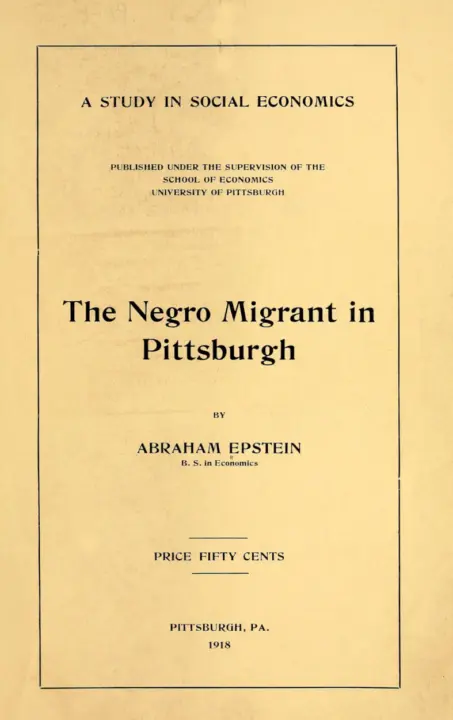
The Negro Migrant in Pittsburgh
Abraham Epstein
THE CLASSIC COLLECTION · 1922
"Facing old age" by Abraham Epstein is a social policy study written in the early 20th century. It argues that modern industrial life, inadequate wages, and weakened family support leave many Americans unable to sustain themselves in later years, and it evaluates charity, savings, and pension schemes—domestic and foreign—to press for a constructive public solution.
The opening of the study is an explicit call for social action: Epstein, drawing on intensive work in Pennsylvania, concludes that only organized social insurance or public pensions can meet the problem that private charity and employer plans fail to solve. An introduction by John B. Andrews situates old age alongside accident, sickness, and unemployment, noting America’s recent progress on compensation and mothers’ aid while stressing that old-age poverty remains largely hidden and untreated outside public-employee systems. The first chapters contrast earlier social orders—where elders retained roles or support—with the modern factory system that “scraps” older workers, shows why most cannot save amid rising living costs and fractured families, and traces the almshouse as the all-too-common end. Epstein then marshals data: the elderly share of the population is growing even as employment after 55 drops sharply, disability days climb steeply with age, and hazardous trades (steel, mining, railroads) force many out before 60; union rolls contain few members over 60. He distinguishes three groups in old age (secure, struggling but “non-dependent,” and dependent) and, using commission and census findings, shows that most institutional entrants arrive after 60, men are overrepresented, the single and widowed without children are most at risk, health impairments are widespread, prior work is largely unskilled, and home ownership and incomes are thin.
Introduction adapted from the source catalogue; source summaries may be automatically generated.
Free to read · English · 104,442 words · No account needed
MAKE TIME FOR A GOOD BOOK
On by default. Untick to stop anonymous reading totals. Each page counts after 10 seconds in view. How this works.
Anonymous counting is on unless you have switched it off.
The table below shows succinctly that the strain of modern machine industry permits only a few wage-earners to remain at work after they have passed three score and five. It is further proof of the above figures pointing to the constant reduction of those 65 years of age and over engaged in mechanical and manufacturing pursuits. An examination of the table compiled in 1920, regarding the ages when actually pensioned as compared with the ages required by these large concerns for obtaining a pension, reveals the fact that in spite of the strict regulations provided, a number of these have actually been pensioned before the specified age. Thus more than one-half of those on the pension list of the United States Steel and Carnegie Pension Fund have retired before the age of 65, although the age for voluntary retirement is set at 65. In the case of the pensioners of the Pennsylvania Railroad Company, while the compulsory age of retirement is set at 70, 44 per cent. had been placed on the pension list before they had reached the compulsory retirement age. Similar proportions are found in the case of most of the other industrial pensioners.
PENSIONABLE AGES PROVIDED AND AGES WHEN ACTUALLY PENSIONED BY LEADING INDUSTRIAL CONCERNS
Name of Pensionable Age
Company Provided Actual Ages When Pensioned
„ „ Under 50 50 to 60 60 to 65
„ „ No. Percent No. Percent No. Percent
U. S. Steel Any age if
& Carnegie permanently
Pension incapacitated;
Fund. 65 at request. 128 3.5 420 11.6 1,487 40.5
Penna. R. R. 70 compulsory,
65 to 69 at
approval of
Board. 1,209 13.0
Philadelphia 70 compulsory;
and 65 to 69 if
Reading R. incapacitated.
R. 20 2.0 15 1.5 24 2.5
N. Y. 70 compulsory;
Central any age if
Railroad unfit for
duty. 1,606 36.3
Philadelphia No compulsory
Electric age; voluntary
retirement,
male 65,
female 60. 13 6.5 35 16.5 54 25.5
Pittsburgh No compulsory
Coal Co. age; any age
if
incapacitated
after 10 years
of service. 8 4.0 42 21.0 55 28.0
Westinghouse 70 compulsory;
Air Brake by order of
Board. 3 3.0 8 7.5 8 7.5
National Compulsory, male
Transit 65, female 55;
Co. voluntary,
male 55,
female 50. 4 6.1 23 35.5
Pittsburgh 70 compulsory;
and Lake any age if
Erie R. R. unfit for
duty. 2 3.7 1 2.0 4 7.3
Name of Pensionable Age
Company Provided Actual Ages When Pensioned
„ „ 65 to 70 70 and over
„ „ No. Percent No. Percent
U. S. Steel Any age if
& Carnegie permanently
Pension incapacitated;
Fund. 65 at request. 927 25.4 695 19.0
Penna. R. R. 70 compulsory,
65 to 69 at
approval of
Board. 2,796 31.0 5,124 56.0
Philadelphia 70 compulsory;
and 65 to 69 if
Reading R. incapacitated.
R. 201 20.5 716 73.5
N. Y. 70 compulsory;
Central any age if
Railroad unfit for
duty. 2,828 63.7
Philadelphia No compulsory
Electric age; voluntary
retirement,
male 65,
female 60. 87 41.5 21 10.0
Pittsburgh No compulsory
Coal Co. age; any age
if
incapacitated
after 10 years
of service. 50 25.0 44 22.0
Westinghouse 70 compulsory;
Air Brake by order of
Board. 16 15.5 69 66.5
National Compulsory, male
Transit 65, female 55;
Co. voluntary,
male 55,
female 50. 21 32.2 17 26.2
Pittsburgh 70 compulsory;
and Lake any age if
Erie R. R. unfit for
duty. 6 11.0 41 76.0
Your reading position is saved on this browser. Take it to another device with a library code. Reading pages adapt to text, rather than matching a printed edition.
Abraham Epstein
BEHIND THE BOOK
This eBook is for the use of anyone anywhere in the United States and most other parts of the world at no cost and with almost no restrictions whatsoever. You may copy it, give it away or re-use it under the terms of the Project Gutenberg License included with this eBook or online at www.gutenberg.org. If you are not located in the United States, you will have to check the laws of the country where you are located before using this eBook. Read the source licence.
The original source file, including credits and licence, is retained by this library. Request an original-format copy at no charge. Please include the book title and Project Gutenberg identifier #77562.
KEEP YOUR CURIOSITY GOING

Charles G. (Charles Griffith) Ross
Hannah Webster Foster

Emily Lawless
Edwin Hamlin Carr

Charles De Lano Hine
Andrew Ure