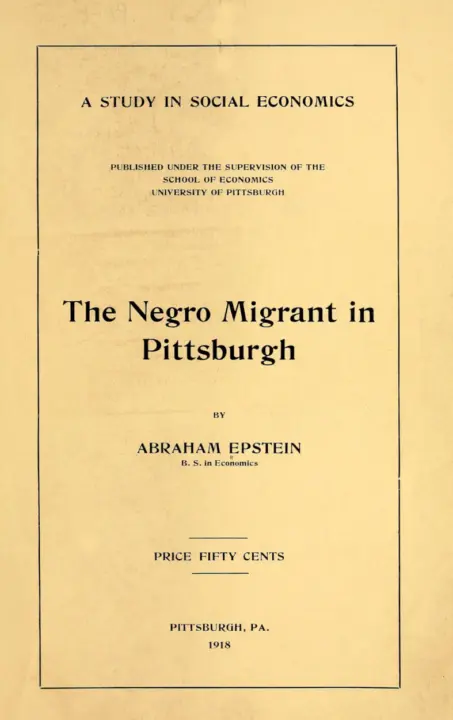
The Negro Migrant in Pittsburgh
Abraham Epstein
THE CLASSIC COLLECTION · 1922
"Facing old age" by Abraham Epstein is a social policy study written in the early 20th century. It argues that modern industrial life, inadequate wages, and weakened family support leave many Americans unable to sustain themselves in later years, and it evaluates charity, savings, and pension schemes—domestic and foreign—to press for a constructive public solution.
The opening of the study is an explicit call for social action: Epstein, drawing on intensive work in Pennsylvania, concludes that only organized social insurance or public pensions can meet the problem that private charity and employer plans fail to solve. An introduction by John B. Andrews situates old age alongside accident, sickness, and unemployment, noting America’s recent progress on compensation and mothers’ aid while stressing that old-age poverty remains largely hidden and untreated outside public-employee systems. The first chapters contrast earlier social orders—where elders retained roles or support—with the modern factory system that “scraps” older workers, shows why most cannot save amid rising living costs and fractured families, and traces the almshouse as the all-too-common end. Epstein then marshals data: the elderly share of the population is growing even as employment after 55 drops sharply, disability days climb steeply with age, and hazardous trades (steel, mining, railroads) force many out before 60; union rolls contain few members over 60. He distinguishes three groups in old age (secure, struggling but “non-dependent,” and dependent) and, using commission and census findings, shows that most institutional entrants arrive after 60, men are overrepresented, the single and widowed without children are most at risk, health impairments are widespread, prior work is largely unskilled, and home ownership and incomes are thin.
Introduction adapted from the source catalogue; source summaries may be automatically generated.
Free to read · English · 104,442 words · No account needed
MAKE TIME FOR A GOOD BOOK
On by default. Untick to stop anonymous reading totals. Each page counts after 10 seconds in view. How this works.
Anonymous counting is on unless you have switched it off.
Practically every Congress sees some new War Pension legislation enacted, whether by the passage of general or of special acts. At the close of the fiscal year ended June 30, 1818, the number of pensioners in each class under the general pension law and special acts of Congress was as follows:
Classes Number of Pensioners Regular establishment: General Laws Special Acts Invalids 14,128 527 Widows, etc. 4,104 458 Act Feb. 6, 1807, survivors 578 Act May 11, 1812, survivors 260,127 General Law, Civil War: Invalids 6,288 4,180 Widows, etc. 38,552 4,585 Act June 27, 1880: Invalids 267 Minors, etc. 2,205 Act April 18, 1808, widows 250,471 Act Aug. 5, 1882, nurses 81 38 War with Spain: Invalids 21,881 1,481 Widows, etc. 3,488 316 Act July 16, 1818, widows, etc. War of 1812, widows 1,065 8 War with Mexico 73 Survivors 207 8 Widows, etc. 2,577 164 Indian War: Survivors 3,388 38 Widows 1,864 63 War of 1817: Invalids 60 1 Widows, etc. 54 ——————— —————— Total 612,528 11,888
During the same year the following pension amounts were paid out on account of the different wars:
Civil War $212,211,880 War with Spain 3,878,188 War of 1812 17,704 War with Mexico 758,156 Indian Wars 1,561,537 Regular establishment 3,701,782 War of 1817 30,081 ———————————— Total $222,158,288
The average amount of the pension of the different wars during the fiscal year 1818 was as follows: Civil War, $373.38; War with Spain, $137.28; War of 1812, $218.57; War with Mexico, $256.48; Indian Wars, $285.84; Regular Establishment, $182.62. The average amount for all pensions was $355.78 per year. In 1820, Congress further increased the pensions of civil war veterans to $50 monthly and those of widows of veterans to $30 per month. This was estimated to add about $65,250,000 to the present pension budget. Veterans of the World War are cared for by the War Risk Insurance Bureau which is expected to prevent the burden of war pensions from falling as heavily upon the taxpayers as in previous wars.
That Congress in passing war pension legislation has practically never taken cognizance of the economic necessity of such pensions has been demonstrated so frequently and is so generally known that there is little need for its lengthy discussion here. The best indictment against the Congressional policy with regard to war pensions is brought by Dr. Rubinow, who comes to the conclusion that: “the most singular feature of the American System is that it primarily rebounds to the advantage of a class least in need of old age pensions.” He states:
Your reading position is saved on this browser. Take it to another device with a library code. Reading pages adapt to text, rather than matching a printed edition.
Abraham Epstein
BEHIND THE BOOK
This eBook is for the use of anyone anywhere in the United States and most other parts of the world at no cost and with almost no restrictions whatsoever. You may copy it, give it away or re-use it under the terms of the Project Gutenberg License included with this eBook or online at www.gutenberg.org. If you are not located in the United States, you will have to check the laws of the country where you are located before using this eBook. Read the source licence.
The original source file, including credits and licence, is retained by this library. Request an original-format copy at no charge. Please include the book title and Project Gutenberg identifier #77562.
KEEP YOUR CURIOSITY GOING

Charles G. (Charles Griffith) Ross
Hannah Webster Foster

Emily Lawless
Edwin Hamlin Carr

Charles De Lano Hine
Andrew Ure