THE CLASSIC COLLECTION✦An outlaw’s diary: the CommuneCLASSIC FREE BOOKS
An outlaw’s diary: the Commune
Cécile Tormay
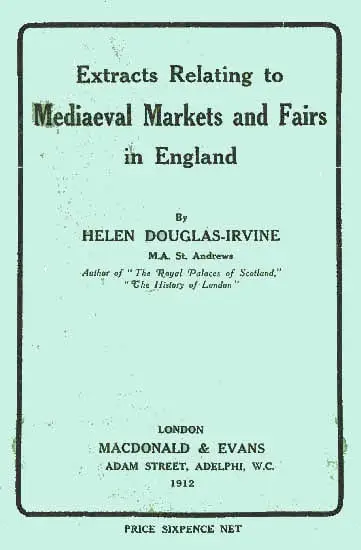
THE CLASSIC COLLECTION · 1912
"Extracts Relating to Mediaeval Markets and Fairs in England" by Helen Douglas-Irvine is a historical account published in the early 20th century. The book provides a detailed exploration of the evolution, significance, and regulation of markets and fairs in medieval England, delving into their socio-economic impact on society during that era. The content of the book features a variety of extracts and original documents that illuminate the customs, regulations, and practices surrounding markets and fairs from the Anglo-Saxon period through to the late medieval times. It discusses the significance of market rights granted by kings, the establishment of specific market locations, and the privileges awarded to merchants. Additionally, the book examines various aspects of market life, including the enforcement of trade laws, the role of foreign merchants, and the decline of traditional fair practices as they transformed into places of entertainment in later centuries. Through this compilation, readers receive an informed perspective on how these economic institutions shaped the fabric of medieval English life.
Introduction adapted from the source catalogue; source summaries may be automatically generated.
Free to read · English · 13,161 words · No account needed
MAKE TIME FOR A GOOD BOOK
On by default. Untick to stop anonymous reading totals. Each page counts after 10 seconds in view. How this works.
Anonymous counting is on unless you have switched it off.
... The mayor and commonalty and citizens, and their successors, shall and may, from henceforth for ever, have, hold, enjoy and use ... tolls, stallages, piccages.
Birch, Charters of City of London, 122.
A duty called scavage or shewage was exacted from strangers who
sold in the fairs.
I have heard also that our townsmen (of Oxford) in their fair, which they keep at Allhallowtide, do exact of strangers a custom for opening and shewing their wares, vendible, &c., which is called scavage or shewage.
Oxford Historical Society, Charter of Henry II. to the citizens of Oxford., II. 2 (from Twyne's MSS. in the Bodleian).
In 1503 it was rendered illegal, except in the case of London, to take scavage from denizens, otherwise from subjects of the king who were of alien birth, so long as they sold goods on which due customs had already been paid.
1503. Be it therefore ordained ... that if any mayor, sheriff, bailiff, or other officer in any city, borough or town within this realm, take or levy any custom called Scavage, otherwise called Shewage, of any merchant denizen, or of any other of the King's subjects denizens, of or for any manner of merchandise to our Sovereign lord the King before truly customed, that is brought or conveyed by land or water, to be uttered and sold in any city, borough, or town in this land, ... that then every mayor, sheriff, bailiff, or other officer, distraining, levying, or taking any such Scavage, shall forfeit for every time he so offendeth £20, the one moiety thereof to our Sovereign lord the King, and the other moiety thereof to the party in that behalf aggrieved, or to any other that first sueth in that party by action of debt in any shire within this realm to be sued.... Provided always that the mayor, sheriffs, and commonalty of the city of London, and every of them, shall have and take all such sums of money for the said Scavage, and of every person denizen, as by our Sovereign lord the King and his honourable council shall be determined to be the right and title of the said mayor, sheriffs, and commonalty of the said city of London, or any of them.
Statute, 19 Henry VII., cap. 8.
Certain citizens and burghers, who had the privilege of free trade in England or throughout the king's dominions, were exempt from paying tolls or other customs.
Charter of Henry I. to the citizens of London.
... Let all the men of London be quit and free, and their goods, both throughout England and in the seaports, of toll and passage[5] and lastage[6] and all other customs.
Stubbs, Select Charters, 108.
[5] Passage was probably the due payable for the use of
ferries.
Your reading position is saved on this browser. Take it to another device with a library code. Reading pages adapt to text, rather than matching a printed edition.
BEHIND THE BOOK
This eBook is for the use of anyone anywhere in the United States and most other parts of the world at no cost and with almost no restrictions whatsoever. You may copy it, give it away or re-use it under the terms of the Project Gutenberg License included with this eBook or online at www.gutenberg.org. If you are not located in the United States, you will have to check the laws of the country where you are located before using this eBook. Read the source licence.
The original source file, including credits and licence, is retained by this library. Request an original-format copy at no charge. Please include the book title and Project Gutenberg identifier #43667.
KEEP YOUR CURIOSITY GOING
Cécile Tormay

Moritz Busch
John L. Ransom
Frances Wright
Cécile Tormay

Mabel Potter Daggett