THE CLASSIC COLLECTION✦An outlaw’s diary: the CommuneCLASSIC FREE BOOKS
An outlaw’s diary: the Commune
Cécile Tormay
THE CLASSIC COLLECTION · 1855
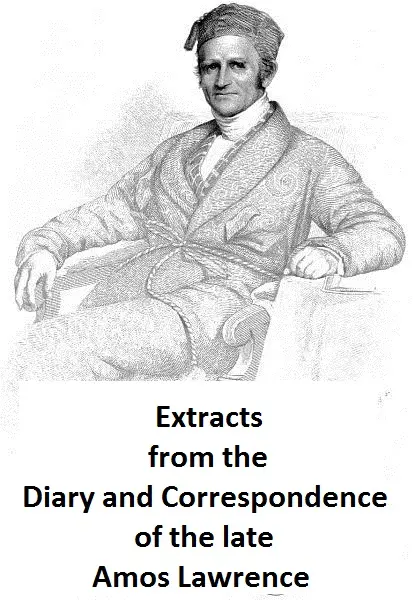
"Extracts from the Diary and Correspondence of the Late Amos Lawrence; with a Brief Account of Some Incidents in His Life" edited by William R. Lawrence, M.D. is a historical account written in the mid-19th century. This work serves as a memorial to Amos Lawrence, encompassing his personal reflections, correspondence, and significant events throughout his life. Highlighting his dedication to family, business, and community, the writings provide insights into the character and values of a man deeply committed to his duties and philanthropic efforts. The opening of the work introduces the reader to the background of Amos Lawrence, detailing his lineage, early life experiences, and the influence of his parents. Remarkably, the preface sets the tone for the memoir, explaining the author's intentions to preserve the virtues and lessons shared within the letters written by Lawrence to his children. These early excerpts reflect on his family's values, his formative years, and the development of his strong moral compass, shaped by both his upbringing and personal observations. The introduction paints a vivid picture of a life lived with purpose, emphasizing the importance of character, integrity, and education that resonates throughout his correspondence.
Introduction adapted from the source catalogue; source summaries may be automatically generated.
Free to read · English · 100,359 words · No account needed
MAKE TIME FOR A GOOD BOOK
On by default. Untick to stop anonymous reading totals. Each page counts after 10 seconds in view. How this works.
Anonymous counting is on unless you have switched it off.
In the above letter Mr. Lawrence speaks of the gratification which he had derived from the results of his efforts in behalf of Williams College; and, as there may be no more fitting place to give an account of these efforts, the following record is here introduced, from the pen of President Hopkins. It is found in his sermon commemorative of the donor, delivered at the request of the students, on February 21, 1853.
"In October, 1841, the building known as the East College was burned. Needy as the institution was before, this rendered necessary an application to the Legislature for funds; and, when this failed, to the public at large. Owing to a panic in the money market, this application was but slightly responded to, except in this town. In Boston the sum raised was less than two thousand dollars; and the largest sum given by any individual was one hundred dollars. This sum was given by Mr. Lawrence, who was applied to by a friend of the college; and this, it is believed, was the only application ever made to him on our behalf. This directed his attention to the wants of the college; but nothing more was heard from him till January, 1844. At that time, I was delivering a course of the Lowell Lectures, in Boston, when his son, Mr. Amos A. Lawrence, called and informed me that his father had five thousand dollars which he wished to place at the disposal of the college. As I was previously but slightly acquainted with Mr. Lawrence, and had had no conversation with him on the subject, this was to me an entire surprise; and, embarrassed as the institution then was by its debt for the new buildings, the relief and encouragement which it brought to my own mind, and to the minds of others, friends of the college, can hardly be expressed. Still, this did not wholly remove the debt. On hearing this casually mentioned, he said, if he had known how we were situated, he thought he should have given us more; and the following July, without another word on the subject, he sent me a check for five thousand dollars. This put the college out of debt, and added two or three thousand dollars to its available funds. In January, 1846, he wrote, saying he wished to see me; and, on meeting him, he said his object was to consult me about the disposition of ten thousand dollars, which he proposed to give the college. He wished to know how I thought it would do the most good. I replied, at once, By being placed at the disposal of the trustees, to be used at their discretion. He said, 'Very well;' and that was all that passed on that point. So I thought; and, knowing his simplicity of character, and singleness of purpose, I felt no embarrassment in making that reply. Here was a beautiful exemplification of the precept of the apostle, 'He that giveth, let him do it with simplicity.' Such a man had a right to have, for one of his mottoes, 'Deeds, not words.' This was just what was needed; but it gave us some breadth and enlargement, and was a beginning in what it had long been felt must, sooner or later, be undertaken,--the securing of an available fund suitable as a basis for such an institution. His next large gift was the library. This came from his asking me, as I was riding with him the following winter, if we wanted anything. Nothing occurred to me at the time, and I replied in the negative; but, the next day, I remembered that the trustees had voted to build a library, provided the treasurer should find it could be done for twenty-five hundred dollars. This I mentioned to him. He inquired what I supposed it would cost. I replied, 'Five thousand dollars.' He said, at once, 'I will give it.' With his approbation, the plan of a building was subsequently adopted that would cost seven thousand dollars; and he paid that sum. A year or two subsequently, he inquired of me the price of tuition here, saying he should like to connect Groton Academy with Williams College; and he paid two thousand dollars to establish four scholarships for any one who might come from that institution. His next gift was the telescope, which cost about fifteen hundred dollars. The history of this would involve some details which I have not now time to give. In 1851, accompanied by Mrs. Lawrence, he made a visit here. This was the first time either of them had seen the place. In walking over the grounds, he said they had great capabilities, but that we needed more land; and authorized the purchase of an adjoining piece of four acres. This purchase was made for one thousand dollars; and, if the college can have the means of laying it out, and adorning it suitably, it will, besides furnishing scope for exercise, be a fit addition of the charms of culture to great beauty of natural scenery. In addition to these gifts, he has, at different times, enriched the library with costly books, of the expense of which I know nothing. Almost everything we have in the form of art was given by him. In December, 1845, I received a letter from him, dated the 22d, or 'Forefathers' Day,' which enclosed one hundred dollars, to be used for the aid of needy students in those emergencies which often arise. This was entirely at his own suggestion; and nothing could have been more timely or appropriate in an institution like this, where so many young men are struggling to make their own way. Since that time, he has furnished me with at least one hundred dollars annually for that purpose; and he regarded the expenditure with much interest. Thus, in different ways, Mr. Lawrence had given to the college between thirty and forty thousand dollars; and he had expressed the purpose, if he should live, of aiding it still further. Understanding as he did the position and wants of this college, he sympathized fully with the trustees in their purpose to raise the sum of fifty thousand dollars, and, at the time of his death, was exerting a most warm-hearted and powerful influence for its accomplishment. In reference to this great effort, we feel that a strong helper is taken away. The aid which Mr. Lawrence thus gave to the college was great and indispensable; and probably no memorial of him will be more enduring than what he has done here. By this, being dead, he yet speaks, and will continue to speak in all coming time. From him will flow down enjoyment and instruction to those who shall walk these grounds, and look at the heavens through this telescope, and read the books gathered in this library, and hear instruction from teachers sustained, wholly or in part, by his bounty. Probably he could not have spent this money more usefully; and there is reason to believe that he could have spent it in no way to bring to himself more enjoyment. The prosperity of the college was a source of great gratification to him; and he said, more than once, that he had been many times repaid for what he had done here. That he should have thus done what he did unsolicited, and that he--and, I may add, his family--should have continued to find in it so much of satisfaction, is most grateful to my own feelings, and must be so to every friend of the college. In doing it, he seemed to place himself in the relation, not so much of a patron of the college, as of a sympathizer and helper in a great and good work."
Your reading position is saved on this browser. Take it to another device with a library code. Reading pages adapt to text, rather than matching a printed edition.
BEHIND THE BOOK
This eBook is for the use of anyone anywhere in the United States and most other parts of the world at no cost and with almost no restrictions whatsoever. You may copy it, give it away or re-use it under the terms of the Project Gutenberg License included with this eBook or online at www.gutenberg.org. If you are not located in the United States, you will have to check the laws of the country where you are located before using this eBook. Read the source licence.
The original source file, including credits and licence, is retained by this library. Request an original-format copy at no charge. Please include the book title and Project Gutenberg identifier #42522.
KEEP YOUR CURIOSITY GOING
Cécile Tormay

Moritz Busch
John L. Ransom
Frances Wright
Cécile Tormay

Mabel Potter Daggett