THE CLASSIC COLLECTION✦An outlaw’s diary: the CommuneCLASSIC FREE BOOKS
An outlaw’s diary: the Commune
Cécile Tormay
THE CLASSIC COLLECTION · 1855
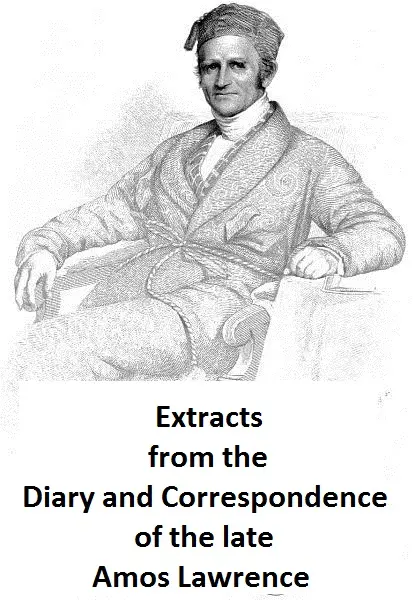
"Extracts from the Diary and Correspondence of the Late Amos Lawrence; with a Brief Account of Some Incidents in His Life" edited by William R. Lawrence, M.D. is a historical account written in the mid-19th century. This work serves as a memorial to Amos Lawrence, encompassing his personal reflections, correspondence, and significant events throughout his life. Highlighting his dedication to family, business, and community, the writings provide insights into the character and values of a man deeply committed to his duties and philanthropic efforts. The opening of the work introduces the reader to the background of Amos Lawrence, detailing his lineage, early life experiences, and the influence of his parents. Remarkably, the preface sets the tone for the memoir, explaining the author's intentions to preserve the virtues and lessons shared within the letters written by Lawrence to his children. These early excerpts reflect on his family's values, his formative years, and the development of his strong moral compass, shaped by both his upbringing and personal observations. The introduction paints a vivid picture of a life lived with purpose, emphasizing the importance of character, integrity, and education that resonates throughout his correspondence.
Introduction adapted from the source catalogue; source summaries may be automatically generated.
Free to read · English · 100,359 words · No account needed
MAKE TIME FOR A GOOD BOOK
On by default. Untick to stop anonymous reading totals. Each page counts after 10 seconds in view. How this works.
Anonymous counting is on unless you have switched it off.
On the 29th of November, Mr. Lawrence addressed to his son a most joyous letter, announcing the birth of twin-grand daughters, and the comfortable health of his daughter, the wife of the Rev. Charles Mason, Rector of St. Peter's Church, at Salem, Massachusetts. The letter is filled with the most devout expressions of gratitude at the event, and cheering anticipations for the future, and yet with some feelings of uneasiness lest the strength of his daughter should not be sufficient to sustain her in these trying circumstances. He adds:
"Why, then, should I worry myself, about what I cannot help, and practically distrust that goodness that sustains and cheers and enlivens my days?"
The fears expressed were too soon and sadly realized; the powers of her constitution had been too severely taxed, nature gave way, and, four days afterwards, she ceased to live. Mr. Lawrence announced the death of this cherished and only daughter in the following letter:
"BOSTON, December 14, 1844.
"MY DEAR SON: The joyous event I mentioned of S.'s twins has in it sad memorials of the uncertainty of all joys, excepting those arising from the happiness of friends whose journey is ended, and whose joys are commencing. Long life does not consist in many years, but in the use of the years allowed us; so that many a man who has seen his four-score has, for all the purposes of life, not lived at all. And, again, others, who have impressed distinct marks, and have been called away before twenty-eight years have passed over them, may have lived long lives, and have been objects of grateful interest to multitudes who hardly spoke to them while living. Such has been the case with our hearts' love and desire, Susan Mason. The giving birth to those two babes, either of whom would have been her pride and delight, was more than she could recruit from. The exhaustion and faintness at the time were great, but not alarming; and the joy of our hearts for a season seemed unmixed. After three days, the alarm for her safety had taken stronger hold of her other friends than of myself; and, at the time I wrote you last, I felt strong confidence in her recovery. On Sunday evening, at seven o'clock, a great change came over her, that precluded all hope, and she was told by C. how it was. She seemed prepared for it, was clear in her mind, and, with what little strength she had, sent messages of love. 'Give love to my father, and tell him I hope we shall meet in heaven,' was her graphic and characteristic message; and then she desired C. to lead and guide her thoughts in prayer, which he continued to do for as many as six times, until within the last half-hour of her life. At three o'clock on Monday morning, the 2d instant, her pure spirit passed out of its earthly tenement to its heavenly home, where our Father has called her to be secured from the trials and pains and exposures to which she was here liable. It is a merciful Father, who knows better than we do what is for our good. What is now mysterious will be made plain at the right time; for 'He doeth all things well.' Shall we, then, my dear children, doubt him in this? Surely not. S. was ripe for heaven, and, as a good scholar, has passed on in advance of her beloved ones; but beckons us on, to be reünited, and become joint heirs with her of those treasures provided for those who are found worthy. We are now to think of her as on the other side of Jordan, before the same altar that we worship at, without any of the alloy that mixes in ours; she praising, and we praying, and all hoping an interest in the Beloved that shall make all things seem less than nothing in comparison with this. We have had the sympathy of friends; and the circumstances have brought to light new friends, that make us feel our work here is not done. I feel called two ways at once: S. beckoning me to come up; the little ones appealing to the inmost recesses of my heart to stay, and lead them, with an old grandfather's fondest, strongest, tenderest emotions, as the embodiment of my child. Her remains are placed at the head of her mother's; and those two young mothers, thus placed, will speak to their kindred with an eloquence that words cannot. I try to say, in these renewed tokens of a Father's discipline, 'Thy will be done,' and to look more carefully after my tendency to have some idol growing upon me that is inconsistent with that first place he requires; and I further try to keep in mind, that, if I loved S. much, he loved her more, and has provided against the changes she was exposed to under the best care I could render. Let us praise God for her long life in a few years, and profit by the example she has left. The people of her own church are deeply afflicted, and not until her death were any of us aware of the strong hold she had upon them. Some touching incidents have occurred, which are a better monument to her memory than any marble that can be reared. * * * *
Your reading position is saved on this browser. Take it to another device with a library code. Reading pages adapt to text, rather than matching a printed edition.
BEHIND THE BOOK
This eBook is for the use of anyone anywhere in the United States and most other parts of the world at no cost and with almost no restrictions whatsoever. You may copy it, give it away or re-use it under the terms of the Project Gutenberg License included with this eBook or online at www.gutenberg.org. If you are not located in the United States, you will have to check the laws of the country where you are located before using this eBook. Read the source licence.
The original source file, including credits and licence, is retained by this library. Request an original-format copy at no charge. Please include the book title and Project Gutenberg identifier #42522.
KEEP YOUR CURIOSITY GOING
Cécile Tormay

Moritz Busch
John L. Ransom
Frances Wright
Cécile Tormay

Mabel Potter Daggett