THE CLASSIC COLLECTION✦An outlaw’s diary: the CommuneCLASSIC FREE BOOKS
An outlaw’s diary: the Commune
Cécile Tormay
THE CLASSIC COLLECTION · 1855
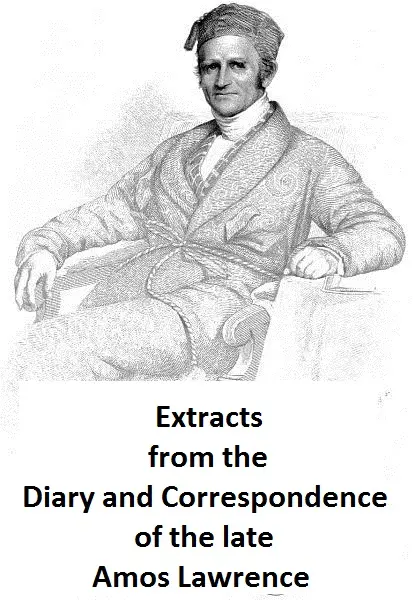
"Extracts from the Diary and Correspondence of the Late Amos Lawrence; with a Brief Account of Some Incidents in His Life" edited by William R. Lawrence, M.D. is a historical account written in the mid-19th century. This work serves as a memorial to Amos Lawrence, encompassing his personal reflections, correspondence, and significant events throughout his life. Highlighting his dedication to family, business, and community, the writings provide insights into the character and values of a man deeply committed to his duties and philanthropic efforts. The opening of the work introduces the reader to the background of Amos Lawrence, detailing his lineage, early life experiences, and the influence of his parents. Remarkably, the preface sets the tone for the memoir, explaining the author's intentions to preserve the virtues and lessons shared within the letters written by Lawrence to his children. These early excerpts reflect on his family's values, his formative years, and the development of his strong moral compass, shaped by both his upbringing and personal observations. The introduction paints a vivid picture of a life lived with purpose, emphasizing the importance of character, integrity, and education that resonates throughout his correspondence.
Introduction adapted from the source catalogue; source summaries may be automatically generated.
Free to read · English · 100,359 words · No account needed
MAKE TIME FOR A GOOD BOOK
On by default. Untick to stop anonymous reading totals. Each page counts after 10 seconds in view. How this works.
Anonymous counting is on unless you have switched it off.
During the autumn of this year, Mr. Lawrence purchased the large building in Mason-street, which had, for many years, been used as the Medical School of Harvard College, with the intention of founding a charitable hospital for children. He had heard of the manner in which such institutions were conducted in France, and believed that a great benefit would be conferred on the poorer classes by caring for their sick children when their own poverty or occupations prevented their giving them that attention which could be secured in an institution of this kind. The great object was to secure the confidence of that class, and to overcome their repugnance to giving up their children to the care of others. The plan had not been tried in this country; though in France, where there exists a much larger and more needy population, the system was completely successful. Although but an experiment, Mr. Lawrence considered the results which might be obtained of sufficient magnitude to warrant the large outlays required. He viewed it not only as a mode of relieving sickness and suffering, but as a means of exercising a humanizing effect upon those who should come directly under its influence, as well as upon that class of persons generally for whose benefit it was designed. His heart was ever open to the cry of suffering; and he was equally ready to relieve it, whether it came from native or foreigner, bond or free. The building which had been purchased for the object, from its internal arrangement, and from its too confined position, was found less suitable than another, in the southerly part of the city, where an open view and ample grounds were more appropriate for the purpose; while there was no cause for that prejudice which, it was found, existed toward the project in the situation first thought of. With characteristic liberality, Mr. Lawrence offered the Medical College, now not required, to the Boston Society of Natural History at the cost, with a subscription from himself of five thousand dollars. The offer was accepted. An effort was made by the Society to raise by subscription the necessary funds; and the result was their possession of the beautiful building since occupied by their various collections in the different departments of natural history. The large house on Washington-street was soon put in complete repair, suitably furnished, provided with physicians and nurses, and opened as the Children's Infirmary, with accommodations for thirty patients. The following spring was marked by a great degree of mortality and suffering among the emigrant passengers, and consequently the beds were soon occupied by whole families of children, who arrived in the greatest state of destitution and misery. Many cases of ship-fever were admitted; so that several of the attendants were attacked by it, and the service became one of considerable danger. Many now living in comfort attribute the preservation of their life to the timely succor then furnished; and, had no other benefits followed, the good bestowed during the few weeks of spring would have compensated for the labor and cost. This institution continued in operation for about eighteen months, during which time some hundreds of patients were provided for. The prejudices of parents, which had been foreseen, were found to exist, but disappeared with the benefits received; and the whole experiment proved conclusively that such an institution may be sustained in this community with vast benefit to a large class of the suffering; and it is hoped that it may one day lead to an establishment of the kind on a larger scale, and with a more extensive organization and means of usefulness. In this experiment, it was found, from the limited number of beds, that the cost of each patient was much greater than if four times the number had been provided for, and so large that Mr. Lawrence decided that the same amount of money could be made to afford relief to much larger numbers of the same class of sufferers applied in some other way. He was a constant visitor at the Infirmary, and took a deep interest in many of the patients, whose varied history had been recited to him; and in after years, as he passed through the streets, many an eye would brighten as it caught a glimpse of the kind friend who had whispered words of consolation and hope in the lonely hours of sickness.
Your reading position is saved on this browser. Take it to another device with a library code. Reading pages adapt to text, rather than matching a printed edition.
BEHIND THE BOOK
This eBook is for the use of anyone anywhere in the United States and most other parts of the world at no cost and with almost no restrictions whatsoever. You may copy it, give it away or re-use it under the terms of the Project Gutenberg License included with this eBook or online at www.gutenberg.org. If you are not located in the United States, you will have to check the laws of the country where you are located before using this eBook. Read the source licence.
The original source file, including credits and licence, is retained by this library. Request an original-format copy at no charge. Please include the book title and Project Gutenberg identifier #42522.
KEEP YOUR CURIOSITY GOING
Cécile Tormay

Moritz Busch
John L. Ransom
Frances Wright
Cécile Tormay

Mabel Potter Daggett