THE CLASSIC COLLECTION✦An outlaw’s diary: the CommuneCLASSIC FREE BOOKS
An outlaw’s diary: the Commune
Cécile Tormay
THE CLASSIC COLLECTION · 1855
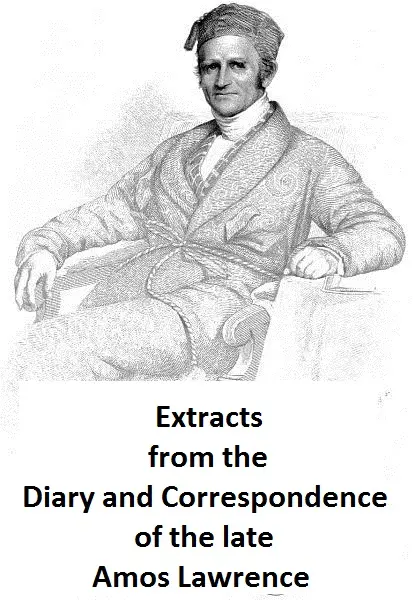
"Extracts from the Diary and Correspondence of the Late Amos Lawrence; with a Brief Account of Some Incidents in His Life" edited by William R. Lawrence, M.D. is a historical account written in the mid-19th century. This work serves as a memorial to Amos Lawrence, encompassing his personal reflections, correspondence, and significant events throughout his life. Highlighting his dedication to family, business, and community, the writings provide insights into the character and values of a man deeply committed to his duties and philanthropic efforts. The opening of the work introduces the reader to the background of Amos Lawrence, detailing his lineage, early life experiences, and the influence of his parents. Remarkably, the preface sets the tone for the memoir, explaining the author's intentions to preserve the virtues and lessons shared within the letters written by Lawrence to his children. These early excerpts reflect on his family's values, his formative years, and the development of his strong moral compass, shaped by both his upbringing and personal observations. The introduction paints a vivid picture of a life lived with purpose, emphasizing the importance of character, integrity, and education that resonates throughout his correspondence.
Introduction adapted from the source catalogue; source summaries may be automatically generated.
Free to read · English · 100,359 words · No account needed
MAKE TIME FOR A GOOD BOOK
On by default. Untick to stop anonymous reading totals. Each page counts after 10 seconds in view. How this works.
Anonymous counting is on unless you have switched it off.
"What think you? Why, that I am interfering in your business. When I awoke this morning, thinks I to myself, My friend won't have elbow-room in the centre of his octagon; and, as there is plenty of land to build upon, he may as well make his outside to outside fifty feet as forty-four feet, and thus give himself more space in the centre. The alcoves appear to me to be very nice; and, in the matter of expense, my young friend A. L. H. will see to that, to the tune of one or two thousand dollars. So you may feel yourself his representative in acting in this matter."
"April 22.--My birth-day! Three-score years old! My life, hanging by a thread for years, and apparently, at times, within a few hours of its close, still continued, while so many around in the prime of life and vigor have been called away!"
"Tremont-street, April, 1846.
"MY FRIEND ----: I have arisen after my siesta, and, as the Quakers say, am moved by the spirit to speak. So you will give what I have to say the value you consider it worth. And, in the first place, I will say, that this period of the year is so full of deeply-interesting memories of the past, that I hardly know where to begin. From my earliest days, the story of the intelligence reaching Groton at ten o'clock on the 19th April, 1775, that the British were coming, was a most interesting one. My father mounted Gen. Prescott's horse, and rode, at a speed which young men even of the present day would think rapid, to the south end of the town, by Sandy Pond, and notified the minute-men to assemble at the centre of the town forthwith. He made a range of seven miles, calling on all the men, and was back at his father's house in forty minutes. At one o'clock, P. M., the company was in readiness to march, and under way to Concord to meet the British. They kept on until they reached Cambridge; but, before that, they had seen and heard all that had been done by the troops sent out to Concord. The plough was left in the field; and my grandfather, with his horse and wagon, brought provisions to his neighbors and his son shortly after. My grandmother on my mother's side, then living in Concord, has described to me over and over again the appearance of the British, as she first saw them coming over the bill from Lincoln, about two miles from the centre of Concord; the sun just rising; and the red coats, glittering muskets, and fearful array, so captivating to us in peace-times, appearing to her as the angel of destruction, to be loathed and hated. She therefore left her house with her children (the house was standing within the last thirty years, and may be now, near the turn to go through Bedford, half a mile or more this side of Concord meeting-house), and went through the fields, and over the hills, to a safe place of retreat. The British, you are aware, on their retreat, had a hard time of it. They were shot down like wild game, and left by the wayside to die or be taken up as it might happen. Three thus left within gun-shot of my grandmother's house were taken up, and died in the course of a very few hours. But what I am coming to is this: Lord Percy, you know, was sent out from Boston with a strong body of troops to protect those first sent out; and, but for this, the whole would have been destroyed or made prisoners. About three years ago, Lord Prudhoe, second son of Lord Percy, was here; and I had considerable delightful intercourse with him. He, as you may well suppose, was deeply interested in all that related to his father; and I met him in the library at Cambridge, where he was very observant of the order and arrangement, and especially of the curious old documents and books, so nicely arranged, touching the early history of the province. After leaving Cambridge, he went to Mr. Cushing's and Mr. Pratt's, at Watertown, and was much interested in all that we in this city are proud of. I had not strength to be devoted to him more than an hour or two at a time, having then some other strangers under my care, belonging to Gov. Colebrooke's family, Lady Colebrooke being a niece of Major André; so that I had only some half-dozen interviews with him, all of which were instructive and interesting."
Your reading position is saved on this browser. Take it to another device with a library code. Reading pages adapt to text, rather than matching a printed edition.
BEHIND THE BOOK
This eBook is for the use of anyone anywhere in the United States and most other parts of the world at no cost and with almost no restrictions whatsoever. You may copy it, give it away or re-use it under the terms of the Project Gutenberg License included with this eBook or online at www.gutenberg.org. If you are not located in the United States, you will have to check the laws of the country where you are located before using this eBook. Read the source licence.
The original source file, including credits and licence, is retained by this library. Request an original-format copy at no charge. Please include the book title and Project Gutenberg identifier #42522.
KEEP YOUR CURIOSITY GOING
Cécile Tormay

Moritz Busch
John L. Ransom
Frances Wright
Cécile Tormay

Mabel Potter Daggett