
Last letters from the living dead man
David Patterson (Spirit) Hatch
THE CLASSIC COLLECTION · 1888
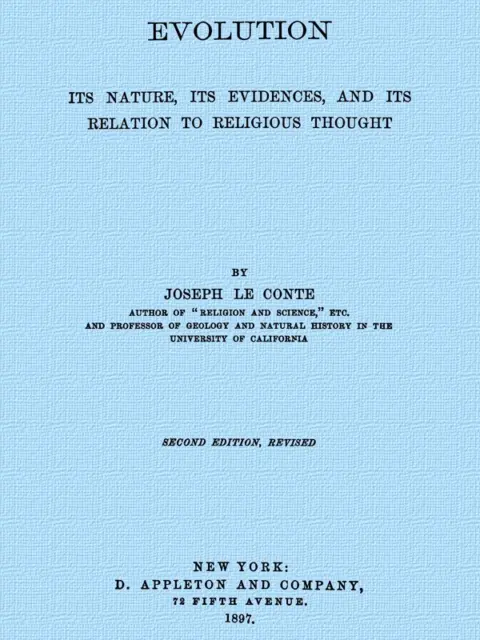
"Evolution: Its Nature, Its Evidences, and Its Relation to Religious Thought" by Joseph Le Conte is a scientific publication written in the late 19th century. The work explores the concept of evolution, its underlying principles, supporting evidence from various scientific fields, and its implications for religious beliefs. Le Conte aims to present a comprehensive yet accessible overview of evolution, making it relevant to both scientific and theological discussions. The opening of the book establishes its purpose, which is to clarify the definition of evolution and its universality across nature. Le Conte states that the concept of evolution is not solely applicable to biology, but extends to all areas of thought and scientific inquiry, including geology, sociology, and astronomy. He introduces the idea of continuous progressive change governed by specific laws and natural forces, arguing that evolution affects every aspect of existence and is fundamentally linked to the evolution of human thought and society. This framing sets the stage for a deeper exploration of evolutionary theory and its interactions with religious doctrines in the following chapters.
Introduction adapted from the source catalogue; source summaries may be automatically generated.
Free to read · English · 92,463 words · No account needed
MAKE TIME FOR A GOOD BOOK
On by default. Untick to stop anonymous reading totals. Each page counts after 10 seconds in view. How this works.
Anonymous counting is on unless you have switched it off.
[43] I know it is the fashion to ridicule the use of the terms vitality, vital force, as a remnant of an old superstition; and yet the same men who do so use the terms gravity, electricity, chemical force, etc. Vital force is indeed correlated with other forces of Nature, but is none the less a distinct form of force, far more distinct than any other unless it be the still higher form of psychical, and therefore it better deserves a distinct name than any lower form. Each form of force gives rise to a peculiar group of phenomena, and the study of these to a special department of science. Now, the group of phenomena called vital is more peculiar, more different from other groups than these are from each other, and the science of physiology is a more distinct department than either physics or chemistry, and therefore the form of force, which determines these phenomena, is more distinct and better entitled to a name than any physical or chemical force.
[44] “Princeton Review” for May, 1884.
[45] “Popular Science Monthly,” December, 1873.
[46] For a fuller statement of this antithesis, see an article by the author entitled “Evolution in Relation to Materialism,” “Princeton Review,” for March, 1881.
[47] Johnstone Stoney, “Nature,” vol. xxxi, p. 422.
[48] “Nature,” vol. xxxiv, p. 385. 1886.
[49] So, again, see a book recently published (“Nature,” vol. xliii, p. 460, 1891), entitled “Whence comes Man, from Nature or from God?” The answer is plain. From both--from God through Nature. Evolution is the method of creation.
Acceleration, law of, 178.
African fauna explained, 204.
Agassiz, his greatest result, 29, 43;
relation to evolution, 32, 37, 43;
relation to Darwin, 46;
compared with Kepler, 47.
Ages of geological history, 16.
Alpine species explained, 215.
Amphibians, development of, 150.
Analogy and homology, 99.
Anima of animals, 313, 317.
Animal architecture, styles of, 209.
Animal kingdom, primary divisions of, 107.
Animals, relation of man to, 311;
spirit embryonic in, 311.
Antiquity of man, religion and, 282;
of the earth, religion and, 281.
Aortic arches, proofs of evolution from, 151.
Arthropods, 132.
Artificial production of varieties, 222.
Australia, fauna and flora of, explained, 200;
when isolated, 202.
Barriers limit faunal and floral regions, 188.
Beauty, origin of, 269.
Birds’ tails, changes of, 174.
Brain, vertebrate, proofs of evolution from, 162;
vertebrate, changes of, in phylogenic series, 168;
relation to mind, 327, 338.
Brain-physiology as a basis for materialism, 306.
Branching tree illustrates evolution, 13-15, 18, 110, 250.
Brooks, W. K., on the cause of variations, 262.
Californian coast-islands, fauna and flora of, 211.
Causation, idea of, from within, 342.
Cause, first and second, 354.
Cells, somatic and germ, 93.
Centers of creation, specific, 194.
Cephalization, 171.
Chambers, his views on evolution, 34.
Changes slow at present, 266.
Christ, the, 359;
relation of evolution to, 359;
as an agent in human progress, 363.
Close-breeding, effects of, 236, 243.
Coast-islands of California, fauna and flora of, 211.
Comparison, method of, 41.
Conflict between religion and science, 280.
Continental faunas and floras, 188.
Continental island life, 208.
Your reading position is saved on this browser. Take it to another device with a library code. Reading pages adapt to text, rather than matching a printed edition.
BEHIND THE BOOK
This eBook is for the use of anyone anywhere in the United States and most other parts of the world at no cost and with almost no restrictions whatsoever. You may copy it, give it away or re-use it under the terms of the Project Gutenberg License included with this eBook or online at www.gutenberg.org. If you are not located in the United States, you will have to check the laws of the country where you are located before using this eBook. Read the source licence.
The original source file, including credits and licence, is retained by this library. Request an original-format copy at no charge. Please include the book title and Project Gutenberg identifier #46834.
KEEP YOUR CURIOSITY GOING
David Patterson (Spirit) Hatch

David Patterson (Spirit) Hatch

David Patterson (Spirit) Hatch
Coulson Kernahan

Ralph Waldo Emerson
Frances Wright