
Last letters from the living dead man
David Patterson (Spirit) Hatch
THE CLASSIC COLLECTION · 1888
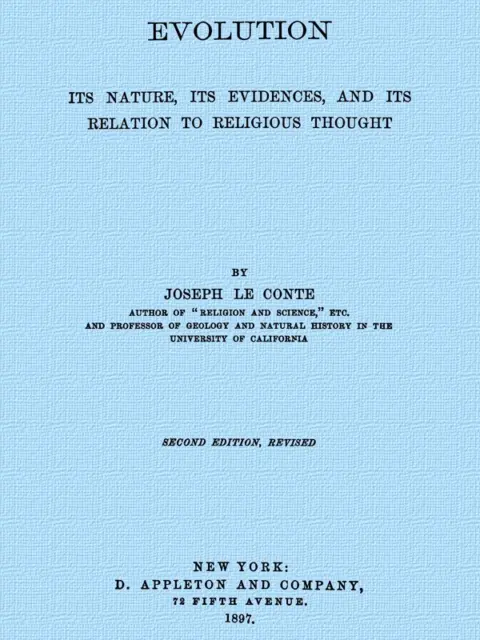
"Evolution: Its Nature, Its Evidences, and Its Relation to Religious Thought" by Joseph Le Conte is a scientific publication written in the late 19th century. The work explores the concept of evolution, its underlying principles, supporting evidence from various scientific fields, and its implications for religious beliefs. Le Conte aims to present a comprehensive yet accessible overview of evolution, making it relevant to both scientific and theological discussions. The opening of the book establishes its purpose, which is to clarify the definition of evolution and its universality across nature. Le Conte states that the concept of evolution is not solely applicable to biology, but extends to all areas of thought and scientific inquiry, including geology, sociology, and astronomy. He introduces the idea of continuous progressive change governed by specific laws and natural forces, arguing that evolution affects every aspect of existence and is fundamentally linked to the evolution of human thought and society. This framing sets the stage for a deeper exploration of evolutionary theory and its interactions with religious doctrines in the following chapters.
Introduction adapted from the source catalogue; source summaries may be automatically generated.
Free to read · English · 92,463 words · No account needed
MAKE TIME FOR A GOOD BOOK
On by default. Untick to stop anonymous reading totals. Each page counts after 10 seconds in view. How this works.
Anonymous counting is on unless you have switched it off.
[29] For fuller discussion of this subject, see “Bulletin of the California Academy of Science,” No. 8, 1887, and “American Journal of Science,” for Dec., 1887.
[30] “Origin of Races of the Dog.” “Annals and Magazine of Natural History,” vol. xvii, p. 295. 1886.
[31] Mr. Galton (“Nature,” August 26, 1886) has used a diagram similar to the above (which I first used in 1879) to illustrate the law of sexual attraction and repugnance.
[32] This subject is more fully discussed by the author in an article entitled “Genesis of Sex,” in “The Popular Science Monthly,” vol. xvi, p. 167, 1879.
[33] For examples of this the reader is referred to Cope, “Bulletin of the National Museum,” No. 1; and to Coues’s “Key to North American Birds,” last edition.
[34] “Monatsbericht d. k. Preuss. Akademie d. Wissenschaft zu Berlin,”
for July, 1866.
[35] “Genesis of Tertiary Species of Planorbis at Steinheim.” A. Hyatt, Anniversary Memoir of the Boston Society of Natural History, 1880.
[36] In a letter to the author, dated February 13, 1887, Prof. Cope says: “Such transitions of species are clearly indicated in the Oreodontidæ, where such different forms as O. gracilis and O. Culbertsoni are connected by intergradations.”
[37] “American Naturalist,” 1873; “Popular Science Monthly,” June, 1873.
[38] For a fuller development of this subject the reader is referred to an article by the author, entitled “Critical Periods in the History of, and their Relation to, Evolution” (“American Journal of Science,” vol. xiv, p. 99, 1877).
[39] “Reflex Action and Theism,” William James, “Unitarian Review” for
November, 1881.
[40] See an article by the author on this subject, “American Journal of Science,” series ii, vol. xxviii, p. 305, 1859, and in “Popular Science Monthly,” vol. iv, p. 156, 1873.
[41] All chemical compounds are dissociated by sufficient heat.
[42] The origin of vital from chemical force in the green leaves of plants can not be doubted; but this does not, of course, explain the mystery of the first origin of life on the earth, for one condition of the change now is the contact of living matter.
Your reading position is saved on this browser. Take it to another device with a library code. Reading pages adapt to text, rather than matching a printed edition.
BEHIND THE BOOK
This eBook is for the use of anyone anywhere in the United States and most other parts of the world at no cost and with almost no restrictions whatsoever. You may copy it, give it away or re-use it under the terms of the Project Gutenberg License included with this eBook or online at www.gutenberg.org. If you are not located in the United States, you will have to check the laws of the country where you are located before using this eBook. Read the source licence.
The original source file, including credits and licence, is retained by this library. Request an original-format copy at no charge. Please include the book title and Project Gutenberg identifier #46834.
KEEP YOUR CURIOSITY GOING
David Patterson (Spirit) Hatch

David Patterson (Spirit) Hatch

David Patterson (Spirit) Hatch
Coulson Kernahan

Ralph Waldo Emerson
Frances Wright