
A world of green hills
Bradford Torrey
THE CLASSIC COLLECTION · 1901
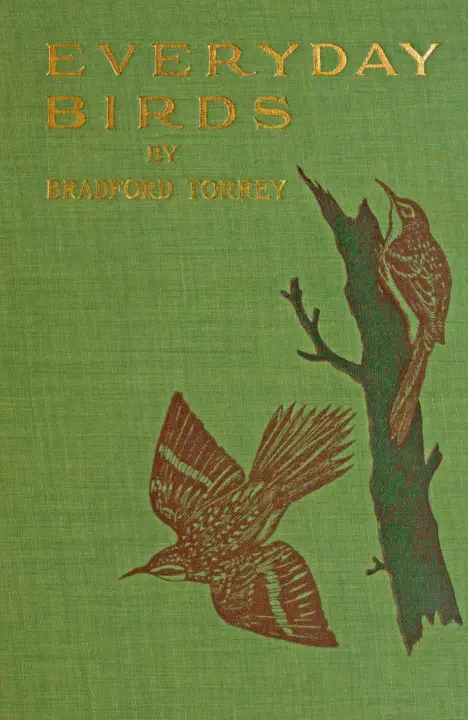
"Everyday Birds: Elementary Studies" by Bradford Torrey is a collection of nature writings focused on birds, written in the early 20th century. The book explores various bird species found in North America, detailing their behaviors, characteristics, and songs. It provides both informative content for readers interested in ornithology and vivid descriptions that invite even casual observers to appreciate the beauty and diversity of these creatures. The opening of the book introduces a variety of birds, starting with the kinglet. Torrey describes the two species of kinglets—the golden-crowned and ruby-crowned—highlighting their distinct features and vocalizations. He emphasizes the ruby-crown's remarkable song, comparing its beauty to that of a canary, while noting the more modest singing abilities of the golden-crowned kinglet. This initial segment sets a tone of wonder and admiration for birdlife, urging readers to engage with nature and recognize the joy that comes from observing the birds in their surroundings.
Introduction adapted from the source catalogue; source summaries may be automatically generated.
Free to read · English · 22,136 words · No account needed
MAKE TIME FOR A GOOD BOOK
On by default. Untick to stop anonymous reading totals. Each page counts after 10 seconds in view. How this works.
Anonymous counting is on unless you have switched it off.
At this time of the year, indeed, there is no lack of such interesting and well-dressed strangers, no matter where we may go. The woods are alive with them by day, and the air by night. There are few evenings when you may not hear them calling overhead as they hasten southward. Men who have watched them through telescopes, pointed at the full moon, have calculated their height at one or two miles. One observer saw more than two hundred cross the moon’s disk in two hours. The greater part passed so swiftly as to make it impossible to say more than that they were birds; but others, flying at a greater altitude, and therefore traversing the field of vision less rapidly, were identified as blackbirds, rails, snipe, and ducks. Another observer plainly recognized swallows, warblers, goldfinches, and woodpeckers.
All over the northern hemisphere to-night, in America, Europe, and Asia, countless multitudes of these wayfarers will be coursing the regions of the upper air; and to-morrow, if we go out with our eyes open, we shall find, here and there, busy little flocks of stragglers that have stopped by the way to rest and feed: sparrows, snowbirds, kinglets, nuthatches, chickadees, thrushes, warblers, wrens, and what not, a few of them singing, and every one of them evidently in love with life, and full of happy expectations.
Bittern:--
American, 68.
least, 78.
Blackbird, red-winged, 86.
Bluebird, 44, 59, 83.
Bob White, 85.
Bobolink, 86.
Butcher-bird, 19, 86.
Catbird, 86.
Cedar-bird, 84.
Chickadee, 7, 12, 83, 88, 91, 92.
Chimney swift, 56, 63.
Creeper, brown, 10, 91.
Crossbill, white-winged, 87.
Crow, 44, 49, 83.
Flicker, 64, 84.
Goldfinch, 84.
Grosbeak:--
cardinal, 25.
rose-breasted, 36, 40.
Grouse, 85.
Hummingbird, ruby-throated, 51, 63, 84, 99.
Indigo-bird, 86.
Jay, blue, 43, 83, 90.
Kingbird, 47, 85.
Kinglet:--
golden-crowned, 1, 91.
ruby-crowned, 1.
Migration, 93, 99.
Mockingbird, 16.
Nighthawk, 60.
Nuthatch:--
red-breasted, 90.
white-breasted, 88, 89.
Oriole, Baltimore, 83.
Partridge, 85.
Plover, golden, 101.
Plovers, 100.
Purple finch, 36, 37.
Redpoll linnet, 37.
Robin, 83.
Sandpipers, 100.
Shrike:--
great northern, 19, 86.
loggerhead, 21.
Snipe, 61.
Snowbird (junco), 36, 59, 86.
Sparrow:--
chipping, 30, 31.
English, 30, 92.
field, 30, 32, 36, 37.
fox, 36, 37.
Ipswich, 38.
savanna, 26, 38.
song, 26, 36, 37, 39, 83.
tree, 36, 37, 38.
vesper, 26, 36, 37, 39.
white-throated, 36, 37, 38.
Swift, chimney, 56, 63.
Tanager:--
scarlet, 22, 85.
southern, 25.
Thrasher, brown, 15, 86.
Vireo, warbling, 98.
Vireos, 84.
Vulture, California, 1, 4.
Warbler:--
golden, 101.
palm, 102.
Warblers, 84.
Waxwing, cedar, 84.
Whip-poor-will, 60.
Woodcock, 61.
Woodpecker:--
downy, 89, 92.
golden-winged, 64, 84.
The Riverside Press
Electrotyped and printed by H. O. Houghton & Co.
Cambridge, Mass., U. S. A.
[1] To which this article was originally contributed.
Italicized text is surrounded by underscores: italics.
Obvious typographical errors have been corrected.
Inconsistencies in hyphenation have been standardized.
Your reading position is saved on this browser. Take it to another device with a library code. Reading pages adapt to text, rather than matching a printed edition.
Bradford Torrey
Bradford Torrey
Bradford Torrey

Bradford Torrey
BEHIND THE BOOK
This eBook is for the use of anyone anywhere in the United States and most other parts of the world at no cost and with almost no restrictions whatsoever. You may copy it, give it away or re-use it under the terms of the Project Gutenberg License included with this eBook or online at www.gutenberg.org. If you are not located in the United States, you will have to check the laws of the country where you are located before using this eBook. Read the source licence.
The original source file, including credits and licence, is retained by this library. Request an original-format copy at no charge. Please include the book title and Project Gutenberg identifier #69563.
KEEP YOUR CURIOSITY GOING

Charles G. (Charles Griffith) Ross
Hannah Webster Foster

Emily Lawless
Edwin Hamlin Carr

Charles De Lano Hine
Andrew Ure