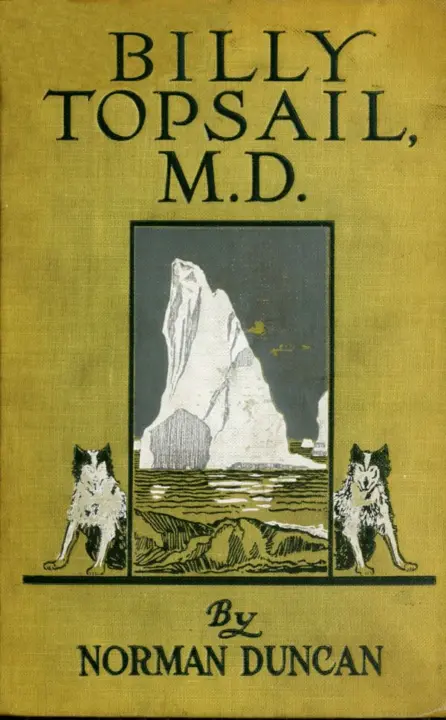
Billy Topsail, M.D.: A Tale of Adventure With Doctor Luke of the Labrador
Norman Duncan
THE CLASSIC COLLECTION · 1906
"Every Man for Himself" by Norman Duncan is a novel written in the early 20th century. The story is set against the rugged backdrop of Newfoundland and follows the life of Tumm, a fisherman who shares tales of his experiences and the eccentric characters around him, particularly focusing on Abraham Botch, a contemplative man from Jug Cove. The narrative explores themes of existence, identity, and the relentless struggle for survival in a harsh, indifferent world. At the start of the novel, we are introduced to Tumm and the crew aboard the trader "Good Samaritan" as they anchor in Poor Man's Harbor during a snowstorm. Tumm engages the crew with a philosophical tale about souls and purpose, leading to an encounter with Abraham Botch, who ponders the nature of existence. Through Tumm's storytelling, we learn of Botch's deep questioning about life, the soul, and the universe, which sets the stage for the exploration of profound themes intertwining with the everyday struggles of the fishermen. Tumm's observations and interactions with Botch highlight the tension between whimsical thoughts and harsh realities, framing the novel's exploration of humanity's quest for understanding in an unforgiving environment.
Introduction adapted from the source catalogue; source summaries may be automatically generated.
Free to read · English · 62,156 words · No account needed
MAKE TIME FOR A GOOD BOOK
On by default. Untick to stop anonymous reading totals. Each page counts after 10 seconds in view. How this works.
Anonymous counting is on unless you have switched it off.
Wull smoothed his cheek and chin. "Ah!" he murmured. He mused, staring at the floor, his restless fingers beating a tattoo on his teeth. He had turned woebegone and very pale. "Jehoshaphat," he asked, turning upon the man, "would you mind tellin' me just how you're 'lowin' t' get my flour against my will?"
Jehoshaphat looked away.
"I'd like t' know," said Wull, "if you wouldn't mind tellin' me."
"No," Jehoshaphat answered. "No, Mister Wull--I wouldn't mind tellin'."
"Then," Wull demanded, "how?"
"Mister Wull," Jehoshaphat explained, "I'm a bigger man than you."
It was very quiet in the office. The wind had gone down in the night, the wood in the stove was burned to glowing coals. It was very, very still in old John Wull's office at the back of the shop, and old John Wull turned away, and went absently to the desk, where he fingered the leaves of his ledger, and dipped his pen in ink, but did not write. There was a broad window over the desk, looking out upon the harbor; through this, blankly, he watched the children at play on the ice, but did not see them. By-and-by, when he had closed the book and put the desk in order, he came back to the counter, leaned against it, crossed his legs, began to smooth his chin, while he mused, staring at the square of sunlight on the floor. Jehoshaphat could not look at him. The old man's face was so gray and drawn, so empty of pride and power, his hand so thin and unsteady, his eyes so dull, so deep in troubled shadows, that Jehoshaphat's heart ached. He wished that the world had gone on in peace, that the evil practices of the great were still hid from his knowledge, that there had been no vision, no call to revolution; he rebelled against the obligation upon him, though it had come to him as a thing that was holy. He regretted his power, had shame, indeed, because of the ease with which the mighty could be put down. He felt that he must be generous, tender, that he must not misuse his strength.
The patch of yellow light had perceptibly moved before the trader spoke. "Jehoshaphat," he asked, "you know much about law?"
"Well, no, Mister Wull," Jehoshaphat answered, with simple candor; "not
too much."
"The law will put you in jail for this."
Constables and jails were like superstitious terrors to Jehoshaphat. He had never set eyes on the brass buttons and stone walls of the law.
"Oh no--no!" he protested. "He wouldn't! Not in jail!"
"The law," Wull warned, with grim delight, "will put you in jail."
Your reading position is saved on this browser. Take it to another device with a library code. Reading pages adapt to text, rather than matching a printed edition.
Norman Duncan
Norman Duncan
Norman Duncan
Norman Duncan
BEHIND THE BOOK
This eBook is for the use of anyone anywhere in the United States and most other parts of the world at no cost and with almost no restrictions whatsoever. You may copy it, give it away or re-use it under the terms of the Project Gutenberg License included with this eBook or online at www.gutenberg.org. If you are not located in the United States, you will have to check the laws of the country where you are located before using this eBook. Read the source licence.
The original source file, including credits and licence, is retained by this library. Request an original-format copy at no charge. Please include the book title and Project Gutenberg identifier #36998.
KEEP YOUR CURIOSITY GOING
Coulson Kernahan

Maurice Baring
Frances Wright
Cécile Tormay

Frederic Jesup Stimson

W. H. P. (William Henry Pope) Jarvis