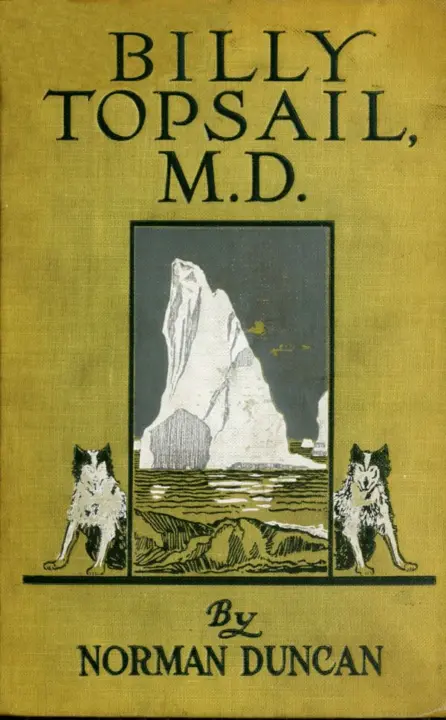
Billy Topsail, M.D.: A Tale of Adventure With Doctor Luke of the Labrador
Norman Duncan
THE CLASSIC COLLECTION · 1906
"Every Man for Himself" by Norman Duncan is a novel written in the early 20th century. The story is set against the rugged backdrop of Newfoundland and follows the life of Tumm, a fisherman who shares tales of his experiences and the eccentric characters around him, particularly focusing on Abraham Botch, a contemplative man from Jug Cove. The narrative explores themes of existence, identity, and the relentless struggle for survival in a harsh, indifferent world. At the start of the novel, we are introduced to Tumm and the crew aboard the trader "Good Samaritan" as they anchor in Poor Man's Harbor during a snowstorm. Tumm engages the crew with a philosophical tale about souls and purpose, leading to an encounter with Abraham Botch, who ponders the nature of existence. Through Tumm's storytelling, we learn of Botch's deep questioning about life, the soul, and the universe, which sets the stage for the exploration of profound themes intertwining with the everyday struggles of the fishermen. Tumm's observations and interactions with Botch highlight the tension between whimsical thoughts and harsh realities, framing the novel's exploration of humanity's quest for understanding in an unforgiving environment.
Introduction adapted from the source catalogue; source summaries may be automatically generated.
Free to read · English · 62,156 words · No account needed
MAKE TIME FOR A GOOD BOOK
On by default. Untick to stop anonymous reading totals. Each page counts after 10 seconds in view. How this works.
Anonymous counting is on unless you have switched it off.
"I'm come, sir," Jehoshaphat repeated, his voice rising a little, "for
the flour."
The trader dipped his pen in ink.
"I says, sir," said Jehoshaphat, laying a hand with some passion upon the counter, "that I'm come for that there barrel o' flour."
"An' I s'pose," the trader softly inquired, eying the page of his ledger more closely, "that you thinks you'll get it, eh?"
"Ay, sir."
Wull dipped his pen and scratched away.
"Mister Wull!"
The trader turned a leaf.
"Mister Wull," Jehoshaphat cried, angrily, "I wants flour. Is you gone
deaf overnight?"
Impertinent question and tone of voice made old John Wull wheel on the stool. In the forty years he had traded at Satan's Trap he had never before met with impertinence that was not timidly offered. He bent a scowling face upon Jehoshaphat. "An' you thinks," said he, "that you'll get it?"
"I does."
"Oh, you does, does you?"
Jehoshaphat nodded.
"It all depends," said Wull. "You're wonderful deep in debt, Jehoshaphat." The trader had now command of himself. "I been lookin' up your account," he went on, softly. "You're so wonderful far behind, Jehoshaphat, on account o' high livin' an' Christmas presents, that I been thinkin' I might do the business a injury by givin' you more credit. I can't think o' myself, Jehoshaphat, in this matter. 'Tis a business matter; an' I got t' think o' the business. You sees, Jehoshaphat, eighteen dollars more credit--"
"Eight," Jehoshaphat corrected.
"Eighteen," the trader insisted.
Jehoshaphat said nothing, nor did his face express feeling. He was looking stolidly at the big key of the storehouse.
"The flour depends," Wull proceeded, after a thoughtful pause, through which he had regarded the gigantic Jehoshaphat with startled curiosity, "on what I thinks the business will stand in the way o' givin' more credit t' you."
"No, sir," said Jehoshaphat.
Wull put down his pen, slipped from the high stool, and came close to Jehoshaphat. He was mechanical and slow in these movements, as though all at once perplexed, given some new view, which disclosed many and strange possibilities. For a moment he leaned against the counter, legs crossed, staring at the floor, with his long, scrawny right hand smoothing his cheek and chin. It was quiet in the office, and warm, and well-disposed, and sunlight came in at the window.
Soon the trader stirred, as though awakening. "You was sayin' eight, wasn't you?" he asked, without looking up.
"Eight, sir."
The trader pondered this. "An' how," he inquired, at last, "was you
makin' that out?"
"Tis a fair price."
Your reading position is saved on this browser. Take it to another device with a library code. Reading pages adapt to text, rather than matching a printed edition.
Norman Duncan
Norman Duncan
Norman Duncan
Norman Duncan
BEHIND THE BOOK
This eBook is for the use of anyone anywhere in the United States and most other parts of the world at no cost and with almost no restrictions whatsoever. You may copy it, give it away or re-use it under the terms of the Project Gutenberg License included with this eBook or online at www.gutenberg.org. If you are not located in the United States, you will have to check the laws of the country where you are located before using this eBook. Read the source licence.
The original source file, including credits and licence, is retained by this library. Request an original-format copy at no charge. Please include the book title and Project Gutenberg identifier #36998.
KEEP YOUR CURIOSITY GOING
Coulson Kernahan

Maurice Baring
Frances Wright
Cécile Tormay

Frederic Jesup Stimson

W. H. P. (William Henry Pope) Jarvis