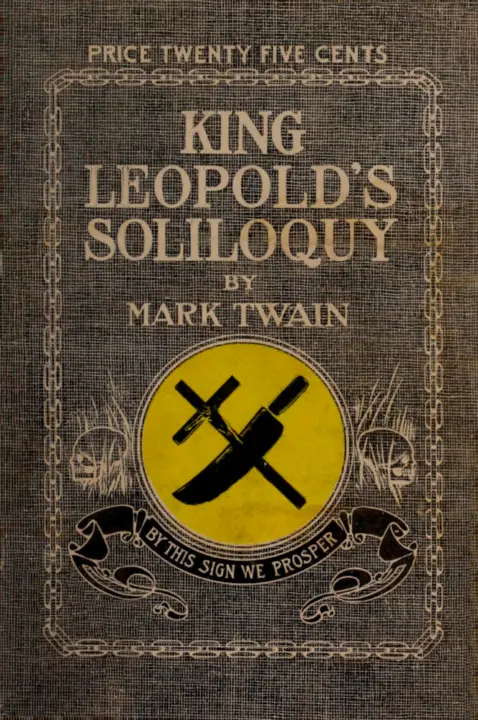
King Leopold’s Soliloquy: A Defense of His Congo Rule
Mark Twain
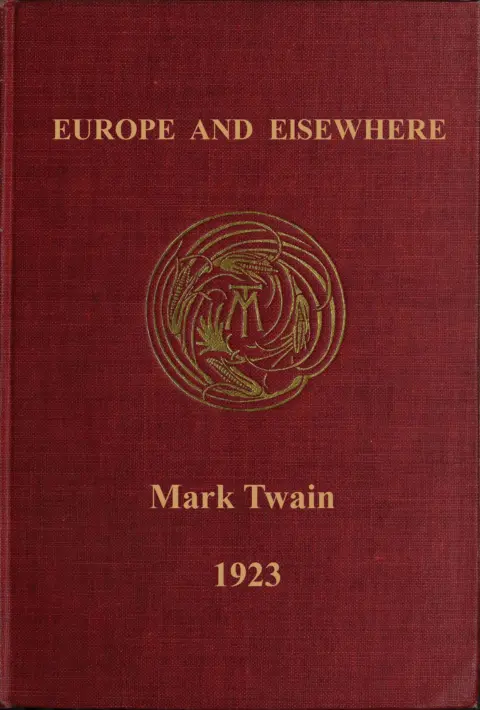
THE CLASSIC COLLECTION · 1923
"Europe and Elsewhere" by Mark Twain is a collection of travel essays and commentaries written in the late 19th century. The work reflects Twain's observations and experiences from his travels throughout Europe and addresses various themes including culture, politics, and social issues. The opening chapter introduces readers to a memorable midnight visit to Westminster Abbey, setting the stage for Twain's blend of humor and incisive critique. At the start of "Europe and Elsewhere," Twain recounts a late-night adventure he embarks on with a friend, who leads him to Westminster Abbey. The atmosphere is both eerie and reverential as they explore the grand yet somber space filled with statues and tombs of historical figures. Twain's keen observations and playful commentary bring the site to life; he describes the remarkable age of the Abbey's architecture and highlights the solemnity of the figures memorialized within its walls. Through this narration, he effectively captures the weight of history and reflects on the contrasts between the past and the present, all while maintaining a humorous undertone with his signature wit.
Introduction adapted from the source catalogue; source summaries may be automatically generated.
Free to read · English · 113,487 words · No account needed
MAKE TIME FOR A GOOD BOOK
On by default. Untick to stop anonymous reading totals. Each page counts after 10 seconds in view. How this works.
Anonymous counting is on unless you have switched it off.
One of the grandest of these veterans was the very one upon whose deck Nelson himself fell in the moment of triumph. I suppose England would rather part with ten colonies than with that illustrious old ship. We passed along within thirty steps of her, and I was just trying to picture in my mind the tremendous scenes that had transpired upon her deck upon that day, the proudest in England’s naval history, when the venerable craft, stirred by the boom of saluting cannon, perhaps, woke up out of her long sleep and began to vomit smoke and thunder herself, and then she looked her own natural self again, and no doubt the spirit of Nelson was near. Still it would have been pleasanter to be on her decks than in front of her guns; for, as the white volumes of smoke burst in our faces, one could not help feeling that a ball might by accident have got mixed up with a blank cartridge, and might chip just enough off the upper end of a man to disfigure him for life; and, besides, the powder they use in cannon is in grains as large as billiard chalks, and it does not all explode--suppose a few should enter one’s system? The crash and roar of these great guns was as unsettling a sound as I have ever heard at short range. I took off my hat and acknowledged the salute, of course, though it seemed to me that it would have been better manners if they had saluted the Lord Mayor, inasmuch as he was on board.
We went out to the Spithead and sailed up and down there for four hours through four long ranks of stately men-of-war--formidable ironclads they were--the most insignificant of which would make a breakfast of a whole fleet of Nelson’s prodigious ships and still be hungry. The show was very fine, for there were forty-nine of the finest ironclads the world can show, and many gunboats besides. Indeed, here in its full strength was the finest navy in the world, and this the only time in history that just such a spectacle has been seen, and none who saw it that day is likely to live long enough to see its like again. The vessels were all dressed out with flags, and all about them frolicked a bewildering host of bannered yachts, steamers, and every imaginable sort of craft. It would be hard to contrive a gayer scene. One of the royal yachts came flying along presently and put the Shah on board one of the ironclads, and then the yards of the whole fleet were manned simultaneously, and such another booming and bellowing of great guns ensued as I cannot possibly describe. Within two minutes the huge fleet was swallowed up in smoke, with angry red tongues of fire darting through it here and there. It was wonderful to look upon. Every time the Devastation let off one of her thirty-five-ton guns it seemed as if an entire London fog issued from her side, and the report was so long coming that if she were to shoot a man he would be dead before he heard it, and would probably go around wondering through all eternity what it was that happened to him. I returned to London in a great hurry by a train that was in no way excited by it, but failed in the end and object I had in view after all, which was to go to the grand concert at Albert Hall in honor of the Shah. I had a strong desire to see that building filled with people once. Albert Hall is one of the many monuments erected to the memory of the late Prince Albert. It is a huge and costly edifice, but the architectural design is old, not to say in some sense a plagiarism; for there is but little originality in putting a dome on a gasometer. It is said to seat 13,000 people, and surely that is a thing worth seeing--at least to a man who was not at the Boston Jubilee. But no tickets were to be had--every seat was full, they said. It was no particular matter, but what made me mad was to come so extremely close and then miss. Indeed, I was madder than I can express, to think that if the architect had only planned the place to hold 13,001 I could have got in. But, after all, I was not the only person who had occasion to feel vexed. Colonel X, a noted man in America, bought a seat some days ago for $10 and a little afterward met a knowing person who said the Shah would be physically worn out before that concert night and would not be there, and consequently nobody else; so the seat was immediately sold for $5. Then came another knowing one, who said the Shah would unquestionably be at the concert, so the colonel went straight and bought his ticket back again. The temporary holder of it only charged him $250 for carrying it around for him during the interval! The colonel was at the concert, and took the Shah’s head clerk for the Shah all the evening. Vexation could go no further than that.
Your reading position is saved on this browser. Take it to another device with a library code. Reading pages adapt to text, rather than matching a printed edition.
BEHIND THE BOOK
This eBook is for the use of anyone anywhere in the United States and most other parts of the world at no cost and with almost no restrictions whatsoever. You may copy it, give it away or re-use it under the terms of the Project Gutenberg License included with this eBook or online at www.gutenberg.org. If you are not located in the United States, you will have to check the laws of the country where you are located before using this eBook. Read the source licence.
The original source file, including credits and licence, is retained by this library. Request an original-format copy at no charge. Please include the book title and Project Gutenberg identifier #68604.
KEEP YOUR CURIOSITY GOING
Wilfrid Scawen Blunt
Wilfrid Scawen Blunt

E. W. (Edgar Watson) Howe

David Patterson (Spirit) Hatch

David Patterson (Spirit) Hatch

David Patterson (Spirit) Hatch