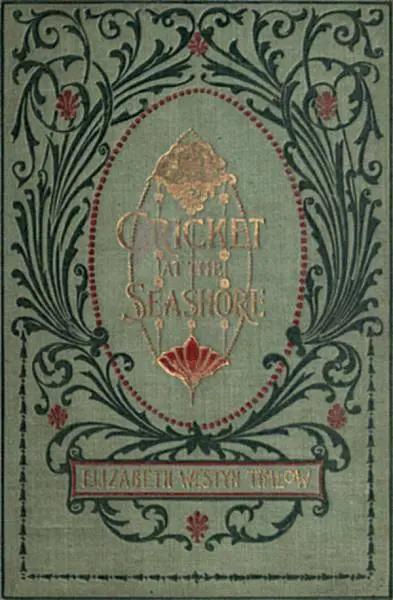
Cricket at the Seashore
Elizabeth Weston Timlow
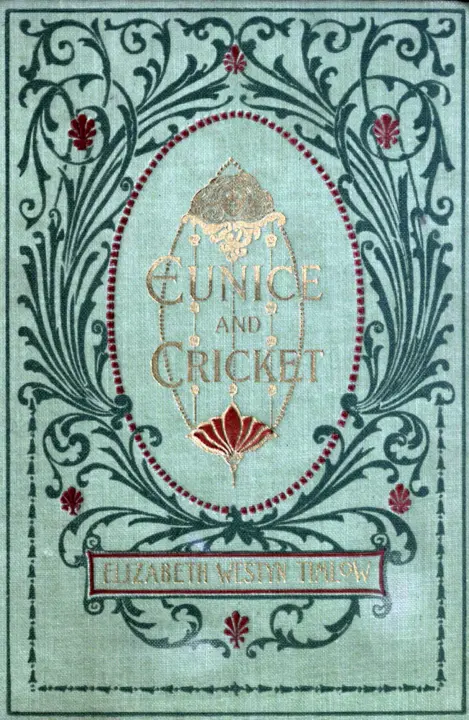
THE CLASSIC COLLECTION · 1897
Eunice and Cricket by Elizabeth Weston Timlow. Explore this classic work in a free online edition. Subjects include Conduct of life -- Juvenile fiction; Goats -- Juvenile fiction; Sisters -- Juvenile fiction; Youth -- Conduct of life -- Juvenile fiction; Families -- Juvenile fiction; Kodak camera -- Juvenile fiction. Read the locally hosted text below, adjust the reading display, and continue where you left off.
Introduction adapted from the source catalogue; source summaries may be automatically generated.
Free to read · English · 53,890 words · No account needed
MAKE TIME FOR A GOOD BOOK
On by default. Untick to stop anonymous reading totals. Each page counts after 10 seconds in view. How this works.
Anonymous counting is on unless you have switched it off.
“It only means ‘tight,’ ‘firmly.’ Why in creation didn’t they say so?”
Fortunately, the remaining directions were sufficiently simple, and in a few minutes the roll of exposures was in Eunice’s hand. The children went back into the closet, to make ready the chemicals.
The careful measuring and mixing of the powder with the required amount of water went on. The trays were arranged in due order, and Eunice announced, for the third time:
“Everything is positively ready now, so we can begin to cut apart the pictures,” taking up the roll of thick, black paper. “How can we tell where to cut them? Oh, here are little white lines on the back. Can you see to cut, Cricket?”
“Yes. What’s all this white stuff between for? It looks like paraffin paper something, only it smells like fury.”
“It’s just to keep the other paper from rubbing when it’s rolled over the spool,” said Eunice, sniffling at the paper, which, you all know, was really the film, on which the picture had been taken. “I should say it does smell. Throw it on the floor after you have cut off the black pieces.”
“Here’s one,” said Cricket. “Oh, I’m so excited, Eunice. Listen: ‘Put it in the water, edge down, to prevent air bubbles.’”
“Done,” said Eunice. “Next.”
Cricket read on under the dim red light, till she came to “In about one minute the film will begin to darken in spots.”
“There, we have not any watch,” interrupted Eunice. “Cut out and get the nursery clock, Cricket. Cover the roll all up, because you know the leastest bit of light will spoil it.”
Cricket obediently “cut out,” and then resumed her reading.
“‘The films will begin to darken in spots, representing the lights.’ Isn’t that the funniest! how can black paper darken in spots, I’d like to know?”
“Can’t imagine; but I know that chemicals make things do all sorts of queer things,” answered Eunice, lucidly. “Cut some more to be soaking while these go into the developer.”
“That first one’s been in more than a minute. Hold it up, Eunice, and let’s see it darken in spots. It hasn’t changed a bit, yet,” she added, disgustedly, after a moment. “Isn’t this waiting going to be slow work?”
The waiting did prove tiresome. Again and again the children took the thick, black squares of carbon paper from their bath in the developer, eagerly scanning the opaque substance, which naturally showed no trace of change.
Five—ten—fifteen minutes ticked slowly away.
Your reading position is saved on this browser. Take it to another device with a library code. Reading pages adapt to text, rather than matching a printed edition.
Elizabeth Weston Timlow
BEHIND THE BOOK
This eBook is for the use of anyone anywhere in the United States and most other parts of the world at no cost and with almost no restrictions whatsoever. You may copy it, give it away or re-use it under the terms of the Project Gutenberg License included with this eBook or online at www.gutenberg.org. If you are not located in the United States, you will have to check the laws of the country where you are located before using this eBook. Read the source licence.
The original source file, including credits and licence, is retained by this library. Request an original-format copy at no charge. Please include the book title and Project Gutenberg identifier #66091.
KEEP YOUR CURIOSITY GOING
Coulson Kernahan

Maurice Baring
Frances Wright
Cécile Tormay

Frederic Jesup Stimson

W. H. P. (William Henry Pope) Jarvis