Cricket at the Seashore
Elizabeth Weston Timlow
THE CLASSIC COLLECTION · 1897
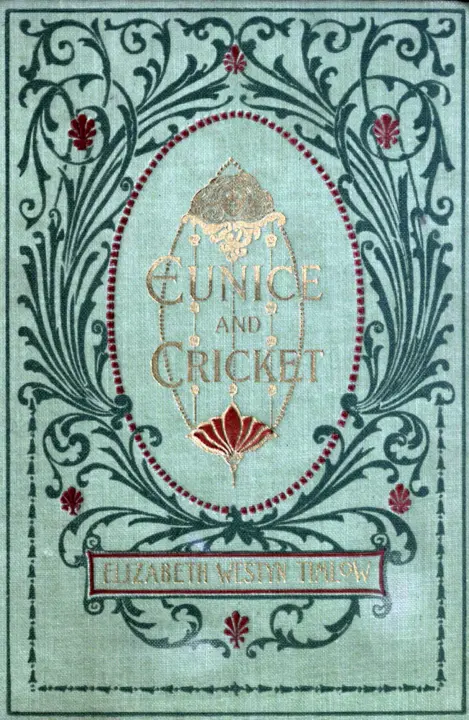
Eunice and Cricket by Elizabeth Weston Timlow. Explore this classic work in a free online edition. Subjects include Conduct of life -- Juvenile fiction; Goats -- Juvenile fiction; Sisters -- Juvenile fiction; Youth -- Conduct of life -- Juvenile fiction; Families -- Juvenile fiction; Kodak camera -- Juvenile fiction. Read the locally hosted text below, adjust the reading display, and continue where you left off.
Introduction adapted from the source catalogue; source summaries may be automatically generated.
Free to read · English · 53,890 words · No account needed
MAKE TIME FOR A GOOD BOOK
On by default. Untick to stop anonymous reading totals. Each page counts after 10 seconds in view. How this works.
Anonymous counting is on unless you have switched it off.
“Oh, have mamma and Kenneth come back so early?” she said, catching sight of a tiny figure in a familiar blue dress.
“No, but this is our new baby, and we’re going to adopt it, if its mother doesn’t come for it; and I don’t much believe she will, for it was pretty dirty, and probably she doesn’t care for it much, so Eunice and I are going to keep it,” poured out Cricket in a breath.
Marjorie dropped against the newel-post.
“Adopt it? What, in the name of common sense, are you talking about, Cricket? Where did the atom come from?”
“We found her in the street this morning,” explained Eunice, “and we couldn’t find anybody that belonged to her, so we had to bring her home, Marjorie. We couldn’t leave her to starve, could we? Poor little mite! she was freezing cold.”
Mosina, quite aware that she was under discussion, clung to the dress of her first friend, sucking her thumb, and staring from one to the other with her solemn blue eyes.
“But, my dear children,” began Marjorie, in a very superior, elder-sisterly tone, “that is perfectly absurd. With all the raft of children we have now, we can’t adopt a whole orphan asylum. Besides, her mother will be looking for her; probably she is nearly frantic. You must send her to the police station.”
“There!” cried Eunice, aggrieved, “that old police station again! Everybody says that. As if I would have this cunning thing, that loves me so, shut up in a horrid old black cell. Why, she’d be as afraid as anything.”
“They don’t put lost children in cells,” began Marjorie, and then stopped, not quite certain what they did do with them. “At any rate, you ought to take her there. People always do.”
“I shan’t do it,” said Eunice, stoutly.
“And, Marjorie, she’d be frightened to death among all those big men,” expostulated Cricket. “We have just got to keep her.”
“Then I’ll tell you what I’ll do,” compromised Marjorie. “I’ll send Jane around to the police station, and tell them she’s here, and describe her, and leave our address. If any one comes, they can send here.”
Just then the door-bell rang.
Your reading position is saved on this browser. Take it to another device with a library code. Reading pages adapt to text, rather than matching a printed edition.
Elizabeth Weston Timlow
BEHIND THE BOOK
This eBook is for the use of anyone anywhere in the United States and most other parts of the world at no cost and with almost no restrictions whatsoever. You may copy it, give it away or re-use it under the terms of the Project Gutenberg License included with this eBook or online at www.gutenberg.org. If you are not located in the United States, you will have to check the laws of the country where you are located before using this eBook. Read the source licence.
The original source file, including credits and licence, is retained by this library. Request an original-format copy at no charge. Please include the book title and Project Gutenberg identifier #66091.
KEEP YOUR CURIOSITY GOING
Coulson Kernahan

Maurice Baring
Frances Wright
Cécile Tormay

Frederic Jesup Stimson

W. H. P. (William Henry Pope) Jarvis