THE CLASSIC COLLECTION✦The school and societyCLASSIC FREE BOOKS
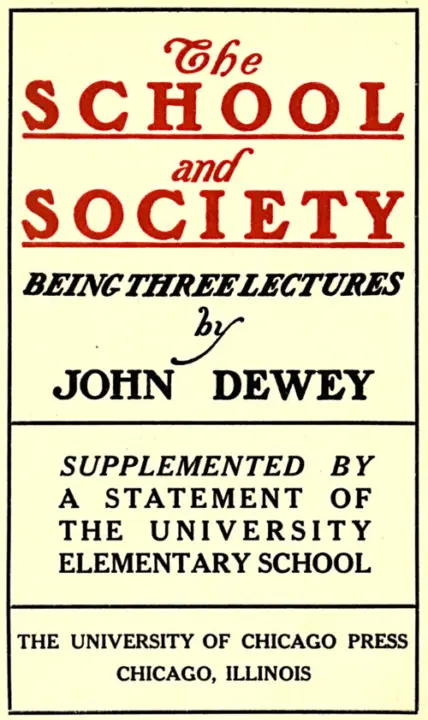
The school and society
John Dewey
THE CLASSIC COLLECTION · 1908
"Ethics" by John Dewey and James Hayden Tufts is a philosophical treatise on moral theory written in the early 20th century. The text seeks to explore moral problems through a historical lens, emphasizing the relationship between individual conduct and the broader social environment. The authors aim to illuminate how our moral judgments evolve, encouraging a reflective and scientific approach to ethical questions. The opening of the work introduces key concepts and outlines the overall structure of the text. It emphasizes the complexity of ethical conduct, which is influenced by both internal motivations and external societal standards. Dewey and Tufts stress the importance of tracing the historical roots of morality to understand its current manifestations, arguing that ethical principles must evolve alongside social developments. This foundation sets the stage for a detailed examination of moral judgment, the growth of ethical concepts, and the role of various societal influences in shaping individual conduct.
Introduction adapted from the source catalogue; source summaries may be automatically generated.
Free to read · English · 202,829 words · No account needed
MAKE TIME FOR A GOOD BOOK
On by default. Untick to stop anonymous reading totals. Each page counts after 10 seconds in view. How this works.
Anonymous counting is on unless you have switched it off.
Hebrews, early morality, 18;
moral development, 91-110;
compared with Greek, 91
Hedonism, 230;
Hebrew, 106 f.;
Greek, 126, 132 f.;
criticism of, 269-75;
universalistic, 286;
egoistic character of, 289-94;
Kant's, 309;
paradox of, 352;
its theory of duty, 353
Hegel, on institutional character of morals, 225-6
High-mindedness, Aristotle's description of, 135 n.
Hobhouse, L. T., on formation of custom, 54;
on social order and individuality, 428;
on the family, 575 f., 577
Hoeffding, 253 n.
Honesty, 188, 414, 496
Honor, 85-8, 144 f., 176
Hosea, 95
Hospitality, in group morality, 67
"How," the, in conduct, 5-8, 228 f., 240;
in group morality, 69 f.;
in Hebrew morality, 102 ff.;
in Greek ethics, 136 ff.;
see Attitude
Howard, 576
Ibsen, 82, 100, 157, 303, 588
Ideal, vs. actual in Greek thought, 136-8;
meaning of, 421 f.
India, customs of, 26, 63, 524
Indians (American), 25, 43, 54, 60
Indifferent Acts, 205-6, 210-11
Individual, the, in early group life, 20, 22 f., 27-30, 34, 71 f.;
collision of with group, 74, 75 f., 82 ff., 88, 184-7, 432;
among Hebrews, 104;
development of, in modern civilization, 148-69;
as affected by reflective morality, 187-92;
and society, 427-36;
relation to corporations
and unions, 500-3;
see Individualism, Self
Individualism, as factor in transition from custom to conscience, 75;
forces producing, 76-87;
in Israel, 94, 102, 104;
in Greece, 114-24, 432;
in Greek ethical theory, 124-6;
in modern world, 149-63, 184-6, 220-3, 432 f.;
in ethical theory, 225 f., 290;
Carlyle's criticism of, 265 f.;
hedonistic, 289 ff., 301 f.;
as self-assertion, 368-75;
true and false, 481;
political formula of, 483 f.;
in economic theory, 523-35;
democratic, 525, 530 f.;
"survival of the fittest," 525, 532-4;
values, 527 f., 548 f.;
does not secure real freedom, 529;
nor justice, 530 ff., 535, 546 f.;
other defects of, 551 ff.;
in U. S. Constitution, 534;
on "unearned increment," 564 f.;
in family, 604;
see Individual, Self
Industry, as a rationalizing agency, 39-42;
differentiation in, 41;
as a socializing agency, 42 f.;
factor in effecting transition from custom to conscience, 76-8;
modern development of, 155-9;
agencies of, 497
Initiation, in primitive tribes, 58
Institutions, 192-5, 222, 225-6;
see Chapter XX.
Intention, and Motive, 246-54, 257-8, 261;
and accident, 63, 104, 459-60;
see Deliberation
Intuitionalism, 226, 232, 306;
discussion of, 317-25;
and casuistry, 325-8
Ireland, ancient law of, 24 f., 62, 83
Israel, moral development of, 91-110, 197
James, William, on the social self, 85-7;
on animal activity, 204;
on effect of emotion on ideas, 253
Japanese morality, 18
Jesus, 106 f., 109
Job, moral theory in, 97, 101 f., 106
Judgments, moral; see Moral
Jural influence, 7, 103, 113 f., 177, 218-9, 224, 328, 353-6, 439,
454-5, 467-8
Justice, in primitive society, 27 f.;
as Hebrew ideal, 94 f., 99 f., 108 f.;
in Greek theory, 113 f.;
natural and conventional, 120 f.;
as interest of the stronger, 122-4;
modern demand for, 148, 161 ff.;
and charity, 148, 389 f.;
virtue of, 414-7;
development of civil, 456-63;
formal and substantial, 465 f., 531;
social, 161, 410, 521, 556-8;
the new, 496 f.;
and individualism, 530-5;
in distribution, theories of, 545-50
Kafirs, clanship among, 19, 35
Your reading position is saved on this browser. Take it to another device with a library code. Reading pages adapt to text, rather than matching a printed edition.
John Dewey
John Dewey

John Dewey
John Dewey
BEHIND THE BOOK
This eBook is for the use of anyone anywhere in the United States and most other parts of the world at no cost and with almost no restrictions whatsoever. You may copy it, give it away or re-use it under the terms of the Project Gutenberg License included with this eBook or online at www.gutenberg.org. If you are not located in the United States, you will have to check the laws of the country where you are located before using this eBook. Read the source licence.
The original source file, including credits and licence, is retained by this library. Request an original-format copy at no charge. Please include the book title and Project Gutenberg identifier #39551.
KEEP YOUR CURIOSITY GOING

David Patterson (Spirit) Hatch
Coulson Kernahan

Ralph Waldo Emerson
Frances Wright
Edwin Abbott Abbott

Joseph Droz