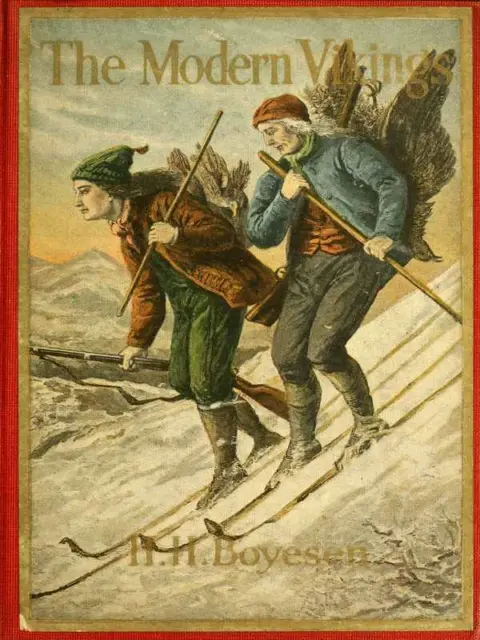
The Modern Vikings: Stories of Life and Sport in the Norseland
Hjalmar Hjorth Boyesen
THE CLASSIC COLLECTION · 1895
"Essays on Scandinavian Literature" by Hjalmar Hjorth Boyesen is a scholarly collection written in the late 19th century. The book examines the literary traditions and influential personalities from Norway, Sweden, and Denmark, showcasing key authors like Henrik Ibsen and Björnstjerne Björnson, among others. Through these essays, the author provides insights into the cultural and historical context that shaped Scandinavian literature, aiming to highlight its significance and evolution. The opening portion introduces Boyesen's ambition to write a comprehensive history of Scandinavian literature, driven by his explorations into prominent literary figures. He reflects on the extensive research required and the rich literary heritage he encountered, noting how his studies led to an in-depth look at Ibsen's works. The preface sets the stage for the following essays, where Boyesen promises to analyze pivotal authors while hinting at his own critical engagement with their contributions to the literary canon. Overall, this introductory section establishes the book's academic purpose and Boyesen's expertise in Scandinavian literary traditions.
Introduction adapted from the source catalogue; source summaries may be automatically generated.
Free to read · English · 66,732 words · No account needed
MAKE TIME FOR A GOOD BOOK
On by default. Untick to stop anonymous reading totals. Each page counts after 10 seconds in view. How this works.
Anonymous counting is on unless you have switched it off.
A second novel, "Common People," which deals with low life in its most varied phases, shows the same admirable truthfulness and exactness in the character drawing, the same refreshing humor and universal sympathy and comprehension. "The Story of Thomas Friis" undertakes to show, in the career of a Danish youth who is meant to be typical, the futility of the vainglorious imaginings with which the little nation has inflated itself to a size out of proportion to its actual historic role. In "The Old Pharmacy" the necessity of facing the changed reality of the modern world, instead of desperately hugging an expiring past, is enforced in a series of vivid and vigorous pictures of provincial life. "The Forester's Children," which is one of the latest of this author's novels, suffers by comparison with its predecessors, but is yet full of cleverness and smacks of the soil.
Schandorph's naturalism is not pathological; not in the nature of an autopsy or a diagnosis of disease. It is full-blooded and vigorous--not particularly squeamish--but always fresh and wholesome. His shorter tales and sketches ("From the Province," "Five Stories," "Novelettes") are of more unequal merit, but are all more or less strongly characterized by the qualities which fascinate in his novels. Of his poems "Samlede Digte," (1882) I have not the space to speak, and can only regret that they are written in a language in which they will remain as hidden from the world as if they had been imprinted in cuneiform inscriptions upon Assyrian bricks. They are largely occasional and polemical; and more remarkable for vigor of thought than sweetness of melody.
J. P. Jacobsen, the second in the group to which I have referred, was a colorist of a very eminent type, both in prose and verse; but his talent lacked that free-flowing, spontaneous abundance--that charming air of improvisation--with which Schandorph captivates his reader, takes him into his confidence, and overwhelms him with entertainment. Jacobsen painted faces better than he did souls; or, rather, he did not seem to think the latter worth painting, unless they exhibited some abnormal mood or trait. There is something forced and morbid in his people--a lack of free movement and natural impulse. His principal work, "Mistress Marie Grubbe," is a series of anxiously finished pictures, carefully executed in the minutest details, but failing somehow to make a complete impression. Each scene is so bewilderingly surcharged with color that, as in the case of a Gobelin tapestry, one has to be at a distance before one discovers the design. There is something almost wearisome in the far-fetched words with which he piles up picturesque effects, returning every now and then to put in an extra touch--to tip a feather with light, to brighten the sheen of his satins, to polish the steely lustre of swords and armors. Yet, if one takes the time to linger over these unusual words and combinations of words, one is likely to find that they are strong and appropriate. All conventional shop-work he disdained; the traditional phrases for eyes, lips, brow, and hair were discarded, not necessarily because they were bad, but because by much use they have lost their freshness. They have come to be mere sounds, and no longer call up vivid conceptions. An author who has the skill and the courage to undertake this repolishing and resharpening of the tools of language is, indeed, a public benefactor; but it requires the finest linguistic taste and discrimination to do it with success. Most authors are satisfied if they succeed in giving currency to one happy phrase involving a novel use of the language, or to an extremely limited number; I know of no one who has undertaken the renovation of his mother-tongue on so extensive a scale as Jacobsen. To say that he has in most cases done it well is, therefore, high praise. "Mistress Marie Grubbe" is not, however, easy reading; and the author's novelettes, entitled "Mogens and Other Stories," seem to be written, primarily, for literary connoisseurs, as their interest as mere stories is scarcely worth considering. They are, rather, essays in the art of saying things unusually and yet well. They do not seem to me, even in this respect, a success. There are single phrases that seem almost an inspiration; there are bits of description, particularly of flowers and moods of nature, which are masterly; but the studious avoidance of the commonplace imparts to the reader something of the strain under which the author has labored. He begins to feel the sympathetic weariness which often overcomes one while watching acrobatic feats.
Your reading position is saved on this browser. Take it to another device with a library code. Reading pages adapt to text, rather than matching a printed edition.
Hjalmar Hjorth Boyesen
Hjalmar Hjorth Boyesen
Hjalmar Hjorth Boyesen
Hjalmar Hjorth Boyesen
BEHIND THE BOOK
This eBook is for the use of anyone anywhere in the United States and most other parts of the world at no cost and with almost no restrictions whatsoever. You may copy it, give it away or re-use it under the terms of the Project Gutenberg License included with this eBook or online at www.gutenberg.org. If you are not located in the United States, you will have to check the laws of the country where you are located before using this eBook. Read the source licence.
The original source file, including credits and licence, is retained by this library. Request an original-format copy at no charge. Please include the book title and Project Gutenberg identifier #19908.
KEEP YOUR CURIOSITY GOING

David Patterson (Spirit) Hatch

David Patterson (Spirit) Hatch

David Patterson (Spirit) Hatch
Cécile Tormay

Moritz Busch
John L. Ransom