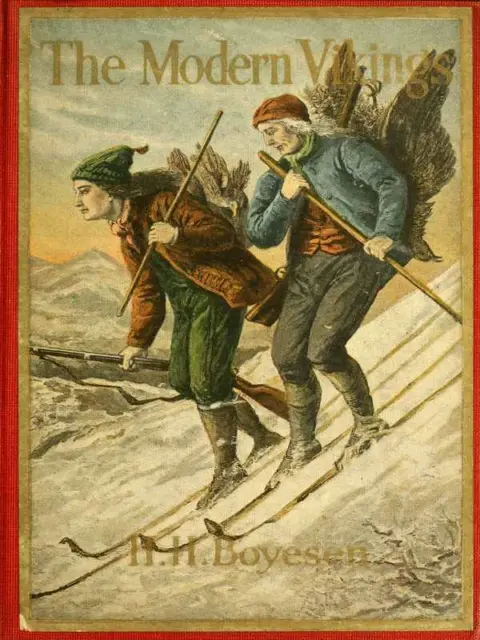
The Modern Vikings: Stories of Life and Sport in the Norseland
Hjalmar Hjorth Boyesen
THE CLASSIC COLLECTION · 1895
"Essays on Scandinavian Literature" by Hjalmar Hjorth Boyesen is a scholarly collection written in the late 19th century. The book examines the literary traditions and influential personalities from Norway, Sweden, and Denmark, showcasing key authors like Henrik Ibsen and Björnstjerne Björnson, among others. Through these essays, the author provides insights into the cultural and historical context that shaped Scandinavian literature, aiming to highlight its significance and evolution. The opening portion introduces Boyesen's ambition to write a comprehensive history of Scandinavian literature, driven by his explorations into prominent literary figures. He reflects on the extensive research required and the rich literary heritage he encountered, noting how his studies led to an in-depth look at Ibsen's works. The preface sets the stage for the following essays, where Boyesen promises to analyze pivotal authors while hinting at his own critical engagement with their contributions to the literary canon. Overall, this introductory section establishes the book's academic purpose and Boyesen's expertise in Scandinavian literary traditions.
Introduction adapted from the source catalogue; source summaries may be automatically generated.
Free to read · English · 66,732 words · No account needed
MAKE TIME FOR A GOOD BOOK
On by default. Untick to stop anonymous reading totals. Each page counts after 10 seconds in view. How this works.
Anonymous counting is on unless you have switched it off.
An author who is born into an age of transition, when old faiths are passing away and new ones are struggling for recognition, is placed in a serious dilemma. Where he makes his choice by mere temperamental bias, he is apt to miss that element of growth which is involved in every spiritual struggle. But if, as is so frequently the case, he finds his choice in a measure made for him, his education, kinships, and worldly advantage identifying him with the established order, it takes a tremendous amount of courage and character to break away from old moorings and steer, without other compass than a sensitive conscience, toward the rosy dawn of the unknown. There was a desperate need of such men in Denmark in the seventies, when the little kingdom was sinking deeply and more deeply into a bog of patriotic delusion and spiritual stagnation. An infusion of new blood was needed--a re-establishment of that circulation of thought which keeps the whole civilized world in vital connection and makes it akin. No country can cut itself off from this universal world-life without withering like a diseased limb. The man who undertook to bring Denmark again into rapport with Europe was Dr. Georg Brandes, whom I have characterized at length in another essay. It was his admirable book, "The Men of the Modern Transition" (translated into German under the title Moderne Geister) which impelled me, some years ago, to make the acquaintance of the three authors who represent whatever there is of promise in contemporary Danish literature, viz., Sophus Schandorph, Holger Drachmann, and J. P. Jacobsen. The last named, who died (1884) in the flower of his young manhood, is, perhaps, not in the strictest sense contemporary. But he is indispensable to the characterization of the group.
Widely different as these three men are in almost everything, they have this in common, that they have deeply breathed the air of the nineteenth century; and they all show more or less the influence of Brandes. That this influence has been direct and personal seems probable from the relation which they have sustained to the revolutionary critics. Of this I am, however, by no means sure. Mr. Jacobsen, who was by profession a botanist, and translated Darwin into Danish, no doubt came by his "advanced views" at first hand. In the case of Schandorph it is more difficult to judge. He is an excellent linguist, and may have had access to the same sources from which Brandes drew his strength. Drachmann is so vacillating in his tendencies that he refuses to be permanently classified in any school of art or thought. Of the three, Schandorph seems altogether the maturest mind and furnishes the most finished and satisfactory work. In his novel "Without a Centre" (Uden Midtpunkt) the reader feels himself at once face to face with an interesting and considerable personality. He has that sense of surprise and delighted expectation which only the masters of fiction are apt to evoke. It is a story of a Danish national type--the conversational artist. In no country in the world is there such a conversational fury as in Denmark. A people has, of course, to do something with its surplus energy; and as political opposition is sure to prove futile, there is nothing left to do but to talk--not only politics, but art, poetry, religion, in fact, everything under the sun. At the time, however, when Albrecht, the hero of "Without a Centre," plied his nimble tongue, the country had a more liberal Government, and criticism of the Ministry was not yet high treason. But centuries of repression and the practical exclusion of the bourgeoisie from public life were undoubtedly the fundamental causes of this abnormal conversational activity. There is something soft and emotional in the character of the Danes, which distinguishes them from their Norwegian and Swedish kinsmen--an easily flowing lyrical vein, which imparts a winning warmth and cordiality to their demeanor. Socially they are the most charming people in the world. Also in this respect Albrecht is typical, and the songs in which he gives vent to his lyrical moods have such a rapturous melody that they keep humming in the brain long after the reader has closed the book. It almost follows as a psychological necessity that a man so richly endowed with the gift of speech is feeble and halting in action. Like Tourgueneff's "Rudin," who suffered from the same malady, he gains by the brilliancy and novelty of his speech the love of a noble young girl, who, taking his phrases at their face value, believes his heart to be as heroic as his tongue. Like him, too, he fails in the critical moment; nay, restrained by petty scruples, he even stays away from the rendezvous, and by his cowardice loses what by his eloquence he had won.
Your reading position is saved on this browser. Take it to another device with a library code. Reading pages adapt to text, rather than matching a printed edition.
Hjalmar Hjorth Boyesen
Hjalmar Hjorth Boyesen
Hjalmar Hjorth Boyesen
Hjalmar Hjorth Boyesen
BEHIND THE BOOK
This eBook is for the use of anyone anywhere in the United States and most other parts of the world at no cost and with almost no restrictions whatsoever. You may copy it, give it away or re-use it under the terms of the Project Gutenberg License included with this eBook or online at www.gutenberg.org. If you are not located in the United States, you will have to check the laws of the country where you are located before using this eBook. Read the source licence.
The original source file, including credits and licence, is retained by this library. Request an original-format copy at no charge. Please include the book title and Project Gutenberg identifier #19908.
KEEP YOUR CURIOSITY GOING

David Patterson (Spirit) Hatch

David Patterson (Spirit) Hatch

David Patterson (Spirit) Hatch
Cécile Tormay

Moritz Busch
John L. Ransom