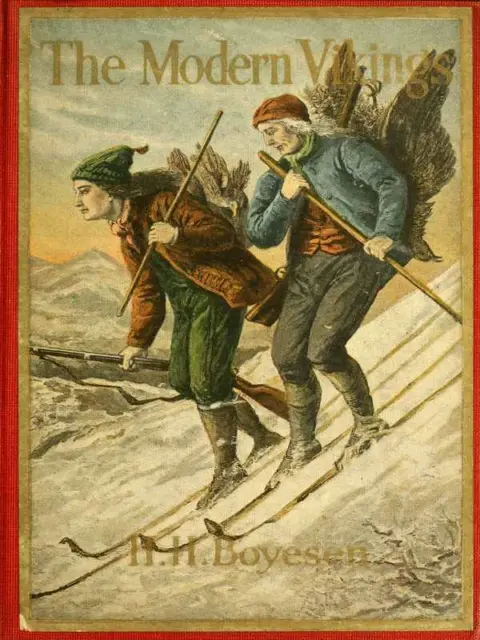
The Modern Vikings: Stories of Life and Sport in the Norseland
Hjalmar Hjorth Boyesen
THE CLASSIC COLLECTION · 1895
"Essays on Scandinavian Literature" by Hjalmar Hjorth Boyesen is a scholarly collection written in the late 19th century. The book examines the literary traditions and influential personalities from Norway, Sweden, and Denmark, showcasing key authors like Henrik Ibsen and Björnstjerne Björnson, among others. Through these essays, the author provides insights into the cultural and historical context that shaped Scandinavian literature, aiming to highlight its significance and evolution. The opening portion introduces Boyesen's ambition to write a comprehensive history of Scandinavian literature, driven by his explorations into prominent literary figures. He reflects on the extensive research required and the rich literary heritage he encountered, noting how his studies led to an in-depth look at Ibsen's works. The preface sets the stage for the following essays, where Boyesen promises to analyze pivotal authors while hinting at his own critical engagement with their contributions to the literary canon. Overall, this introductory section establishes the book's academic purpose and Boyesen's expertise in Scandinavian literary traditions.
Introduction adapted from the source catalogue; source summaries may be automatically generated.
Free to read · English · 66,732 words · No account needed
MAKE TIME FOR A GOOD BOOK
On by default. Untick to stop anonymous reading totals. Each page counts after 10 seconds in view. How this works.
Anonymous counting is on unless you have switched it off.
In order not to miss any phase of his problem, Bjoernson also takes up briefly the illegitimate line of the Kurts, which, being unsupplied with any favorable environment, sinks deeper and deeper into the mire of vice. The inevitable result is insanity and ultimate extinction. Mrs. Rendalen's visit to the slums, and her recognition of the peculiar scream of her own son in a terrible little ragamuffin, is one of the most remarkable incidents in this remarkable book.
One thing that especially strikes the reader in this novel is the author's fierce indignation against all shams, deceits, and social lies. Therefore he calls a spade a spade, and leaves you to blush if you are so inclined. The young girls whom he introduces are mostly misses in their teens, and his portrayal of them is physiological rather than pictorial. The points which he selects for comment are those which would particularly be noted by their medical advisers; and the progress of their histories, as he follows them, is characterized by this same scientific minuteness of observation. Zola's ideal of scientific realism (which Bjoernson has repudiated) has nevertheless found its most brilliant exponent in him. Here the sordid and cruel facts of life are not dwelt upon by preference; nor are they optimistically glossed over. I doubt if a great and vital problem has ever been more vigorously, unflinchingly, and convincingly treated in a work of fiction.
"Paa Guds Veje" ("In the Ways of God"), (1889), in which Thomas Rendalen again figures, though not as hero, is another indictment of conventional morality. It is a very powerful but scarcely an agreeable book. The abrupt, laconic style has no flux, no continuity, and gives the reader the sensation of being pulled up sharply with a curb bit, whenever he fancies that he has a free rein. Though every page is crowded with trenchant and often admirable observations, they have not the coherence of an organic structure, but rather that of a mosaic. The design is obvious, striking, and impressive. It is neither distorted nor overdrawn. It is unquestionably thus we treat moral non-conformists, even though it be in pure self-preservation that they broke the bond which we are agreed to enforce. The question resolves itself into this: Has society, in its effort to uphold its moral standards, the right to exact the sacrifice of life itself and every hope of happiness from the victims of its own ignorance and injustice? When the young physician, Edward Kallem, rescues the eighteen-year old Ragni Kule from the degradation of her marriage to a husband afflicted with a most loathsome disease, and afterward marries her--does he deserve censure or praise? Bjoernson's answer is unmistakable. It is exactly the situation, depicted five years later, by Madame Sarah Grand in the relation of Edith to the young rake, Sir Moseley Menteith. Only, Bjoernson rescues the victim, while the author of "The Heavenly Twins" makes her perish. In both instances it is the pious ignorance of clerical parents which precipitates the tragedy. Ragni's deliverance is, however, only an apparent one. Society, which without indignation had witnessed her sale to the corrupt old libertine, is frightfully shocked by her marriage to Dr. Kallem, and manifests its disapproval with an emphasis which takes no account of ameliorating circumstances. The sanguinary ingenuity in the constant slights and stabs to which she is exposed makes her life a martyrdom and finally kills her. "Contempt will pierce the armor of a tortoise," says an oriental proverb; and poor Ragni had no chelonian armor. When her most harmless remarks are misinterpreted and her most generous acts become weapons wherewith to slay her, she loses all heart for resistance, and merely lies down to die. Very subtile and beautiful is the manner in which Bjoernson indicates the interaction of psychical and physical conditions. The "soul-frost" which chills the very marrow of her bones is so vividly conveyed that you shiver sympathetically. The self-righteous and brutally censorious attitude of the community lowers the temperature and makes the atmosphere deadly. And the fact that it is Ragni's unsuspicious innocence, and even her love of her husband, which expose her to this condemnation is made plain with much delicate art. Her residence of five years in the United States after her divorce, and before her second marriage, had, no doubt, accustomed her to a greater freedom of intercourse between man and woman, and thereby disposed her to trip rather lightly over the stumbling-blocks of prudence.
Your reading position is saved on this browser. Take it to another device with a library code. Reading pages adapt to text, rather than matching a printed edition.
Hjalmar Hjorth Boyesen
Hjalmar Hjorth Boyesen
Hjalmar Hjorth Boyesen
Hjalmar Hjorth Boyesen
BEHIND THE BOOK
This eBook is for the use of anyone anywhere in the United States and most other parts of the world at no cost and with almost no restrictions whatsoever. You may copy it, give it away or re-use it under the terms of the Project Gutenberg License included with this eBook or online at www.gutenberg.org. If you are not located in the United States, you will have to check the laws of the country where you are located before using this eBook. Read the source licence.
The original source file, including credits and licence, is retained by this library. Request an original-format copy at no charge. Please include the book title and Project Gutenberg identifier #19908.
KEEP YOUR CURIOSITY GOING

David Patterson (Spirit) Hatch

David Patterson (Spirit) Hatch

David Patterson (Spirit) Hatch
Cécile Tormay

Moritz Busch
John L. Ransom