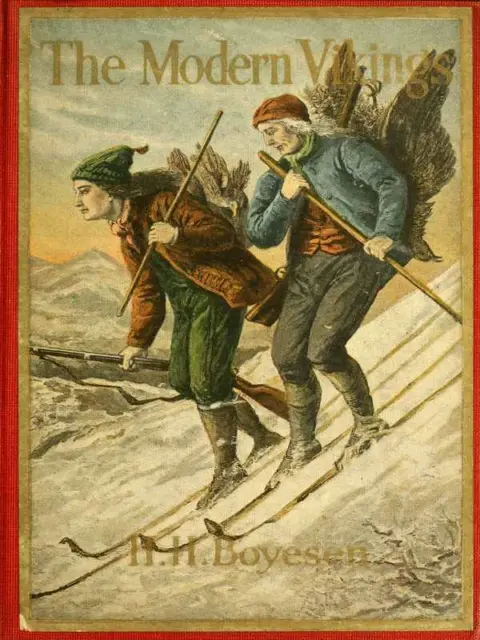
The Modern Vikings: Stories of Life and Sport in the Norseland
Hjalmar Hjorth Boyesen
THE CLASSIC COLLECTION · 1895
"Essays on Scandinavian Literature" by Hjalmar Hjorth Boyesen is a scholarly collection written in the late 19th century. The book examines the literary traditions and influential personalities from Norway, Sweden, and Denmark, showcasing key authors like Henrik Ibsen and Björnstjerne Björnson, among others. Through these essays, the author provides insights into the cultural and historical context that shaped Scandinavian literature, aiming to highlight its significance and evolution. The opening portion introduces Boyesen's ambition to write a comprehensive history of Scandinavian literature, driven by his explorations into prominent literary figures. He reflects on the extensive research required and the rich literary heritage he encountered, noting how his studies led to an in-depth look at Ibsen's works. The preface sets the stage for the following essays, where Boyesen promises to analyze pivotal authors while hinting at his own critical engagement with their contributions to the literary canon. Overall, this introductory section establishes the book's academic purpose and Boyesen's expertise in Scandinavian literary traditions.
Introduction adapted from the source catalogue; source summaries may be automatically generated.
Free to read · English · 66,732 words · No account needed
MAKE TIME FOR A GOOD BOOK
On by default. Untick to stop anonymous reading totals. Each page counts after 10 seconds in view. How this works.
Anonymous counting is on unless you have switched it off.
He is by no means a good boy, but his mother, by a kind of heroic conscientiousness and rationality, slowly conquers him and secures his attachment. She has solemnly abjured her connection with her husband's family, assumed her maiden name, and has consecrated her life to what she regards as the highest utility--the work of education. She wishes to atone to the race for her guilt in having perpetuated the race of the Kurts. The scene in which she makes a bonfire of all the ancestral portraits in the Hall of Knights, and the smell of all the burning Kurts is blown far and wide over city and harbor, would, in the hands of another novelist, have been made the central scene in the book. But Bjoernson is so tremendously in earnest that he cannot afford to stop and note picturesque effect. Therefore he relates the burning of the Kurts quite incidentally, and proceeds at once to talk of more serious things.
By turning the great, dusky, ancestral mansion into a school, Mrs. Rendalen believes that she can best settle the account of the Kurts with humanity. All the latest, improved methods of education are introduced. The Hall of Knights is turned into a chemical laboratory, and the daylight is allowed to pour unobscured into all its murky recesses. Through the dim and lofty passage-ways resounds the laughter of children; on the scenes of so many hoary crimes the prattle of innocent girls is heard; a multitude of scientific instruments labor to demonstrate the laws of nature, and to simplify the problem of existence which the crimes of the Kurts had tended to complicate. Thomas Rendalen, profoundly impressed as he is with his responsibility as the last descendant of such a race, takes up this educational mission with a lofty humanitarian enthusiasm. He has spent many years abroad in preparing himself for this work, and possesses, like his great-grandfather, the gift of lucid exposition. But his perpetual and conscious struggle with his heritage makes him nervous and ill-balanced. He conceives the idea, fostered both by observation and by the study of his own family history, that unchastity is the chief curse of humanity, and the primal cause of the degeneracy of races. He believes that the false modesty which leaves young people in ignorance of one of the most important natural functions is largely responsible for the prevailing immorality, and he advocates, as a remedy, fearless and searching physiological study. His inaugural address as superintendent of the school deals uncompromisingly with this subject, and excites such universal indignation that it comes near wrecking the promising enterprise. A great speech in a small town, Bjoernson hints, is always more or less risky. But we are also given to understand that though Rendalen obviously speaks out of the author's heart, this very speech is in itself a subtle manifestation of the Kurt heritage. Rendalen is as immoderate in virtue as his ancestors have been in vice. The violent energy which formerly expended itself in lawless acts now expends itself in an excessive, ascetic enthusiasm for self-conquest and lofty humanitarian ideals. As a piece of psychology this is admirable. Prudent, well adapted or adaptable to the civilization in which he lives, the scion of the Kurts is not yet; but as a promise of the redemption of the race he represents the first upward step. It is highly characteristic of Bjoernson's respect for reality that he makes Rendalen neither agreeable, handsome, nor lovable; nay, he dwells again and again on the bad relations which temporarily exist between him and his mother, between him and the teachers, between him and the town. For all that we are filled with a profound respect for a man who can fight in himself so great a fight, and win so great a victory. It is the sturdy peasant blood which he derived from his mother that enables him to wrestle thus mightily with the Lord, and extort at last the tardy blessing; for we are assured in the last pages of the book that he makes a marriage, which is a further step toward health and virtue. We are not assured that he conquers happiness either for himself or for his wife; and there is not a syllable to betray that he cherishes for her any romantic attachment. But the chances are that, in transforming and ennobling the Kurt heritage, he insures vigor and usefulness to his descendants. He bequeathes to them a more wholesome mixture of blood than he himself possesses, and an energy, nay, perhaps a genius, derived from the Kurts, which, with an upward instead of a downward tendency, may be a redeeming force in society instead of a corrupting one.
Your reading position is saved on this browser. Take it to another device with a library code. Reading pages adapt to text, rather than matching a printed edition.
Hjalmar Hjorth Boyesen
Hjalmar Hjorth Boyesen
Hjalmar Hjorth Boyesen
Hjalmar Hjorth Boyesen
BEHIND THE BOOK
This eBook is for the use of anyone anywhere in the United States and most other parts of the world at no cost and with almost no restrictions whatsoever. You may copy it, give it away or re-use it under the terms of the Project Gutenberg License included with this eBook or online at www.gutenberg.org. If you are not located in the United States, you will have to check the laws of the country where you are located before using this eBook. Read the source licence.
The original source file, including credits and licence, is retained by this library. Request an original-format copy at no charge. Please include the book title and Project Gutenberg identifier #19908.
KEEP YOUR CURIOSITY GOING

David Patterson (Spirit) Hatch

David Patterson (Spirit) Hatch

David Patterson (Spirit) Hatch
Cécile Tormay

Moritz Busch
John L. Ransom