
Last letters from the living dead man
David Patterson (Spirit) Hatch
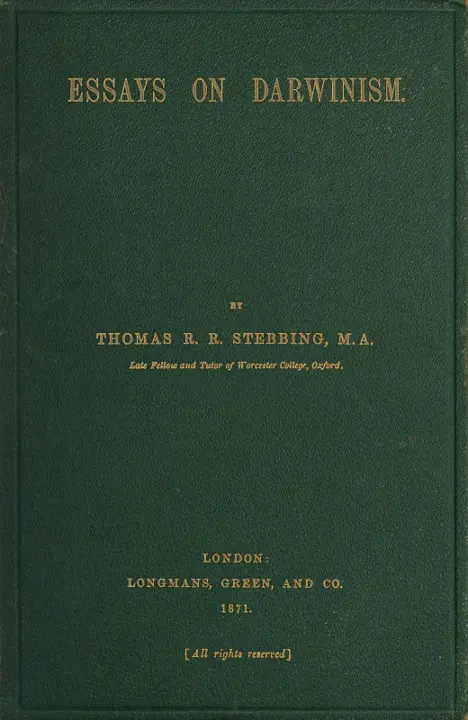
THE CLASSIC COLLECTION · 1871
"Essays on Darwinism" by Thomas Roscoe Rede Stebbing is a collection of essays written in the late 19th century. This work delves into the implications and nuances of Darwin's theories of natural selection and evolution, emphasizing the importance of understanding the science behind these groundbreaking ideas. Stebbing addresses common misconceptions, critiques of Darwinism, and the connections between evolution and broader existential queries about life and humanity. The opening of this scholarly work serves as a preface, laying the foundation for a more in-depth exploration of Darwinian thought. Stebbing praises Darwin's clarity and commitment to truth while critically examining the misunderstandings surrounding his theories. He highlights how many reject Darwinism without engaging with the material and emphasizes the need for a thoughtful and open-minded exploration of these scientific principles. This introduction sets the stage for subsequent essays, which promise to tackle various aspects of Darwinism, the intersection of science and religion, and the implications of evolutionary theory for humanity and morality.
Introduction adapted from the source catalogue; source summaries may be automatically generated.
Free to read · English · 48,503 words · No account needed
MAKE TIME FOR A GOOD BOOK
On by default. Untick to stop anonymous reading totals. Each page counts after 10 seconds in view. How this works.
Anonymous counting is on unless you have switched it off.
It is curious that we should abuse the hen for being now and then deceived by our impostures, considering the immense quantities of counterfeit coin we ourselves accept as currency, and the strange compounds of chalk and mud and alum and poisonous herbs and minerals which, according to the analysts, we contentedly swallow down as milk and butter, bread and beer. But the hen in a wild state is not subject to our impositions, and possibly the domestic hen finds it better for herself to overlook them. At any rate, as the mistakes concern her progeny, if her conduct is other than beneficial, it is an argument against the perfection of instinct, which it tends to bring down to the level of imperfect human reason. It is commonly supposed that ducklings take to the water by instinct. And Addison tells us that on one occasion, as he was walking in the yard of his friend’s country-house, he ‘was wonderfully pleased to see the different workings of instinct in a hen followed by a brood of ducks. The young, upon the sight of a pond, immediately ran into it; while the step-mother, with all imaginable anxiety, hovered about the borders of it, to call them out of an element that appeared to her so dangerous and destructive[35].’ In order to test the real force of nature in this matter, as distinct from experience and education, I ventured on the experiment of placing some little orphan ducklings, which had been reared away from any pond, in a shallow bath of water just deep enough for them to swim in. The experiment was two or three times repeated, but in each case with a sort of impiety, or, at any rate, gross disrespect towards the grand principle of instinct, the ducklings, instead of enjoying themselves in their appropriate element, made the most violent and unceasing efforts to escape from it. The whole theory of instinct, indeed, probably rests on a multitude of evidences which have themselves been taken for granted. At every point minute observation, or actual questioning of the facts asserted, undermines it. Addison himself must have begun to waver, before he inserted in the numbers of the ‘Guardian[36]’ the French philosopher’s account of the ant, and its wonderful ingenuity and perseverance. Nor are passages wanting in his works, which might have been expressly written in support of the theory of development. After commenting on the various insensible gradations of perceptive being, ‘If we look,’ he says, ‘into the several inward perfections of cunning and sagacity, or what we generally call instinct, we find them rising after the same manner, imperceptibly one above another, and receiving additional improvements, according to the species in which they are implanted. This progress in nature is so very gradual, that the most perfect of an inferior species comes very near to the most imperfect of that which is immediately above it.’ Again: ‘The whole chasm in nature, from a plant to a man, is filled up with divers kinds of creatures, rising one over another, by such a gentle and easy ascent, that the little transitions and deviations from one species to another are almost insensible;’ and he quotes with approbation a passage from Locke, in which we read, ‘There are some brutes that seem to have as much knowledge and reason as some that are called men[37].’ Pope, who pursues much the same track in his ‘Essay on Man,’ permits himself to speak of ‘the half-reasoning elephant.’ Any one who doubts the appropriateness of such an epithet, not only to the elephant but to many other animals, should begin to study the ways and doings of the lower creatures with an eye to this very question,--at every turn asking himself how the action observed can be accounted for by a blind irrational instinct. A stumbling horse, for example, that is generally beaten for stumbling, starts after a false step before the lash is applied. How ridiculous will it be to ascribe to horses an instinct of starting after stumbling--a conditional instinct, that appears only in those horses that have been previously beaten when they stumbled! We need not suppose, as Lord Bacon appears to have done, that ‘dogs know the dog-killer’ by a kind of power of divination[38]. By their watchful habits, and quick inference from acute observation of the few particulars they are able to comprehend, it can scarcely be doubted that dogs learn something of the dispositions and intentions of mankind, recognize their humours, and distinguish those who are friendly to themselves from those who are hostile.
Your reading position is saved on this browser. Take it to another device with a library code. Reading pages adapt to text, rather than matching a printed edition.
BEHIND THE BOOK
This eBook is for the use of anyone anywhere in the United States and most other parts of the world at no cost and with almost no restrictions whatsoever. You may copy it, give it away or re-use it under the terms of the Project Gutenberg License included with this eBook or online at www.gutenberg.org. If you are not located in the United States, you will have to check the laws of the country where you are located before using this eBook. Read the source licence.
The original source file, including credits and licence, is retained by this library. Request an original-format copy at no charge. Please include the book title and Project Gutenberg identifier #48987.
KEEP YOUR CURIOSITY GOING
David Patterson (Spirit) Hatch

David Patterson (Spirit) Hatch

David Patterson (Spirit) Hatch
Coulson Kernahan

Ralph Waldo Emerson

Maurice Baring