
Last letters from the living dead man
David Patterson (Spirit) Hatch
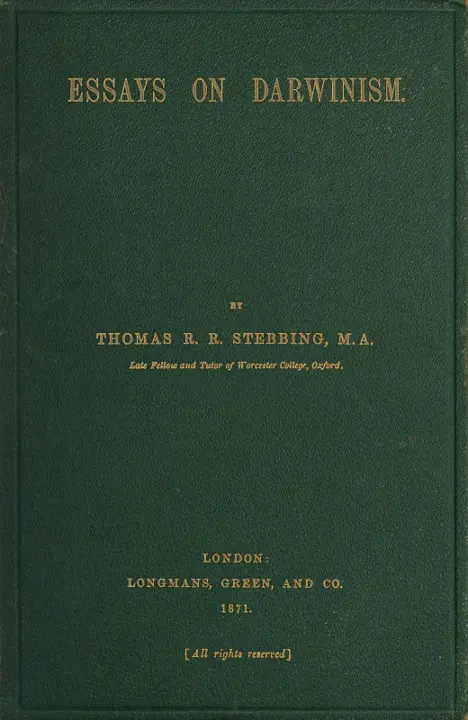
THE CLASSIC COLLECTION · 1871
"Essays on Darwinism" by Thomas Roscoe Rede Stebbing is a collection of essays written in the late 19th century. This work delves into the implications and nuances of Darwin's theories of natural selection and evolution, emphasizing the importance of understanding the science behind these groundbreaking ideas. Stebbing addresses common misconceptions, critiques of Darwinism, and the connections between evolution and broader existential queries about life and humanity. The opening of this scholarly work serves as a preface, laying the foundation for a more in-depth exploration of Darwinian thought. Stebbing praises Darwin's clarity and commitment to truth while critically examining the misunderstandings surrounding his theories. He highlights how many reject Darwinism without engaging with the material and emphasizes the need for a thoughtful and open-minded exploration of these scientific principles. This introduction sets the stage for subsequent essays, which promise to tackle various aspects of Darwinism, the intersection of science and religion, and the implications of evolutionary theory for humanity and morality.
Introduction adapted from the source catalogue; source summaries may be automatically generated.
Free to read · English · 48,503 words · No account needed
MAKE TIME FOR A GOOD BOOK
On by default. Untick to stop anonymous reading totals. Each page counts after 10 seconds in view. How this works.
Anonymous counting is on unless you have switched it off.
The history of domesticated animals is a continuous proof that some at least of the lower creatures are capable of learning, and how learning can be achieved without intelligence has never yet been explained, and is never likely to be. But Mr. Wallace points out that we have made a gratuitous assumption, unsupported by evidence, in supposing birds, for example, to build their nests by instinct rather than by following the example and instruction of their parents. Many things, he remarks, which we ourselves are said to do instinctively, such as putting out our hands to save ourselves from falling, are acquired habits, not instinctive actions, and in fact not possessed by infants. Mr. Darwin[31] tells us of a species of ant which behaves differently towards its slaves in England and in Switzerland respectively. In his memorable account of the busy bee, he shows that some species of bees are less clever at their work than others, and that the accuracy even of the most advanced cell-makers has been overrated. This is the more worthy to be noted, because the same persons who are extremely zealous to set forth reason as superior in kind to what they call instinct, are yet often eager to extol the effects of the lower faculty above those of the higher. An interesting account has recently been given of baboons in the neighbourhood of the Cape of Good Hope combining to pursue, and after a chase of two days and a night, successfully destroying a leopard which had invaded their haunts. Two tribes of baboons in the same locality, the occupants of separate rocky strongholds, are described as upon one occasion meeting in battle, the result being, that nearly a hundred were afterwards found dead or dying on the scene of action[32]. The shape of the creature, and the combination for warlike purposes, which carries with it such a tinge of humanity, can scarcely fail to affect the imagination. Yet these isolated instances must be far less telling than the comparison which Mr. Wallace has so ingeniously instituted between man as a builder and birds in the same capacity. The shelter of the savage is in many cases a less finished contrivance than the nest which the bird prepares for its young. The featherless biped, like the feathered one, takes the materials readiest to its digits. Generations upon generations follow one another without improvement or signs of inventive skill. Even in the days of enlightenment, and in nations which pride themselves most upon it, the human nest is repeatedly constructed without the smallest attention to comfort, health, or beauty. Men, whose fathers before them have built long rows of red-brick boxes to live in, build, by instinct if you will, for it can scarcely be by reason, more lengthening chains of red-brick boxes. There is no reason, indeed, for supposing that the bird consults any principle of beauty in the construction of its nest, but a principle of expedience some birds certainly do consult; the orchard oriole, for example, building its nest shallow or deep, according as it is placed among firm and stiff branches, or suspended from the slender wind-swayed twigs of the weeping-willow[33]. The fact that birds build in human habitations, and make use of human manufactures, is a proof that they are capable of choice both as to locality and materials. The often-observed circumstance, that animals in a newly-discovered country are without fear of man,--a fear which they speedily acquire from experience of his mischievous propensities,--is a clear proof that they are capable of learning caution. It cannot be pretended that a caution which thus only comes in conjunction with experience is instinctive, or anything else than the result of observation, and therefore a sign of intelligent judgment. The lower animals, then, can learn prudence; can profit by experience. In the training of domesticated animals, the same motives of pleasure and pain are applied, and applied effectually, as are used in the education of human beings by parents and schoolmasters and lawgivers. This could not be if the groundwork of the moral nature were not the same in man and the lower animals. Addison was inclined to hold the old opinion, that ‘God himself is the soul of brutes,’ Deus est anima brutorum. ‘One would wonder,’ he says, ‘to hear sceptical men disputing for the reason of animals, and telling us it is only our pride and prejudices that will not allow them the use of that faculty[34].’ And yet his charming essays upon the natural history of animals, in which he took so keen a personal pleasure, with very little alteration, might be read as arguments in defence of the opinion he thus condemns. He remarks that birds, which ordinarily drive away their young as soon as they are able to get their own livelihood, nevertheless continue to feed them if they are tied to the nest, or confined within a cage, or by any other means appear to be out of a condition of supplying their own necessities. He observes, that the brood-hen will leave her eggs longer in summer than in winter, because in summer they will cool less speedily. But apart from the ingenuity necessary for the propagation of the species, he considers the same bird to be a very idiot, without the least glimmering of thought or common sense, mistaking a piece of chalk for an egg, and sitting upon it as though it were one, insensible of an increase or diminution in the number of those she lays, not distinguishing between her own and those of another species; and when the birth appears of never so different a bird, cherishing it for her own.
Your reading position is saved on this browser. Take it to another device with a library code. Reading pages adapt to text, rather than matching a printed edition.
BEHIND THE BOOK
This eBook is for the use of anyone anywhere in the United States and most other parts of the world at no cost and with almost no restrictions whatsoever. You may copy it, give it away or re-use it under the terms of the Project Gutenberg License included with this eBook or online at www.gutenberg.org. If you are not located in the United States, you will have to check the laws of the country where you are located before using this eBook. Read the source licence.
The original source file, including credits and licence, is retained by this library. Request an original-format copy at no charge. Please include the book title and Project Gutenberg identifier #48987.
KEEP YOUR CURIOSITY GOING
David Patterson (Spirit) Hatch

David Patterson (Spirit) Hatch

David Patterson (Spirit) Hatch
Coulson Kernahan

Ralph Waldo Emerson

Maurice Baring