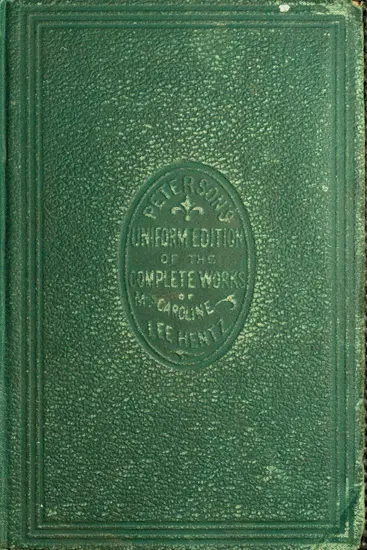
Love After Marriage; and Other Stories of the Heart
Caroline Lee Hentz
THE CLASSIC COLLECTION · 1856
"Ernest Linwood; or, The Inner Life of the Author" by Caroline Lee Hentz is a novel written in the mid-19th century. The story revolves around Gabriella Lynn, a sensitive and aspiring young poet, who experiences harsh criticism from her teacher during a school presentation. This pivotal moment sets in motion a chain of events that leads to her struggles with identity, societal expectations, and the complexities of her relationships, particularly with her supportive yet ill mother. The opening of the novel introduces Gabriella's tumultuous emotional landscape as she grapples with humiliation at the hands of Mr. Regulus, her teacher. This profound incident leaves her feeling chastised and introspective, prompting her to retreat to the solitude of the woods after fleeing school. The narrative deepens as we see glimpses of her inner world marked by artistic aspirations, the pain of social rejection, and the pillow of grief over her mother's deteriorating health, reflecting themes of kindness, artistic struggle, and the burdens of unrecognized talent. The stark contrast between her poetic passions and the harsh realities of life begins to take shape, hinting at the novel's exploration of personal and societal dilemmas.
Introduction adapted from the source catalogue; source summaries may be automatically generated.
Free to read · English · 157,992 words · No account needed
MAKE TIME FOR A GOOD BOOK
On by default. Untick to stop anonymous reading totals. Each page counts after 10 seconds in view. How this works.
Anonymous counting is on unless you have switched it off.
"You have seen him when he was quite a youth," answered his mother, "but have probably forgotten him. He is a young man of great promise, and has been awarded the first honors of his class. I feel a deep interest in him for his own sake, and moreover I am indebted to him for my introduction to our own Gabriella."
"Indeed!" repeated her son, and glancing towards me, his countenance lighted up with a sudden look of intelligence.
Why need Mrs. Linwood have said that? Why need she have associated him so intimately and significantly with me? And why could I not keep down the rising crimson, which might be attributed to another source than embarrassment? I opened my lips to deny any interest in Richard beyond that of friendly acquaintanceship; but Mrs. Linwood's mild, serene, yet resolute eyes, beat mine down and choked my eager utterance.
Her eyes said as clearly as words could say, "what matters it to my son, how little or how great an interest you feel in Richard Clyde or any other person?"
"You must accompany us, Gabriella," she said, with great kindness. "You have never witnessed this gathering of the literati of our State, and I know of no one who would enjoy it more. It will be quite an intellectual banquet."
"I thank you, but I cannot accept the invitation," I answered, suppressing a sigh, not of disappointment at the necessity of refusal, but of mortification at the inference that would probably be drawn from this conversation. "My vacation does not begin till afterwards."
"I think I can intercede with Mr. Regulus to release you," said Mrs.
Linwood.
"Thank you,--I do not wish to go,--indeed I would much rather not, unless," I added, fearful I had spoken too energetically, "you have an urgent desire that I should."
"I wish very much to make you happy, and I think you would enjoy far more than you now anticipate. But there is time enough to decide. There will be a fortnight hence."
"But the dresses, mamma," cried Edith; "you know she will need new dresses if she goes, and they will require some time to prepare."
"As Gabriella will not come out, as it is called, till next winter," replied Mrs. Linwood, "it is not a matter of so much consequence as you imagine. Simplicity is much more charming than ornament in the dress of a very young girl."
"I agree with you, mother," observed Ernest, without lifting his eyes from his book, "especially where artificial ornaments are superfluous."
"I did not think you were listening to our remarks about dress," said Edith. "This is something quite new, brother."
Your reading position is saved on this browser. Take it to another device with a library code. Reading pages adapt to text, rather than matching a printed edition.
BEHIND THE BOOK
This eBook is for the use of anyone anywhere in the United States and most other parts of the world at no cost and with almost no restrictions whatsoever. You may copy it, give it away or re-use it under the terms of the Project Gutenberg License included with this eBook or online at www.gutenberg.org. If you are not located in the United States, you will have to check the laws of the country where you are located before using this eBook. Read the source licence.
The original source file, including credits and licence, is retained by this library. Request an original-format copy at no charge. Please include the book title and Project Gutenberg identifier #20462.
KEEP YOUR CURIOSITY GOING
Coulson Kernahan

Maurice Baring
Frances Wright
Cécile Tormay

Frederic Jesup Stimson

W. H. P. (William Henry Pope) Jarvis