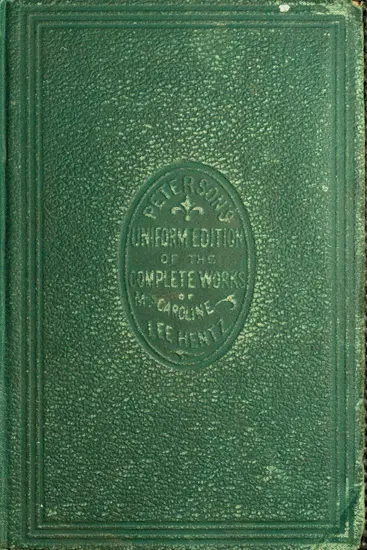
Love After Marriage; and Other Stories of the Heart
Caroline Lee Hentz
THE CLASSIC COLLECTION · 1856
"Ernest Linwood; or, The Inner Life of the Author" by Caroline Lee Hentz is a novel written in the mid-19th century. The story revolves around Gabriella Lynn, a sensitive and aspiring young poet, who experiences harsh criticism from her teacher during a school presentation. This pivotal moment sets in motion a chain of events that leads to her struggles with identity, societal expectations, and the complexities of her relationships, particularly with her supportive yet ill mother. The opening of the novel introduces Gabriella's tumultuous emotional landscape as she grapples with humiliation at the hands of Mr. Regulus, her teacher. This profound incident leaves her feeling chastised and introspective, prompting her to retreat to the solitude of the woods after fleeing school. The narrative deepens as we see glimpses of her inner world marked by artistic aspirations, the pain of social rejection, and the pillow of grief over her mother's deteriorating health, reflecting themes of kindness, artistic struggle, and the burdens of unrecognized talent. The stark contrast between her poetic passions and the harsh realities of life begins to take shape, hinting at the novel's exploration of personal and societal dilemmas.
Introduction adapted from the source catalogue; source summaries may be automatically generated.
Free to read · English · 157,992 words · No account needed
MAKE TIME FOR A GOOD BOOK
On by default. Untick to stop anonymous reading totals. Each page counts after 10 seconds in view. How this works.
Anonymous counting is on unless you have switched it off.
I had nerved myself for the trial, and went with the spirit of a martyr, though with blanched cheek and faltering step, into the heart of that frowning pile, on which I could never gaze without shuddering.
Clinging to the arm of Richard, I felt myself borne along through cold and dreary walls, that seemed to my startled ear echoing with sighs and groans and curses, upward through dark galleries, and passed ponderous iron doors that reminded me of Milton's description of the gates of hell, till the prison officer who preceded us paused before one of those grim portals, and inserting a massy key, a heavy grating sound scraped and lacerated my ear.
"Wait one moment," I gasped, leaning almost powerless on the shoulder of
Richard.
"I feared so," said he, passing his arm around me, his eyes expressing the most intense sensibility. "I knew you could not bear it. Let us return,--I was wrong to permit your coming in the first place."
"No, no,--I am able to go in now,--the shock is over,--I am quite strong
now."
And raising my head, I drew a quick, painful breath, passed through the iron door into the narrow cell, where the gloom of eternal twilight darkly hung.
At first I could not distinguish the objects within, for a mist was over my sight, which deepened the shadows of the dungeon walls. But as my eye became accustomed to the dimness, I saw a tall, emaciated figure rising from the bed, which nearly filled the limited space which inclosed us. A narrow aperture in the deep, massy stone, admitted all the light which illumined us after the iron door slowly closed.
The dark, sunken eyes of the prisoner gleamed like the flash of an expiring taper, wild and fitful, on our entering forms. He was dreadfully altered,--I should scarcely have recognized him through the gloomy shade of his long-neglected hair, and thick, unshorn beard.
"Father," said Richard, trying to speak in a cheerful tone, "I have brought you a comforter. A daughter's presence must be more soothing than a son's."
I held out my hand as Richard spoke, and he took it as if it were marble. No tenderness softened his countenance,--he rather seemed to recoil from me than to welcome. I noticed a great difference in his reception of Richard. He grasped his hand, and perused his features as if he could not withdraw his gaze.
"Are you indeed my son?" he asked, in an unsteady tone. "Do you not mock me? Tell me once more, are you Theresa's child?"
"As surely as I believe her an angel in heaven, I am."
Your reading position is saved on this browser. Take it to another device with a library code. Reading pages adapt to text, rather than matching a printed edition.
BEHIND THE BOOK
This eBook is for the use of anyone anywhere in the United States and most other parts of the world at no cost and with almost no restrictions whatsoever. You may copy it, give it away or re-use it under the terms of the Project Gutenberg License included with this eBook or online at www.gutenberg.org. If you are not located in the United States, you will have to check the laws of the country where you are located before using this eBook. Read the source licence.
The original source file, including credits and licence, is retained by this library. Request an original-format copy at no charge. Please include the book title and Project Gutenberg identifier #20462.
KEEP YOUR CURIOSITY GOING
Coulson Kernahan

Maurice Baring
Frances Wright
Cécile Tormay

Frederic Jesup Stimson

W. H. P. (William Henry Pope) Jarvis