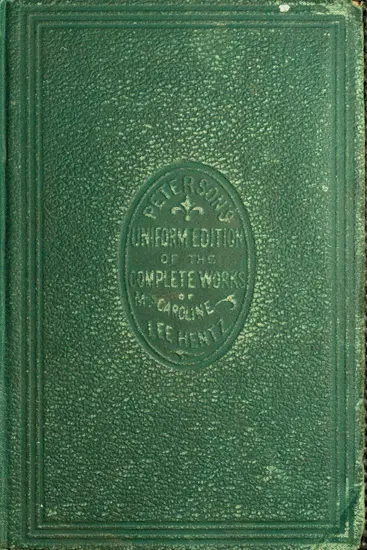
Love After Marriage; and Other Stories of the Heart
Caroline Lee Hentz
THE CLASSIC COLLECTION · 1856
"Ernest Linwood; or, The Inner Life of the Author" by Caroline Lee Hentz is a novel written in the mid-19th century. The story revolves around Gabriella Lynn, a sensitive and aspiring young poet, who experiences harsh criticism from her teacher during a school presentation. This pivotal moment sets in motion a chain of events that leads to her struggles with identity, societal expectations, and the complexities of her relationships, particularly with her supportive yet ill mother. The opening of the novel introduces Gabriella's tumultuous emotional landscape as she grapples with humiliation at the hands of Mr. Regulus, her teacher. This profound incident leaves her feeling chastised and introspective, prompting her to retreat to the solitude of the woods after fleeing school. The narrative deepens as we see glimpses of her inner world marked by artistic aspirations, the pain of social rejection, and the pillow of grief over her mother's deteriorating health, reflecting themes of kindness, artistic struggle, and the burdens of unrecognized talent. The stark contrast between her poetic passions and the harsh realities of life begins to take shape, hinting at the novel's exploration of personal and societal dilemmas.
Introduction adapted from the source catalogue; source summaries may be automatically generated.
Free to read · English · 157,992 words · No account needed
MAKE TIME FOR A GOOD BOOK
On by default. Untick to stop anonymous reading totals. Each page counts after 10 seconds in view. How this works.
Anonymous counting is on unless you have switched it off.
"I wish I had been called sooner," said he, with a slight contraction of the brows, "but we will do all we can to relieve her."
He called for a basin and linen bandage, and taking a lancet from his pocket, held up the sharp, gleaming point to the light. I shuddered, I had never seen any one bled, and it seemed to me an awful operation.
"You will hold the basin," said he, directing me with his calm, benignant eye. "You are a brave girl,--you will not shrink, as some foolish persons do, at the sight of blood. This side, if you please, my dear."
Ashamed to forfeit the confidence he had in my bravery, or rather moral courage, I grasped the basin with both hands, and held it firm, though my lips quivered and my cheek blanched.
Peggy, awakened by the pressure of the bandage, began to rave and struggle, and I feared it would be impossible to subdue her into sufficient quietness; but delirious as she was, there was something in the calm, authoritative tones of Dr. Harlowe's voice, that seemed irresistible. She became still, and lay with her half-closed eyes fixed magnetically on his face. As the dark-red blood spouted into the basin, I started, and would have recoiled had not a strong controlling influence been exerted over me. The gates of life were opened. How easy for life itself to pass away in that deep crimson tide!
"This is the poetry of our profession," said the doctor, binding up the wound with all a woman's gentleness.
Poor Peggy, who could ever associate the idea of poetry with her! I could not help smiling as I looked at her sturdy arm, through whose opaque surface the blue wandering of the veins was vainly sought.
"And now," said he, after giving her a comforting draught, "she will sleep, and you must sleep, madam," turning respectfully to my mother; "you have not strength enough to resist fatigue,--your daughter will have two to nurse instead of one, if you do not follow my advice."
"I cannot sleep," replied my mother.
"But you can rest, madam; it is your duty. What did I come here for, but to relieve your cares? Go with your mother, my dear, and after a while you may come back and help me."
"You are very kind, sir," she answered. With a graceful bend of the head she passed from the room, while his eyes followed her with an expression of intense interest.
Your reading position is saved on this browser. Take it to another device with a library code. Reading pages adapt to text, rather than matching a printed edition.
BEHIND THE BOOK
This eBook is for the use of anyone anywhere in the United States and most other parts of the world at no cost and with almost no restrictions whatsoever. You may copy it, give it away or re-use it under the terms of the Project Gutenberg License included with this eBook or online at www.gutenberg.org. If you are not located in the United States, you will have to check the laws of the country where you are located before using this eBook. Read the source licence.
The original source file, including credits and licence, is retained by this library. Request an original-format copy at no charge. Please include the book title and Project Gutenberg identifier #20462.
KEEP YOUR CURIOSITY GOING
Coulson Kernahan

Maurice Baring
Frances Wright
Cécile Tormay

Frederic Jesup Stimson

W. H. P. (William Henry Pope) Jarvis