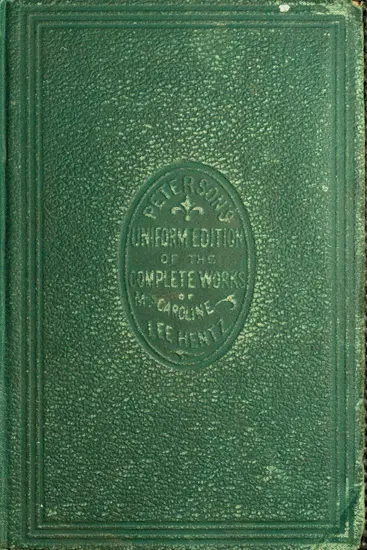
Love After Marriage; and Other Stories of the Heart
Caroline Lee Hentz
THE CLASSIC COLLECTION · 1856
"Ernest Linwood; or, The Inner Life of the Author" by Caroline Lee Hentz is a novel written in the mid-19th century. The story revolves around Gabriella Lynn, a sensitive and aspiring young poet, who experiences harsh criticism from her teacher during a school presentation. This pivotal moment sets in motion a chain of events that leads to her struggles with identity, societal expectations, and the complexities of her relationships, particularly with her supportive yet ill mother. The opening of the novel introduces Gabriella's tumultuous emotional landscape as she grapples with humiliation at the hands of Mr. Regulus, her teacher. This profound incident leaves her feeling chastised and introspective, prompting her to retreat to the solitude of the woods after fleeing school. The narrative deepens as we see glimpses of her inner world marked by artistic aspirations, the pain of social rejection, and the pillow of grief over her mother's deteriorating health, reflecting themes of kindness, artistic struggle, and the burdens of unrecognized talent. The stark contrast between her poetic passions and the harsh realities of life begins to take shape, hinting at the novel's exploration of personal and societal dilemmas.
Introduction adapted from the source catalogue; source summaries may be automatically generated.
Free to read · English · 157,992 words · No account needed
MAKE TIME FOR A GOOD BOOK
On by default. Untick to stop anonymous reading totals. Each page counts after 10 seconds in view. How this works.
Anonymous counting is on unless you have switched it off.
I cannot say but that these daily proofs of carelessness and destructiveness were trials of the temper and constant gratings on the nerves. It was difficult to smile with a frowning heart, for such wanton disregard for the property and feelings of others must pain that nice moral sense which is connected with the great law of self-preservation.
This evening, she seized a beautiful perfume bottle that stood on my toilet, and opening it, spilled it half on her handkerchief, though one drop would fill the whole apartment with richest odor.
"Do not break that bottle, Margaret; it is very beautiful, and Ernest gave it me this very morning."
"Oh! nonsense, I am the most careful creature in the world. Once in a while, to be sure,--but then accidents will happen, you know. O Gabriella I have something to tell you. Mr. Harland wants me to marry him,--ha, ha, ha!"
"Well, you seemed pleased, Margaret. He is an accomplished gentleman, and an agreeable one. Do you like him?"
"No! I liked him very well, till he wanted me to like him better, and now I detest him. He is all froth,--does not know much more than I do myself. No, no,--that will never do."
"Perhaps you like some one else better?" said I, thinking if Margaret was ever caught in the matrimonial noose, it must be a lasso, such as are thrown round the neck of the wild horses of the prairies.
"What makes you say that?" she asked, quickly, and my beautiful essence bottle was demolished by some sudden jerk which brought it in contact with the marble table. "The brittle thing!" she exclaimed, tossing the fragments on the carpet, at the risk of cutting our slippers and wounding our feet. "I would not thank Ernest for such baby trifles,--I was scarcely touching it. What makes you think I like anybody better?"
"I merely asked the question," I answered, closing my work box, and drawing it nearer, so that her depredating fingers could not reach it. She had already destroyed half its contents.
"I do like somebody a great deal better," she said, tossing her hair over her forehead and veiling her eyes; "but if you guessed till doomsday, you could not imagine who it is."
"I pity him, whoever it may be," said I, laughing.
"Why?"
"You are no more fit to be a wife, Madge, than a child of five years old. You have no more thought or consideration, foresight or care."
"I am two years older than you are, notwithstanding."
Your reading position is saved on this browser. Take it to another device with a library code. Reading pages adapt to text, rather than matching a printed edition.
BEHIND THE BOOK
This eBook is for the use of anyone anywhere in the United States and most other parts of the world at no cost and with almost no restrictions whatsoever. You may copy it, give it away or re-use it under the terms of the Project Gutenberg License included with this eBook or online at www.gutenberg.org. If you are not located in the United States, you will have to check the laws of the country where you are located before using this eBook. Read the source licence.
The original source file, including credits and licence, is retained by this library. Request an original-format copy at no charge. Please include the book title and Project Gutenberg identifier #20462.
KEEP YOUR CURIOSITY GOING
Coulson Kernahan

Maurice Baring
Frances Wright
Cécile Tormay

Frederic Jesup Stimson

W. H. P. (William Henry Pope) Jarvis