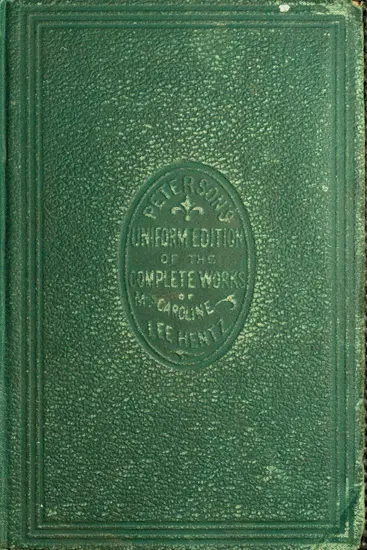
Love After Marriage; and Other Stories of the Heart
Caroline Lee Hentz
THE CLASSIC COLLECTION · 1856
"Ernest Linwood; or, The Inner Life of the Author" by Caroline Lee Hentz is a novel written in the mid-19th century. The story revolves around Gabriella Lynn, a sensitive and aspiring young poet, who experiences harsh criticism from her teacher during a school presentation. This pivotal moment sets in motion a chain of events that leads to her struggles with identity, societal expectations, and the complexities of her relationships, particularly with her supportive yet ill mother. The opening of the novel introduces Gabriella's tumultuous emotional landscape as she grapples with humiliation at the hands of Mr. Regulus, her teacher. This profound incident leaves her feeling chastised and introspective, prompting her to retreat to the solitude of the woods after fleeing school. The narrative deepens as we see glimpses of her inner world marked by artistic aspirations, the pain of social rejection, and the pillow of grief over her mother's deteriorating health, reflecting themes of kindness, artistic struggle, and the burdens of unrecognized talent. The stark contrast between her poetic passions and the harsh realities of life begins to take shape, hinting at the novel's exploration of personal and societal dilemmas.
Introduction adapted from the source catalogue; source summaries may be automatically generated.
Free to read · English · 157,992 words · No account needed
MAKE TIME FOR A GOOD BOOK
On by default. Untick to stop anonymous reading totals. Each page counts after 10 seconds in view. How this works.
Anonymous counting is on unless you have switched it off.
This sarcasm was received with acclamation; but Meg lifted her brow as dauntless as ever and laughed as loudly.
I began to feel weary of mirth in which I could not sympathize. Mrs. Linwood came to me, and saying I looked pale and wan, insisted upon my retiring. To this I gladly assented. The little misunderstanding between Edith and myself weighed heavily on my spirits, and I longed to be alone.
Just as we were crossing the hall of entrance, Richard Clyde came in. He greeted me with so much feeling, such earnest, unaffected pleasure, yet a pleasure so chastened by sensibility, I realized, perhaps for the first time, the value of the heart I had rejected.
"You have been ill, Gabriella," said he, retaining for a moment the hand he had taken. "You look pale and languid. You do not know how much your friends have suffered on your account, or how grateful they feel for your convalesence."
"I did not think I was of so much consequence," I replied. "It is well to be sick now and then, so as to be able to appreciate the kindness of friends."
"You must suffer us to go now, Richard," said Mrs. Linwood moving towards the staircase; "you will find merry company in the parlor ready to entertain you. As Gabriella is no longer a prisoner, you will have future opportunities of seeing her."
"I must embrace them soon," said he, sadly. "I expect to leave this place before long,--my friends, and my country."
"You, Richard?" I exclaimed. Then I remembered the remarks I had heard on commencement day, of his being sent to Europe to complete his education. I regretted to lose the champion of my childhood, the friend of my youth, and my countenance expressed my emotion.
"I have a great deal to say to you, Gabriella," said he, in a low tone. "May I see you to-morrow?"
"Certainly,--that is, I think, I hope so." A glance that flashed on me from the doorway arrested my stammering tongue. Ernest was standing there, observing the interview, and the dark passion of which his mother had warned me clouded his brow. Snatching my hand from Richard, I bade him a hasty good-night, and ascended the stairs, with a prophetic heart.
Yet, while I felt the shadow on his brow stealing darkly over me, I
repeated to myself,--
"The keenest pangs the wretched find,
Are rapture to the dreary void,
The leafless desert of the mind,
The waste of feelings unemployed."
Your reading position is saved on this browser. Take it to another device with a library code. Reading pages adapt to text, rather than matching a printed edition.
BEHIND THE BOOK
This eBook is for the use of anyone anywhere in the United States and most other parts of the world at no cost and with almost no restrictions whatsoever. You may copy it, give it away or re-use it under the terms of the Project Gutenberg License included with this eBook or online at www.gutenberg.org. If you are not located in the United States, you will have to check the laws of the country where you are located before using this eBook. Read the source licence.
The original source file, including credits and licence, is retained by this library. Request an original-format copy at no charge. Please include the book title and Project Gutenberg identifier #20462.
KEEP YOUR CURIOSITY GOING
Coulson Kernahan

Maurice Baring
Frances Wright
Cécile Tormay

Frederic Jesup Stimson

W. H. P. (William Henry Pope) Jarvis