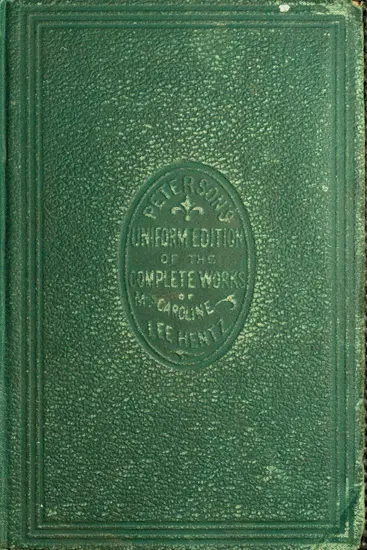
Love After Marriage; and Other Stories of the Heart
Caroline Lee Hentz
THE CLASSIC COLLECTION · 1856
"Ernest Linwood; or, The Inner Life of the Author" by Caroline Lee Hentz is a novel written in the mid-19th century. The story revolves around Gabriella Lynn, a sensitive and aspiring young poet, who experiences harsh criticism from her teacher during a school presentation. This pivotal moment sets in motion a chain of events that leads to her struggles with identity, societal expectations, and the complexities of her relationships, particularly with her supportive yet ill mother. The opening of the novel introduces Gabriella's tumultuous emotional landscape as she grapples with humiliation at the hands of Mr. Regulus, her teacher. This profound incident leaves her feeling chastised and introspective, prompting her to retreat to the solitude of the woods after fleeing school. The narrative deepens as we see glimpses of her inner world marked by artistic aspirations, the pain of social rejection, and the pillow of grief over her mother's deteriorating health, reflecting themes of kindness, artistic struggle, and the burdens of unrecognized talent. The stark contrast between her poetic passions and the harsh realities of life begins to take shape, hinting at the novel's exploration of personal and societal dilemmas.
Introduction adapted from the source catalogue; source summaries may be automatically generated.
Free to read · English · 157,992 words · No account needed
MAKE TIME FOR A GOOD BOOK
On by default. Untick to stop anonymous reading totals. Each page counts after 10 seconds in view. How this works.
Anonymous counting is on unless you have switched it off.
"There--the curtains are down. I am not going to speak another word--I am a perfect lamb--I will bathe your head with cologne, and put you to sleep nicely."
Stepping across the room, as she thought, very softly, but making more noise than Edith would in a week, she seized a bottle of cologne, and coming close to the bedside, bent over me, so that her great, black eyes almost touched mine. Had they been a pair of pistols, I could not have recoiled with greater terror.
"Don't!" again I murmured,--"I am very weak."
"Hush! I am going to put you to sleep."
Pouring the cologne in her hand, till it dripped all over the counterpane and pillow, she deluged my hair, and patted my forehead as she would a colt's that she wanted to stand still. In mute despair I submitted to her tender mercies, certain I should die, if some one did not come to my relief, when the door softly opened, and Mrs. Linwood entered.
"Heaven be praised," thought I,--I had not strength to say it. Tears of weariness and vexation were mingling with the drops with which she had saturated my hair.
"Margaret," said Mrs. Linwood, in a tone of serious displeasure, "what have you been doing? I left her in a sweet sleep, and now I find her wan, tearful, and agitated. You will worry her into a relapse."
"All she needs now is cheerful company, I am sure," she answered demurely; "you all make her so tender and baby-like, she never will have any strength again. I've been as soft as a cooing dove. Dr. Harlowe would have been delighted with me."
"You must go, Margaret, indeed you must. You may think yourself a dove, but others have a different opinion."
"Going, going, gone!" she cried, giving me a vehement kiss and
vanishing.
The consequence of this energetic visit was a relapse; and Dr. Harlowe was as angry as his nature admitted when he learned the cause.
"That wild-cat must not remain here," said he, shaking his head. "She will kill my gentle patient. Where did you find her, Mrs. Linwood? From what menagerie has she broken loose?"
"She is the daughter of an early and very dear friend of mine," replied Mrs. Linwood, smiling; "a very original and independent young lady, I grant she is."
"What in the world did you bring her here for?" asked the doctor bluntly; "I intend to chain her, while my child is sick."
"She wished to make a visit in the country, and I thought her wild good-humor would be a counterpoise to the poetry and romance of Grandison Place."
Your reading position is saved on this browser. Take it to another device with a library code. Reading pages adapt to text, rather than matching a printed edition.
BEHIND THE BOOK
This eBook is for the use of anyone anywhere in the United States and most other parts of the world at no cost and with almost no restrictions whatsoever. You may copy it, give it away or re-use it under the terms of the Project Gutenberg License included with this eBook or online at www.gutenberg.org. If you are not located in the United States, you will have to check the laws of the country where you are located before using this eBook. Read the source licence.
The original source file, including credits and licence, is retained by this library. Request an original-format copy at no charge. Please include the book title and Project Gutenberg identifier #20462.
KEEP YOUR CURIOSITY GOING
Coulson Kernahan

Maurice Baring
Frances Wright
Cécile Tormay

Frederic Jesup Stimson

W. H. P. (William Henry Pope) Jarvis