THE CLASSIC COLLECTION✦Hawthorne (English Men of Letters Series)CLASSIC FREE BOOKS
Hawthorne (English Men of Letters Series)
Henry James
THE CLASSIC COLLECTION · 1875
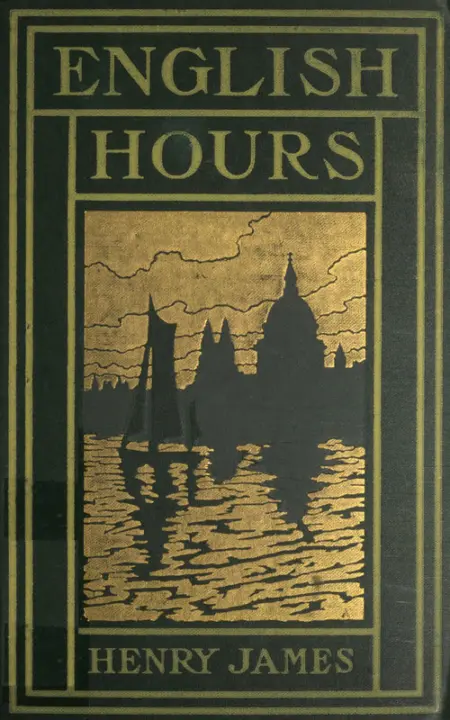
"English Hours" by Henry James is a collection of travel essays published in 1905. Drawing from more than thirty years of writing about England, James chronicles his experiences in his adopted country, from London's "greasy" streets to the pastoral countryside of Devon, Warwickshire, and Suffolk. With knowing affection, he captures both the "dreadful, delightful" British capital and the quiet charms of rural towns like Rye, offering readers an intimate portrait of Victorian and Edwardian England through American eyes.
Introduction adapted from the source catalogue; source summaries may be automatically generated.
Free to read · English · 76,282 words · No account needed
MAKE TIME FOR A GOOD BOOK
On by default. Untick to stop anonymous reading totals. Each page counts after 10 seconds in view. How this works.
Anonymous counting is on unless you have switched it off.
I believe it is supposed to require a good deal of courage to confess that one has spent the month of so-called social August in London; and I will therefore, taking the bull by the horns, plead guilty at the very outset to this poorness of spirit. I might attempt some ingenious extenuation of it; I might say that my remaining in town had been the most unexpected necessity or the merest inadvertence; I might pretend I liked it—that I had done it in fact for the perverse love of the thing; I might claim that you don’t really know the charms of London until on one of the dog-days you have imprinted your boot-sole in the slumbering dust of Belgravia, or, gazing along the empty vista of the Drive, in Hyde Park, have beheld, for almost the first time in England, a landscape without figures. But little would remain of these specious apologies save the bald circumstance that I had distinctly failed to pack and be off—either on the first of August with the ladies and children, or on the thirteenth with the members of Parliament, or on the twelfth when the grouse-shooting began. (I am not sure that I have got my dates right to a day, but these were about the proper opportunities.) I have, in fact, survived the departure of everything genteel, and the three millions of persons who remained behind with me have been witnesses of my shame.
I cannot pretend, on the other hand, that, having lingered in town, I have found it a very odious or painful experience. Being a stranger, I have not felt it necessary to incarcerate myself during the day and steal abroad only under cover of the darkness—a line of conduct imposed by public opinion, if I am to trust the social criticism of the weekly papers (which I am far from doing), upon the native residents who allow themselves to be overtaken by the unfashionable season. I have indeed always held that few things are pleasanter, during very hot weather, than to have a great city, and a large house within it, quite to one’s self. Yet these majestic conditions have not embellished my own metropolitan sojourn, and I have received an impression that in London it would be rather difficult for a visitor not having the command of a good deal of powerful machinery to find them united. English summer weather is rarely hot enough to make it necessary to darken one’s house and denude one’s person. The present year has indeed in this respect been “exceptional,” as any year is, for that matter, that one spends anywhere. But the manners of the people are, to alien eyes, a sufficient indication that at the best (or the worst) even the highest flights of the thermometer in the united Kingdom betray a broken wing. People live with closed windows in August very much as they do in January, and there is to the eye no appreciable difference in the character—that is in the thickness and stiffness—of their coats and boots. A “bath” in England, for the most part, all the year round, means a little portable tin tub and a sponge. Peaches and pears, grapes and melons, are not a more obvious ornament of the market at midsummer than at Christmas. This matter of peaches and melons, by the way, offers one of the best examples of that fact to which a commentator on English manners from afar finds himself constantly recurring, and to which he grows at last almost ashamed of alluding—the fact that the beauty and luxury of the country, that elaborate system known and revered all over the world as “English comfort,” is a limited and restricted, an essentially private, affair. I am not one of those irreverent strangers who talk of English fruit as a rather audacious plaisanterie, though I could see very well what was meant a short time since by an anecdote related to me in a tone of contemptuous generalisation by a couple of my fellow countrywomen. They had arrived in London in the dog-days, and, lunching at their hotel, had asked to be served with some fruit. The hotel was of the stateliest pattern, and they were waited upon by a functionary whose grandeur was proportionate. This personage bowed and retired, and, after a long delay, reappearing, placed before them with an inimitable gesture a dish of gooseberries and currants. It appeared upon investigation that these acrid vegetables were the only things of succulence that the establishment could undertake to supply; and it seemed to increase the irony of the situation that the establishment was as near as possible to Buckingham Palace. I say that the heroines of my anecdote seemed disposed to generalise: this was sufficiently the case, I mean, to give me a pretext for assuring them that on a thousand fine properties the most beautiful peaches and melons were at that moment ripening either under glass or in warm old walled gardens. My auditors tossed their heads of course at the fine properties, the glass, and the walled gardens; and indeed at their place of privation close to Buckingham Palace such a piece of knowledge was but scantily consoling.
Your reading position is saved on this browser. Take it to another device with a library code. Reading pages adapt to text, rather than matching a printed edition.
Henry James
Henry James
Henry James

Henry James
BEHIND THE BOOK
This eBook is for the use of anyone anywhere in the United States and most other parts of the world at no cost and with almost no restrictions whatsoever. You may copy it, give it away or re-use it under the terms of the Project Gutenberg License included with this eBook or online at www.gutenberg.org. If you are not located in the United States, you will have to check the laws of the country where you are located before using this eBook. Read the source licence.
The original source file, including credits and licence, is retained by this library. Request an original-format copy at no charge. Please include the book title and Project Gutenberg identifier #58938.
KEEP YOUR CURIOSITY GOING
Wilfrid Scawen Blunt
Wilfrid Scawen Blunt

E. W. (Edgar Watson) Howe

David Patterson (Spirit) Hatch

David Patterson (Spirit) Hatch

David Patterson (Spirit) Hatch