THE CLASSIC COLLECTION✦Hawthorne (English Men of Letters Series)CLASSIC FREE BOOKS
Hawthorne (English Men of Letters Series)
Henry James
THE CLASSIC COLLECTION · 1875
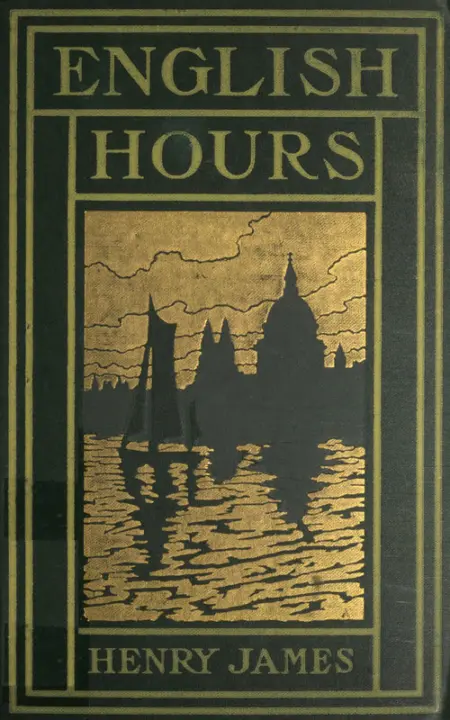
"English Hours" by Henry James is a collection of travel essays published in 1905. Drawing from more than thirty years of writing about England, James chronicles his experiences in his adopted country, from London's "greasy" streets to the pastoral countryside of Devon, Warwickshire, and Suffolk. With knowing affection, he captures both the "dreadful, delightful" British capital and the quiet charms of rural towns like Rye, offering readers an intimate portrait of Victorian and Edwardian England through American eyes.
Introduction adapted from the source catalogue; source summaries may be automatically generated.
Free to read · English · 76,282 words · No account needed
MAKE TIME FOR A GOOD BOOK
On by default. Untick to stop anonymous reading totals. Each page counts after 10 seconds in view. How this works.
Anonymous counting is on unless you have switched it off.
It is not the absence of a close that damages Canterbury; the cathedral stands amid grass and trees, with a cultivated margin all round it, and is placed in such a way that, as you pass out from under the gate-house you appreciate immediately its grand feature—its extraordinary and magnificent length. None of the English cathedrals seems to sit more gravely apart, to desire more to be shut up to itself. It is a long walk, beneath the walls, from the gateway of the close to the farther end of the last chapel. Of all that there is to observe in this upward-gazing stroll I can give no detailed account; I can, in my fear to pretend to dabble in the esoteric constructional question—often so combined with an absence of other felt relations—speak only of the picture, the mere builded scène. This is altogether delightful. None of the rivals of Canterbury has a more complicated and elaborate architecture, a more perplexing intermixture of periods, a more charming jumble of Norman arches and English points and perpendiculars. What makes the side-view superb, moreover, is the double transepts, which produce the finest agglomeration of gables and buttresses. It is as if two great churches had joined forces toward the middle—one giving its nave and the other its choir, and each keeping its own great cross-aisles. Astride of the roof, between them, sits a huge gothic tower, which is one of the latest portions of the building, though it looks like one of the earliest, so tempered and tinted, so thumb-marked and rubbed smooth is it, by the handling of the ages and the breath of the elements. Like the rest of the structure it has a magnificent colour—a sort of rich dull yellow, a sort of personal accent of tone that is neither brown nor grey. This is particularly appreciable from the cloisters on the further side of the church—the side, I mean, away from the town and the open garden-sweep I spoke of; the side that looks toward a damp old clerical house, lurking behind a brown archway through which you see young ladies in Gainsborough hats playing something on a patch of velvet turf; the side, in short, that is somehow intermingled with a green quadrangle—a quadrangle serving as a playground to a King’s School and adorned externally with a very precious and picturesque old fragment of Norman staircase. This cloister is not “kept up;” it is very dusky and mouldy and dilapidated, and of course very sketchable. The old black arches and capitals are various and handsome, and in the centre are tumbled together a group of crooked gravestones, themselves almost buried in the deep soft grass. Out of the cloister opens the chapter-house, which is not kept up either, but which is none the less a magnificent structure; a noble, lofty hall, with a beautiful wooden roof, simply arched like that of a tunnel, without columns or brackets. The place is now given up to dust and echoes; but it looks more like a banqueting-hall than a council-room of priests, and as you sit on the old wooden bench, which, raised on two or three steps, runs round the base of the four walls, you may gaze up and make out the faint ghostly traces of decorative paint and gold upon the brown ceiling. A little patch of this has been restored “to give an idea.” From one of the angles of the cloister you are recommended by the verger to take a view of the great tower, which indeed detaches itself with tremendous effect. You see it base itself upon the roof as broadly as if it were striking roots in earth, and then pile itself away to a height which seems to make the very swallows dizzy as they drop from the topmost shelf. Within the cathedral you hear a great deal, of course, about poor great Thomas A’Becket, and the special sensation of the place is to stand on the spot where he was murdered and look down at a small fragmentary slab which the verger points out to you as a bit of the pavement that caught the blood-drops of the struggle. It was late in the afternoon when I first entered the church; there had been a service in the choir, but that was well over, and I had the place to myself. The verger, who had some pushing-about of benches to attend to, turned me into the locked gates and left me to wander through the side-aisles of the choir and into the great chapel beyond it. I say I had the place to myself; but it would be more decent to affirm that I shared it, in particular, with another gentleman. This personage was stretched upon a couch of stone, beneath a quaint old canopy of wood; his hands were crossed upon his breast, and his pointed toes rested upon a little griffin or leopard. He was a very handsome fellow and the image of a gallant knight. His name was Edward Plantagenet, and his sobriquet was the Black Prince. “De la mort ne pensai-je mye,” he says in the beautiful inscription embossed upon the bronze base of his image; and I too, as I stood there, lost the sense of death in a momentary impression of personal nearness to him. One had been further off, after all, from other famous knights. In this same chapel, for many a year, stood the shrine of St. Thomas of Canterbury, one of the richest and most potent in Christendom. The pavement which lay before it has kept its place, but Henry VIII swept away everything else in his famous short cut to reform. Becket was originally buried in the crypt of the church; his ashes lay there for fifty years, and it was only little by little that his martyrdom was made a “draw.” Then he was transplanted into the Lady Chapel; every grain of his dust became a priceless relic, and the pavement was hallowed by the knees of pilgrims. It was on this errand of course that Chaucer’s story-telling cavalcade came to Canterbury. I made my way down into the crypt, which is a magnificent maze of low, dark arches and pillars, and groped about till I found the place where the frightened monks had first shuffled the inanimate victim of Moreville and Fitzurse out of the reach of further desecration. While I stood there a violent thunderstorm broke over the cathedral; great rumbling gusts and rain-drifts came sweeping through the open sides of the crypt and, mingling with the darkness which seemed to deepen and flash in corners and with the potent mouldy smell, made me feel as if I had descended into the very bowels of history. I emerged again, but the rain had settled down and spoiled the evening, and I splashed back to my inn and sat, in an uncomfortable chair by the coffee-room fire, reading Dean Stanley’s agreeable “Memorials of Canterbury” and wondering over the musty appointments and meagre resources of so many English hostels. This establishment had entitled itself (in compliment to the Black Prince, I suppose) the “Fleur-de-Lis.” The name was very pretty (I had been foolish enough to let it attract me to the inn), but the lily was sadly deflowered.
Your reading position is saved on this browser. Take it to another device with a library code. Reading pages adapt to text, rather than matching a printed edition.
Henry James
Henry James
Henry James

Henry James
BEHIND THE BOOK
This eBook is for the use of anyone anywhere in the United States and most other parts of the world at no cost and with almost no restrictions whatsoever. You may copy it, give it away or re-use it under the terms of the Project Gutenberg License included with this eBook or online at www.gutenberg.org. If you are not located in the United States, you will have to check the laws of the country where you are located before using this eBook. Read the source licence.
The original source file, including credits and licence, is retained by this library. Request an original-format copy at no charge. Please include the book title and Project Gutenberg identifier #58938.
KEEP YOUR CURIOSITY GOING
Wilfrid Scawen Blunt
Wilfrid Scawen Blunt

E. W. (Edgar Watson) Howe

David Patterson (Spirit) Hatch

David Patterson (Spirit) Hatch

David Patterson (Spirit) Hatch