THE CLASSIC COLLECTION✦Hawthorne (English Men of Letters Series)CLASSIC FREE BOOKS
Hawthorne (English Men of Letters Series)
Henry James
THE CLASSIC COLLECTION · 1875
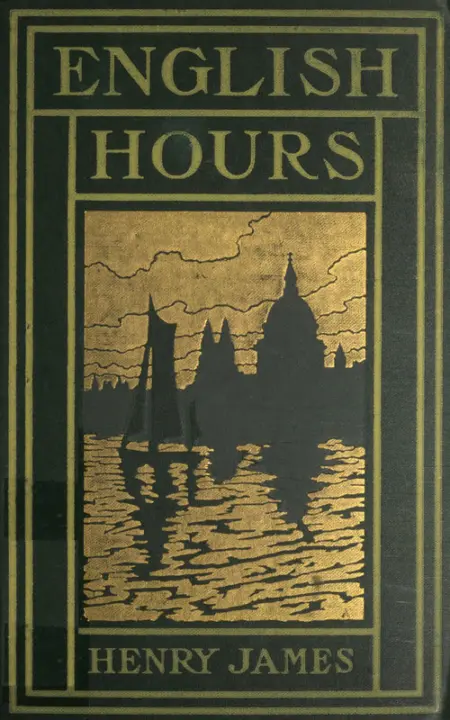
"English Hours" by Henry James is a collection of travel essays published in 1905. Drawing from more than thirty years of writing about England, James chronicles his experiences in his adopted country, from London's "greasy" streets to the pastoral countryside of Devon, Warwickshire, and Suffolk. With knowing affection, he captures both the "dreadful, delightful" British capital and the quiet charms of rural towns like Rye, offering readers an intimate portrait of Victorian and Edwardian England through American eyes.
Introduction adapted from the source catalogue; source summaries may be automatically generated.
Free to read · English · 76,282 words · No account needed
MAKE TIME FOR A GOOD BOOK
On by default. Untick to stop anonymous reading totals. Each page counts after 10 seconds in view. How this works.
Anonymous counting is on unless you have switched it off.
To walk in quest of any object that one has more or less tenderly dreamed of, to find your way, to steal upon it softly, to see at last, if it be church or castle, the tower-tops peeping above elms or beeches—to push forward with a rush, and emerge and pause and draw that first long breath which is the compromise between so many sensations: this is a pleasure left to the tourist even after the broad glare of photography has dissipated so many of the sweet mysteries of travel; even in a season when he is fatally apt to meet a dozen fellow pilgrims returning from the shrine, each as big a fool, so to speak, as he ever was, or to overtake a dozen more telegraphing their impressions down the line as they arrive. Such a pleasure I lately enjoyed quite in its perfection, in a walk to Haddon Hall, along a meadow-path by the Wye, in this interminable English twilight which I am never weary of admiring watch in hand. Haddon Hall lies among Derbyshire hills, in a region infested, I was about to write, by Americans. But I achieved my own sly pilgrimage in perfect solitude; and as I descried the grey walls among the rook-haunted elms I felt not like a dusty tourist, but like a successful adventurer. I have certainly had, as a dusty tourist, few more charming moments than some—such as any one, I suppose, is free to have—that I passed on a little ruined grey bridge which spans, with its single narrow arch, a trickling stream at the base of the eminence from which those walls and trees look down. The twilight deepened, the ragged battlements and the low, broad oriels glanced duskily from the foliage, the rooks wheeled and clamoured in the glowing sky; and if there had been a ghost on the premises I certainly ought to have seen it. In fact I did see it, as we see ghosts nowadays. I felt the incommunicable spirit of the scene with the last, the right intensity. The old life, the old manners, the old figures seemed present again. The great coup de théâtre of the young woman who shows you the Hall—it is rather languidly done on her part—is to point out a little dusky door opening from a turret to a back terrace as the aperture through which Dorothy Vernon eloped with Lord John Manners. I was ignorant of this episode, for I was not to enter the place till the morrow, and I am still unversed in the history of the actors. But as I stood in the luminous dusk weaving the romance of the spot, I recognised the inevitability of a Dorothy Vernon and quite understood a Lord John. It was of course on just such an evening that the romantic event came off, and by listening with the proper credulity I might surely hear on the flags of the castle-court ghostly footfalls and feel in their movement the old heartbeats. The only footfall I can conscientiously swear to, however, is the far from spectral tread of the damsel who led me through the mansion in the prosier light of the next morning. Haddon Hall, I believe, is one of the sights in which it is the fashion to be “disappointed;” a fact explained in a great measure by the absence of a formal approach to the house, which shows its low, grey front to every trudger on the high-road. But the charm of the spot is so much less that of grandeur than that of melancholy, that it is rather deepened than diminished by this attitude of obvious survival and decay. And for that matter, when you have entered the steep little outer court through the huge thickness of the low gateway, the present seems effectually walled out and the past walled in, even as a dead man in a sepulchre. It is very dead, of a fine June morning, the genius of Haddon Hall; and the silent courts and chambers, with their hues of ashen grey and faded brown, seem as time-bleached as the dry bones of any mouldering mortality. The comparison is odd, but Haddon Hall reminded me perversely of some of the larger houses at Pompeii. The private life of the past is revealed in each case with very much the same distinctness and on a scale small enough not to stagger the imagination. This old dwelling indeed has so little of the mass and expanse of the classic feudal castle that it almost suggests one of those miniature models of great buildings which lurk in dusty corners of museums. But it is large enough to be delectably complete and to contain an infinite store of the poetry of grass-grown courts looked into by wide, jutting windows and climbed out of by crooked stone stairways mounting against the walls to little high-placed doors. The “tone” of Haddon Hall, of all its walls and towers and stonework, is the grey of unpolished silver, and the reader who has been in England need hardly be reminded of the sweet accord—to eye and mind alike—existing between all stony surfaces covered with the pale corrosions of time and the deep living green of the strong ivy which seems to feed on their slow decay. Of this effect and of a hundred others—from those that belong to low-browed, stone-paved empty rooms where life was warm and atmospheres thick, to those one may note where the dark tower stairway emerges at last, on a level with the highest beech-tops, against the cracked and sun-baked parapet which flaunted the castle standard over the castle woods—of every form of sad desuetude and picturesque decay Haddon Hall contains some delightful example. Its finest point is undoubtedly a certain court from which a stately flight of steps ascends to the terrace where that daughter of the Vernons whom I have mentioned took such happy thought for our requiring, as the phrase is, a reference. These steps, with the terrace, its balustrade topped with great ivy-muffled knobs of stone and its high background of massed woods, form the ideal mise en scène for portions of Shakespeare’s comedies. “It’s exactly Elizabethan,” said my companion. Here the Countess Olivia may have listened to the fantastic Malvolio, or Beatrix, superbest of flirts, have come to summon Benedick to dinner.
Your reading position is saved on this browser. Take it to another device with a library code. Reading pages adapt to text, rather than matching a printed edition.
Henry James
Henry James
Henry James

Henry James
BEHIND THE BOOK
This eBook is for the use of anyone anywhere in the United States and most other parts of the world at no cost and with almost no restrictions whatsoever. You may copy it, give it away or re-use it under the terms of the Project Gutenberg License included with this eBook or online at www.gutenberg.org. If you are not located in the United States, you will have to check the laws of the country where you are located before using this eBook. Read the source licence.
The original source file, including credits and licence, is retained by this library. Request an original-format copy at no charge. Please include the book title and Project Gutenberg identifier #58938.
KEEP YOUR CURIOSITY GOING
Wilfrid Scawen Blunt
Wilfrid Scawen Blunt

E. W. (Edgar Watson) Howe

David Patterson (Spirit) Hatch

David Patterson (Spirit) Hatch

David Patterson (Spirit) Hatch