THE CLASSIC COLLECTION✦Hawthorne (English Men of Letters Series)CLASSIC FREE BOOKS
Hawthorne (English Men of Letters Series)
Henry James
THE CLASSIC COLLECTION · 1875
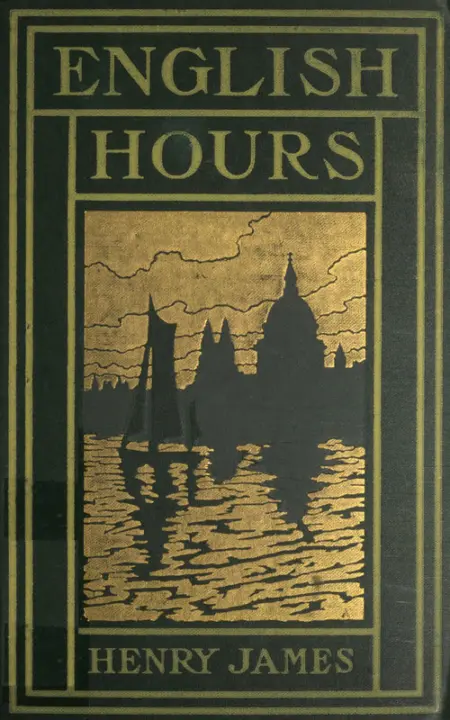
"English Hours" by Henry James is a collection of travel essays published in 1905. Drawing from more than thirty years of writing about England, James chronicles his experiences in his adopted country, from London's "greasy" streets to the pastoral countryside of Devon, Warwickshire, and Suffolk. With knowing affection, he captures both the "dreadful, delightful" British capital and the quiet charms of rural towns like Rye, offering readers an intimate portrait of Victorian and Edwardian England through American eyes.
Introduction adapted from the source catalogue; source summaries may be automatically generated.
Free to read · English · 76,282 words · No account needed
MAKE TIME FOR A GOOD BOOK
On by default. Untick to stop anonymous reading totals. Each page counts after 10 seconds in view. How this works.
Anonymous counting is on unless you have switched it off.
If every dull provincial town, however, formed but a girdle of quietude to a cathedral as rich as that of Lichfield, one would thank it for letting one alone. Lichfield cathedral is great among churches, and bravely performs the prime duty of objects of its order—that of seeming for the time (to minds unsophisticated by architectural culture) the finest, on the whole, of all such objects. This one is rather oddly placed, on the slope of a hill, the particular spot having been chosen, I believe, because sanctified by the sufferings of certain primitive martyrs; but it is fine to see how its upper portions surmount any crookedness of posture and its great towers overtake in mid-air the conditions of perfect symmetry. The close is extraordinarily attractive; a long sheet of water expands behind it and, besides leading the eye off into a sweet green landscape, renders the inestimable service of reflecting the three spires as they rise above the great trees which mask the Palace and the Deanery. These august abodes edge the northern side of the slope, and behind their huge gate-posts and close-wrought gates the atmosphere of the Georgian era seems to abide. Before them stretches a row of huge elms, which must have been old when Johnson was young; and between these and the long-buttressed wall of the cathedral, you may stroll to and fro among as pleasant a mixture of influences (I imagine) as any in England. You can stand back here, too, from the west front further than in many cases, and examine at your ease its lavish decoration. You are perhaps a trifle too much at your ease, for you soon discover what a more cursory glance might not betray, that the immense façade has been covered with stucco and paint, that an effigy of Charles II, in wig and plumes and trunk-hose, of almost gothic grotesqueness, surmounts the middle window; that the various other statues of saints and kings have but recently climbed into their niches; and that the whole expanse is in short an imposture. All this was done some fifty years ago, in the taste of that day as to restoration, and yet it but partially mitigates the impressiveness of the high façade, with its brace of spires, and the great embossed and image-fretted surface, to which the lowness of the portals (the too frequent reproach of English abbeys) seems to give a loftier reach. Passing beneath one of these low portals, however, I found myself gazing down as noble a church vista as any you need desire. The cathedral is of magnificent length, and the screen between nave and choir has been removed, so that from stem to stern, as one may say, of the great vessel of the church, it is all a mighty avenue of multitudinous slender columns, terminating in what seems a great screen of ruby and sapphire and topaz—one of the finest east windows in England. The cathedral is narrow in proportion to its length; it is the long-drawn aisle of the poet in perfection, and there is something grandly elegant in the unity of effect produced by this unobstructed perspective. The charm is increased by a singular architectural fantasy. Standing in the centre of the doorway, you perceive that the eastern wall does not directly face you, and that from the beginning of the choir the receding aisle deflects slightly to the left, in reported suggestion of the droop of the Saviour’s head on the cross. Here again Mr. Gilbert Scott has lately laboured to no small purpose of undoing, it would appear—undoing the misdeeds of the last century. This extraordinary period expended an incalculable amount of imagination in proving that it had none. Universal whitewash was the least of its offences. But this has been scraped away and the solid stonework left to speak for itself, the delicate capitals and cornices disencrusted and discreetly rechiselled and the whole temple æsthetically rededicated. Its most beautiful feature, happily, has needed no repair, for its perfect beauty has been its safeguard. The great choir window of Lichfield is the noblest glasswork before the spell of which one’s soul has become simple. I remember nowhere colours so chaste and grave, and yet so rich and true, or a cluster of designs so piously decorative and yet so vivified. Such a window as this seems to me the most sacred ornament of a great church; to be, not like vault and screen and altar, the dim contingent promise to the spirit, but the very redemption of the whole vow. This Lichfield glass is not the less interesting for being visibly of foreign origin. Exceeding so obviously as it does the range of English genius in this line, it indicates at least the heavenly treasure stored up in continental churches. It dates from the early sixteenth century, and was transferred hither sixty years ago from a decayed Belgian abbey. This, however, is not all of Lichfield. You have not seen it till you have strolled and restrolled along the close on every side, and watched the three spires constantly change their relation as you move and pause. Nothing can well be finer than the combination of the two lesser ones soaring equally in front with the third riding tremendously the magnificently sustained line of the roof. At a certain distance against the sky this long ridge seems something infinite and the great spire to sit astride of it like a giant mounted on a mastodon. Your sense of the huge mass of the building is deepened by the fact that though the central steeple is of double the elevation of the others, you see it, from some points, borne back in a perspective which drops it to half their stature and lifts them into immensity. But it would take long to tell all that one sees and fancies and thinks in a lingering walk about so great a church as this.
Your reading position is saved on this browser. Take it to another device with a library code. Reading pages adapt to text, rather than matching a printed edition.
Henry James
Henry James
Henry James

Henry James
BEHIND THE BOOK
This eBook is for the use of anyone anywhere in the United States and most other parts of the world at no cost and with almost no restrictions whatsoever. You may copy it, give it away or re-use it under the terms of the Project Gutenberg License included with this eBook or online at www.gutenberg.org. If you are not located in the United States, you will have to check the laws of the country where you are located before using this eBook. Read the source licence.
The original source file, including credits and licence, is retained by this library. Request an original-format copy at no charge. Please include the book title and Project Gutenberg identifier #58938.
KEEP YOUR CURIOSITY GOING
Wilfrid Scawen Blunt
Wilfrid Scawen Blunt

E. W. (Edgar Watson) Howe

David Patterson (Spirit) Hatch

David Patterson (Spirit) Hatch

David Patterson (Spirit) Hatch