THE CLASSIC COLLECTION✦Hawthorne (English Men of Letters Series)CLASSIC FREE BOOKS
Hawthorne (English Men of Letters Series)
Henry James
THE CLASSIC COLLECTION · 1875
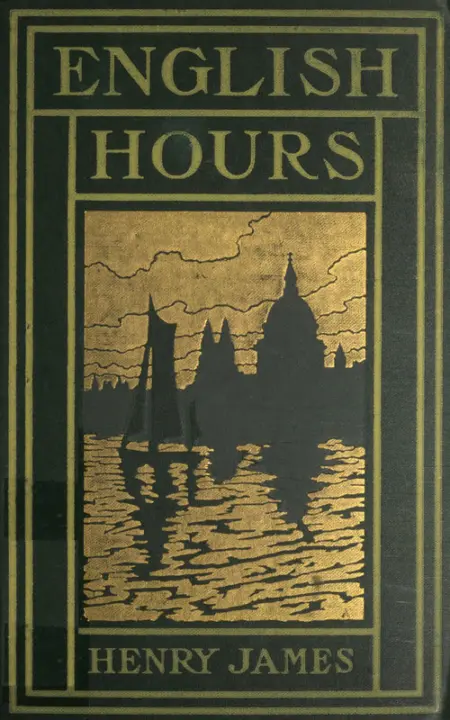
"English Hours" by Henry James is a collection of travel essays published in 1905. Drawing from more than thirty years of writing about England, James chronicles his experiences in his adopted country, from London's "greasy" streets to the pastoral countryside of Devon, Warwickshire, and Suffolk. With knowing affection, he captures both the "dreadful, delightful" British capital and the quiet charms of rural towns like Rye, offering readers an intimate portrait of Victorian and Edwardian England through American eyes.
Introduction adapted from the source catalogue; source summaries may be automatically generated.
Free to read · English · 76,282 words · No account needed
MAKE TIME FOR A GOOD BOOK
On by default. Untick to stop anonymous reading totals. Each page counts after 10 seconds in view. How this works.
Anonymous counting is on unless you have switched it off.
Johnson, Samuel, first glimpse of Temple Bar, 79;
birthplace, 78-83.
Jones, Inigo, 167.
Kenilworth, 198-201.
Kensington Gardens, enchanting vista in, 18.
Kingsley, Charles, discourse at Chester, 74, 75.
Lichfield, Dr. Johnson’s birth-house, 78;
cathedral, 79-83;
Haddon Hall, 83-87;
Chatsworth, 87.
Liverpool, first impression of, 2, 3, 5;
journey from, to London, 3-5.
London, first impressions of, 1, 4, 7, 8;
St. Paul’s, 4;
Morley’s Hotel, 4, 5;
Temple Bar, 5;
Ludgate Hill, 6;
Strand, 6, 7;
Charing Cross, 7;
Piccadilly, 7, 8;
its immensity an advantage, 8-13;
creeds and coteries, 11;
home of human race, 13;
headquarters of English speech, 14;
absence of style, 15;
accident of style replaces intention, 16, 17;
parks, 16-25;
rural impressions, 18, 19;
rustic walk from Notting Hill to Whitehall, 18-25;
Hyde Park, 19-22;
Hyde Park Corner, 20;
Grosvenor Place 21;
Apsley House, 20, 21;
Green Park, 21-23;
Buckingham Palace, 21-23;
levelling tendencies of London life, 25-28;
beautiful women the great admiration, 28;
liberal hospitality, 29;
cultivation of the abrupt, 29, 30;
lights and shades, 31-36, 134;
holidays, 34;
railway stations, 37, 38;
bookstalls, 38, 39;
Thames River, 40-43;
Hampstead, 43, 44;
Kensington, 44;
the Season, 45-51;
Easter exodus, 126-128;
Passion Week, 130-138;
architectural ugliness, 133, 134;
people of the slums, 137;
proletariat funeral, 138-141;
the Tower, 142, 143;
dog-days in, 153-161;
no “public fund” of amusement, 157-159;
tramps, 160, 161;
convivial gatherings, 162-164.
Ludgate Hill, 6.
Ludlow, a charming old town, 240;
provincial society at, 241-243.
Lynton, 102-104.
Mayfair, mind of, residences of, 15, 16.
“Middlemarch,” locality of, 216, 217.
“Mill on the Floss,” retrospective pictures in, 65.
Milton, John, 14.
Monmouthshire, April in, 245, 246;
the Skirrid, 246, 247;
Abergavenny, 247;
a mediæval church, 247-249;
feudal manors, 249, 250.
Newmarket Heath, 265, 266.
Notting Hill, rustic walk to Whitehall, 18-25.
North Devon, 93-105;
Exeter Cathedral, 95-97;
beauties of Ilfracombe, 97-101;
Lynton, 102-104;
Somerset, 104, 105.
Odger, George, radical agitator, his funeral, 138-141.
“Oliver Twist,” visit to a workhouse recalls, 274.
Oxford, 41;
at Commemoration, 189-196;
typifies union of science and sense, 261;
Trinity College, 261-264.
“Pall Mall Gazette,” 176.
Pall Mall, 32, 33.
Piccadilly, 7, 8, 14, 21;
funeral procession on, 130, 140;
the “White House,” 177.
Portsmouth, untidy and prosaic, 255, 256;
Nelson’s “Victory,” 256, 257.
“Punch,” 7.
Queen Anne, statue of, 6.
Rembrandt, pictures at Warwick Castle, 90.
Rochester, the Dickens country, 143-145;
Watts’s shelter, 144;
the cathedral, 145-147.
Ryde, 251.
Rye, locality of “Denis Duval,” 288-315;
old shipyards, 304, 306;
old gardens, 304-306;
haunt of artists, 306-308;
birthplace of Fletcher, 309;
landscape beauties, 313-315;
Romney Marsh, 314.
St. Leonards, 278, 285.
St. Paul’s, cathedral of, 4.
Salisbury, the cathedral, 117, 118;
Stonehenge, 118, 119;
Wilton House, 119, 120.
Scott, Sir Walter, 290;
locality of “Woodstock,” 221, 222.
Serpentine, bridge over, 17, 18.
Shakespeare, William, 14;
Warwickshire his country, 88, 213, 214;
his clowns, 201;
Dame Quickly’s ale-house identified, 201;
a garden setting for his comedies, 216.
Shanklin, 254.
“Sir Roger de Coverley,” visualized at Porlock, 105.
Skirrid, the, 246, 247.
Somerset, 104, 105.
Stokesay, 236;
the castle, 237-240.
Stonehenge, 118, 119.
Strand, first walk in, 6;
Exeter Hall, 6, 7.
Stratford, 201;
ideal home for a scholar, 214;
a modern house in, 215.
Suffolk, locality of “David Copperfield,” 317-319;
Dunwich, 320-330;
Aldeburgh, 323, 324;
Wesselton, 325, 326.
Swinburne, Algernon Charles, 323.
Temple Bar, 5;
Dr. Johnson’s first glimpse, 79.
Thackeray, William Makepeace, locality of “Denis Duval,” 288-315;
“Lovel the Widower,” 288;
Adventures of Philip, 288;
“Henry Esmond,” 289;
“The Roundabout Papers,” 295, 296.
Your reading position is saved on this browser. Take it to another device with a library code. Reading pages adapt to text, rather than matching a printed edition.
Henry James
Henry James
Henry James

Henry James
BEHIND THE BOOK
This eBook is for the use of anyone anywhere in the United States and most other parts of the world at no cost and with almost no restrictions whatsoever. You may copy it, give it away or re-use it under the terms of the Project Gutenberg License included with this eBook or online at www.gutenberg.org. If you are not located in the United States, you will have to check the laws of the country where you are located before using this eBook. Read the source licence.
The original source file, including credits and licence, is retained by this library. Request an original-format copy at no charge. Please include the book title and Project Gutenberg identifier #58938.
KEEP YOUR CURIOSITY GOING
Wilfrid Scawen Blunt
Wilfrid Scawen Blunt

E. W. (Edgar Watson) Howe

David Patterson (Spirit) Hatch

David Patterson (Spirit) Hatch

David Patterson (Spirit) Hatch