Things to be Remembered in Daily Life With Personal Experiences and Recollections
John Timbs
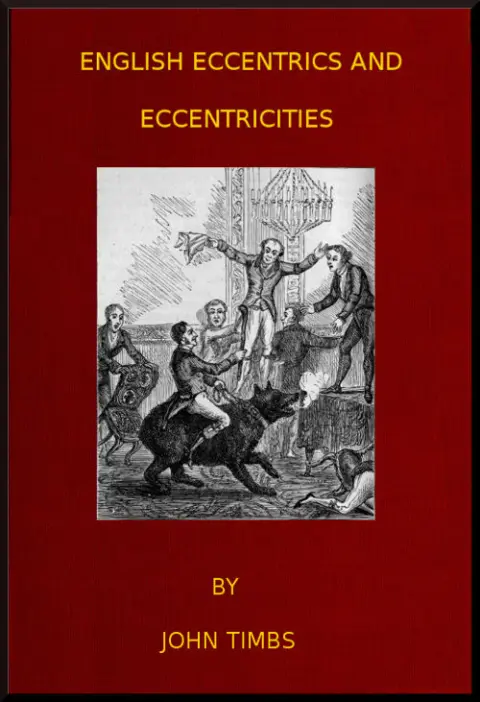
THE CLASSIC COLLECTION · 1866
"English Eccentrics and Eccentricities" by John Timbs is a biographical collection published in 1866. This two-volume work catalogues the lives of unusual people from the late 18th and early 19th centuries, ranging from celebrities to recluses, religious figures to astrologers, and authors to tragedians. Timbs explores how oddity of character can coexist with goodness of heart, presenting a gallery of "motley-minded and grotesque" individuals whose rare accidents offer lessons in both thrift and humor.
Introduction adapted from the source catalogue; source summaries may be automatically generated.
Free to read · English · 178,908 words · No account needed
MAKE TIME FOR A GOOD BOOK
On by default. Untick to stop anonymous reading totals. Each page counts after 10 seconds in view. How this works.
Anonymous counting is on unless you have switched it off.
By his second wife he had one son and two daughters. The son, William Joseph, a man of sound principle and excellent character, though less penurious than his father, who, when he entertained a friend at dinner in St. Mary Axe, used to walk to the butcher's and bring home a rump-steak in a cabbage-leaf in his pocket, was remarkable for his disinclination to detach even the smallest sum from his enormous capital. Thus, when the nephew to whom he bequeathed 85,000l. per annum, fell into railway difficulties (the speculation having been undertaken with the sanction of his uncle), he permitted him, to avoid legal proceedings, to withdraw to Boulogne-sur-Mer, and reside there a twelvemonth with his young family, rather than pay for him the sum of 2,000l.
Mr. Denison, the father, died in 1806; his son, succeeding to the banking business (the firm being now Denison, Heywood, and Kennard), continued to accumulate; and at his death, in 1849, he left two millions and a half of money. He had sat in Parliament for Surrey since 1818. He was a man of cultivated tastes, and possessed a knowledge of art and elegant literature. He feared to be thought ostentatious, and could with difficulty be prevailed on to have a lodge erected at the entrance to a new road which he had just formed on his estate in Surrey.
Mr. Denison's two sisters were Elizabeth, married, in 1794, to Henry, first Marquis Conyngham; and Maria, married, in 1793, to Sir Robert Lawley, Bart., created, in 1831, Baron Wenlock. Up to the age of twenty-seven, Miss Denison resided with her father in St. Mary Axe. Here the rich and beautiful heiress was won and wedded in 1794 by the Honourable Henry Burton, then a captain, twenty-eight years old, and the eldest son of the fortunate Francis Pierpoint Burton, of Buncraggy, who succeeded through his mother, after the death of her two brothers, to the barony and estates of the old Conynghams, won at the battle of the Boyne by Sir Albert Conyngham, Lieutenant-General of the Ordnance of Ireland, and aggrandized by many forfeitures and marriages subsequently. Captain Burton carried off his wife to Ireland, and only revisited England in his forty-second year, to kiss hands, in 1808, on his promotion to a major-generalship. On succeeding to his father's title and estates, his lordship so improved their condition that he was justly regarded as one of the benefactors of his country; and a visit to his estate at Slane, on the banks of the Boyne, is recorded by Mr. Parkinson in his Experiences of Agriculture in the same terms as a visit to Holkham would have been chronicled in the days of Mr. Coke. The barony of Conyngham was increased to an earldom as a reward for the spirited conduct of his lordship's father, which led to a reciprocity of trade between Ireland and England. Upon the conclusion of the war with France, when George IV. paid a visit to Ireland, he was hospitably received and entertained at Slane Castle. Here, probably, commenced that more intimate acquaintance between His Majesty and the Marquis Conyngham and his family which induced the King, upon his return to England, to invite the whole family to court, and, after they had accepted the invitation, to retain them in his household. In 1816 his lordship was created Viscount Slane (the restoration of an ancient title forfeited in the Rebellion), Earl of Mountcharles, and Marquis Conyngham; and in 1821 he was enrolled in the British Peerage as Baron Minster, of Minster Abbey, in the county of Kent. The Marchioness was left a widow in 1832, and survived until 1861, having attained the venerable age of ninety-two, and lived to see both her sons peers of the realm--the one in succession of his father; the second, Albert Denison, as the heir to her own father's great fortune and estates, with the title of Baron Londesborough.
Your reading position is saved on this browser. Take it to another device with a library code. Reading pages adapt to text, rather than matching a printed edition.
John Timbs
John Timbs
John Timbs
John Timbs
BEHIND THE BOOK
This eBook is for the use of anyone anywhere in the United States and most other parts of the world at no cost and with almost no restrictions whatsoever. You may copy it, give it away or re-use it under the terms of the Project Gutenberg License included with this eBook or online at www.gutenberg.org. If you are not located in the United States, you will have to check the laws of the country where you are located before using this eBook. Read the source licence.
The original source file, including credits and licence, is retained by this library. Request an original-format copy at no charge. Please include the book title and Project Gutenberg identifier #50439.
KEEP YOUR CURIOSITY GOING

Charles G. (Charles Griffith) Ross
Hannah Webster Foster

Emily Lawless
Edwin Hamlin Carr

Charles De Lano Hine
Andrew Ure