Things to be Remembered in Daily Life With Personal Experiences and Recollections
John Timbs
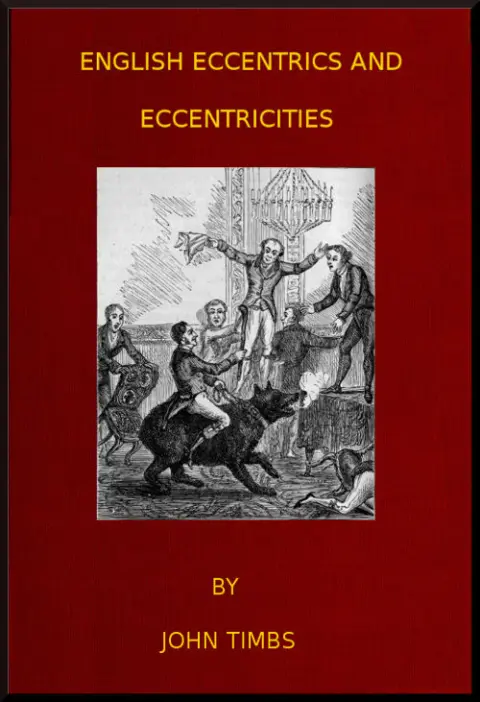
THE CLASSIC COLLECTION · 1866
"English Eccentrics and Eccentricities" by John Timbs is a biographical collection published in 1866. This two-volume work catalogues the lives of unusual people from the late 18th and early 19th centuries, ranging from celebrities to recluses, religious figures to astrologers, and authors to tragedians. Timbs explores how oddity of character can coexist with goodness of heart, presenting a gallery of "motley-minded and grotesque" individuals whose rare accidents offer lessons in both thrift and humor.
Introduction adapted from the source catalogue; source summaries may be automatically generated.
Free to read · English · 178,908 words · No account needed
MAKE TIME FOR A GOOD BOOK
On by default. Untick to stop anonymous reading totals. Each page counts after 10 seconds in view. How this works.
Anonymous counting is on unless you have switched it off.
It was on the morning after Dr. Raven's mad freak that Sir Edward Dering presented himself as a suitor. How he commenced this important enterprise, and how he sped, we learn from a minute journal which he kept of his proceedings, and which he did not afterwards think it necessary to burn. Here are a few entries. Thus begins the journal:--
Nov. 20. Edmund, King. I adventured, was denied. Sent up a letter, which was returned, after she had read it.
This repulse rendered it necessary to resort to crooked means. Servants are corruptible, and so we find--
Nov. 21. I inveigled G. Newman with 20s.
Nov. 24. I did re-engage him, 20s. I did also oil the cash-keeper,
20s.
Nov. 26. I gave Edmund Aspull [the cash-keeper] another 20s. I was
there, but denied sight.
Unpromising this, but Sir Edward does not lose courage.
Nov. 27. I sent a second letter, which was kept.
There is hope, then, but we must not relax. Same day.
I set Sir John Skeffington upon Matthew Cradock.
Matthew Cradock is a cousin of the widow, and her trusty adviser. Same
day.
The cash-keeper supped with me.
Nov. 28. I went to Mr. Cradock, but found him cold.
Sir John Skeffington could not have exerted himself much.
Nov. 29. I was at the Old Jewry Church and saw her, both forenoon and
afternoon.
Dec. 1. I sent a third letter, which was likewise kept.
The widow had a troublesome affair on her hands. It appears that one Steward, under the abominable system of wardships which then prevailed, had obtained a grant from the crown of the wardship of Mrs. Bennett's little boy, then four years old. The widow was in treaty with Steward to buy from him the wardship of her own child, which the rogue refused to release for 1,500l., offered him in hard cash. Between this affair, and Dr. Raven and other suitors, the widow had enough to think of. Steward had also made matrimonial proposals, which Mrs. Bennett deemed it not prudent to cut short at once, while the bargaining for the wardship was going on. On the 5th December Sir Edward communicates with one Loe, an influential person with the widow. Loe answers, "that Steward was so testy that she durst not give admittance unto any, until he and she were fully concluded for the wardship--that she had a good opinion of me--that he (Loe) heard nobly of me--that he would inform me when Steward was off--that he was engaged for another--that I need not refrain from going to the church where she was, unless I thought it to disparage myself." Acting on this advice, Sir Edward goes to St. Olave's next Sunday, and on coming out of church George Newman whispers in his ear, "Good news! Good news!" After dinner George calls on Sir Edward, who had taken a lodging in the sight of the widow's house, and tells him that she "liked well his carriage, and that if his land were not settled on his eldest son there was good hope." The bearer of such news certainly merits oiling, so, Sir Edward says, "I gave him twenty shillings." That evening Sir Edward supped with his rival, Sir Heneage Finch, who gave him to understand that he himself despaired of his own suit, and was ready to vacate the field, and even promised to assist the worthy knight.
Your reading position is saved on this browser. Take it to another device with a library code. Reading pages adapt to text, rather than matching a printed edition.
John Timbs
John Timbs
John Timbs
John Timbs
BEHIND THE BOOK
This eBook is for the use of anyone anywhere in the United States and most other parts of the world at no cost and with almost no restrictions whatsoever. You may copy it, give it away or re-use it under the terms of the Project Gutenberg License included with this eBook or online at www.gutenberg.org. If you are not located in the United States, you will have to check the laws of the country where you are located before using this eBook. Read the source licence.
The original source file, including credits and licence, is retained by this library. Request an original-format copy at no charge. Please include the book title and Project Gutenberg identifier #50439.
KEEP YOUR CURIOSITY GOING

Charles G. (Charles Griffith) Ross
Hannah Webster Foster

Emily Lawless
Edwin Hamlin Carr

Charles De Lano Hine
Andrew Ure