Things to be Remembered in Daily Life With Personal Experiences and Recollections
John Timbs
THE CLASSIC COLLECTION · 1866
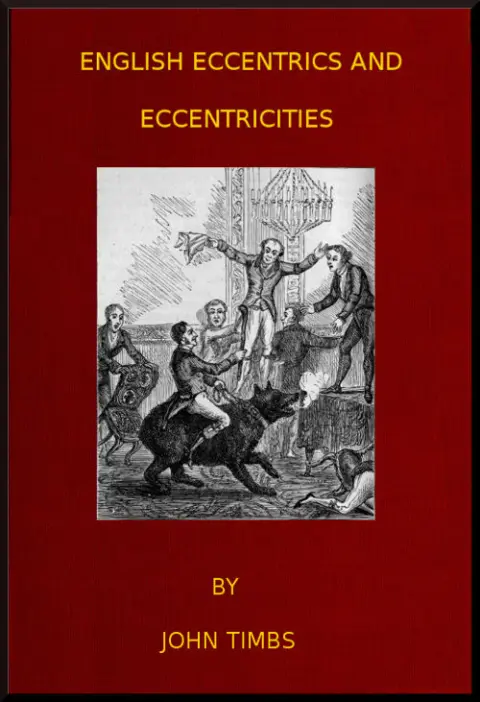
"English Eccentrics and Eccentricities" by John Timbs is a biographical collection published in 1866. This two-volume work catalogues the lives of unusual people from the late 18th and early 19th centuries, ranging from celebrities to recluses, religious figures to astrologers, and authors to tragedians. Timbs explores how oddity of character can coexist with goodness of heart, presenting a gallery of "motley-minded and grotesque" individuals whose rare accidents offer lessons in both thrift and humor.
Introduction adapted from the source catalogue; source summaries may be automatically generated.
Free to read · English · 178,908 words · No account needed
MAKE TIME FOR A GOOD BOOK
On by default. Untick to stop anonymous reading totals. Each page counts after 10 seconds in view. How this works.
Anonymous counting is on unless you have switched it off.
True to the Text.
A curious instance of this occurred many years ago, at the termination of the tragedy of Richard the Third. Mr. Elliston was enacting the part of Richmond; and having, during the evening, disobeyed the injunction which the King of Denmark lays down to the Queen, "Gertrude, do not drink," he accosted Mr. Powell, who was personating Lord Stanley (for the safety of whose son Richmond is naturally anxious), THUS, on his entry, after the issue of the battle:--
Elliston (as Richmond). Your son, George Stanley, is he dead?
Powell (as Lord Stanley). He is, my Lord, and safe in Leicester
town!
Elliston (as Richmond). I mean--ah!--is he missing?
Powell (as Lord Stanley). He is, my Lord, and safe in Leicester
town!!
And it is but justice to the memory of this punctilious veteran, to say that he would have made the same reply to any question which could, at that particular moment, have been put to him.
Monk Lewis
"Hail! wonder-working Lewis."
This early lover of rhymes and numbers, and "flashes of merriment that were wont to set the table on a roar," was, in his boyhood, more remarkable for his love of theatrical exhibitions than for his love of learning. He read books on Witchcraft when a child, and published his marvellous story of the Monk when in his twenty-second year; it contains his best poetry as well as prose. In the midst of this celebrity, being one autumn on his way to a fashionable watering-place, he stayed a night in a country-town and witnessed a performance by a company of strolling players. Among them was a young actress, whose benefit was on the tapis, and who, hearing of the arrival of a person so talked of as Monk Lewis, waited upon him at the inn to request the very trifling favour of an original piece from his pen. The lady pleaded in terms that urged the spirit of benevolence to advocate her cause in a heart never closed to such an appeal. Lewis had by him at that time an unpublished trifle, called The Hindoo Bride, in which a widow was immolated on the funeral pile of her husband. The subject was one well suited to attract a country audience, and he determined thus to appropriate the drama. The delighted suppliant departed all joy and gratitude at being requested to call for the manuscript the next day. Lewis, however, soon discovered that he had been reckoning without his host, for, on searching his travelling-desk, which contained many of his papers, the Bride was nowhere to be found, having, in fact, been left behind in town. Exceedingly annoyed by this circumstance, which there was no time to remedy, the dramatist took a pondering stroll in the rural environs, when a sudden shower compelled him to take refuge in a huckster's shop, where he overheard, in the adjoining apartment, two voices in earnest conversation, and in one of them recognized that of his theatrical petitioner of the morning, apparently replying to the feeble tones of age and infirmity. "There now, mother, always that old story--when I've brought such good news, too--after I've had the face to call on Mr. Monk Lewis, and found him so different to what I expected; so good-humoured, so affable, and willing to assist me. I did not say a word about you, mother; for though in some respects it might have done good, I thought it would seem like a begging affair, so I merely represented my late ill-success, and he promised to give me an original drama which he had with him for my benefit. I hope he did not think me too bold." "I hope not, Jane," replied the feeble voice; "only don't do these things again without consulting me; for you don't know the world, and it may be thought----" The sun then just gave a broad hint that the shower had ceased, and the sympathizing author returned to his inn, and having penned the following letter, ordered post-horses and despatched a porter to the young actress with this epistle:--
Your reading position is saved on this browser. Take it to another device with a library code. Reading pages adapt to text, rather than matching a printed edition.
John Timbs
John Timbs
John Timbs
John Timbs
BEHIND THE BOOK
This eBook is for the use of anyone anywhere in the United States and most other parts of the world at no cost and with almost no restrictions whatsoever. You may copy it, give it away or re-use it under the terms of the Project Gutenberg License included with this eBook or online at www.gutenberg.org. If you are not located in the United States, you will have to check the laws of the country where you are located before using this eBook. Read the source licence.
The original source file, including credits and licence, is retained by this library. Request an original-format copy at no charge. Please include the book title and Project Gutenberg identifier #50439.
KEEP YOUR CURIOSITY GOING

Charles G. (Charles Griffith) Ross
Hannah Webster Foster

Emily Lawless
Edwin Hamlin Carr

Charles De Lano Hine
Andrew Ure