THE CLASSIC COLLECTION✦With Zola in England: A Story of ExileCLASSIC FREE BOOKS
With Zola in England: A Story of Exile
Ernest Alfred Vizetelly
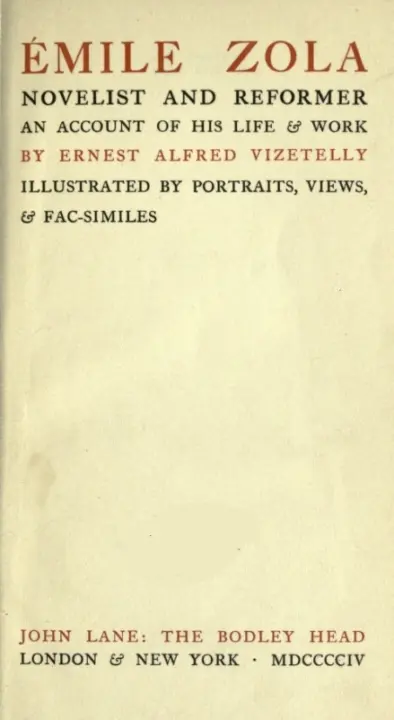
THE CLASSIC COLLECTION · 1904
"Émile Zola, Novelist and Reformer: An Account of His Life & Work" by Ernest Alfred Vizetelly is a biographical account written in the early 20th century. This work delves into the significant life events and achievements of the influential French novelist Émile Zola, highlighting his relentless commitment to social reform and the literary contributions that marked his career. The book aims to provide insights into Zola's motivations and the context in which he worked, revealing how his dual identity as a novelist and a reformer shaped his legacy. At the start of the biography, the author introduces the Zola family background, including François Zola's career as an engineer and the family's struggles, particularly after François's untimely death. It discusses Émile Zola's early childhood in Paris, the influence of his father's engineering ambitions, and hints at the hardships faced by his mother, Françoise Émilie Zola. This beginning sets a tone of familial pride and struggle, establishing the context for the development of Émile Zola's character as a prominent figure in literature and social justice. The narrative talks about his birth, early years, and the environment that nurtured his later motivations as a writer and social critic.
Introduction adapted from the source catalogue; source summaries may be automatically generated.
Free to read · English · 163,641 words · No account needed
MAKE TIME FOR A GOOD BOOK
On by default. Untick to stop anonymous reading totals. Each page counts after 10 seconds in view. How this works.
Anonymous counting is on unless you have switched it off.
[12] See ante, p. 30.
[13] Notably with regard to the publication of that extraordinary
romance, "L'Homme qui Rit," for which Lacroix paid much more than its
value.
[14] The Parnassians, who were brought together by Xavier de Ricard, dated from about 1860. The first series of "Le Parnasse contemporain" was issued by Lemerre in 1866.
[15] "The Adventures of my Life," by Henri Rochefort, English edition, London, 1896, Vol. I, p. 206.
[16] His brother, Charles Vacquerie, after marrying the poet's
daughter, Léopoldine Hugo, had been drowned with her off Villequier, in
1843.
[17] This was perhaps due to the circumstance that Glais-Bizoin, the enfant terrible of the Republican opposition in the Corps Législatif, played the chief part in the directorship of the paper, the latter's better features being imparted to it by his co-editor, the scholarly Eugène Pelletan. It was run chiefly in view of the 1869 elections and Zola subsequently remarked that excepting himself and the office boy every member of its staff was a parliamentary candidate.
[18] "Journal des Goncourt," Vol V, p. 150 (November 13, 1874).
[19] "Papiers et Correspondance de la Famille Impériale," Paris,
Imprimerie Nationale, 1870.
[20] See ante, p. 100.
[21] "L'Œuvre," p. 208.
[22] "L'Œuvre," p. 251. Alexis, p. 91.
[23] "Le Gaulois," March 26, 1869.
[24] The "Blowitz Memoirs" (London, 1903) give an erroneous version of this story, transferring the scene to the Quai d'Orsay, in Paris, and making Cavalié secretary to Paschal Grousset, "Delegate for Foreign Affairs" of the Commune of 1871. As Lord Lyons was not then in Paris, that version is obviously wrong. The incident, which the ambassador himself narrated more than once in after years, really occurred at Tours late in 1870, Cavalie's words being: "Dites donc, mon vieux, il ne faut pas se faire de bile, au sujet du patron. Allons plutôt prendre in bon bock!" Cavalié was a notorious bohemian, worthy of Murger; he had been one of the leaders of the cabal against the Goncourts' play, "Henriette Maréchal."
[25] Alexis, l. c., p. 173.
[26] This was a crisis provoked by Thiers' Presidential Message of November 13, 1872, by which he asked for the definite constitution of a Republic, a proposal which led to a great outcry on the part of those who wished to place the Count de Chambord or the Count de Paris on the throne.
[27] See "Souvenirs; XIV," in the "Nouveaux Contes à Ninon."
[28] "La Fortune des Rougon," Librairie Internationale. 1st and 2d editions: 1871, 389 pages, 18mo, 3 francs; 3d edition, Charpentier, 1872, 385 pages, 18mo, 3 francs 50 centimes. Thirty-eighth thousand on sale in 1903.
[29] "La Curée," Librairie Internationale; 1st edition: covers dated 1872, title-pages, 1871, 360 pages, 18mo, 3 francs; 2d edition, Charpentier, 1872, 354 pages, 18mo, 3 francs 50 centimes; 5th edition, 360 pages, 1876; fiftieth thousand on sale in 1903.
[30] M. Adolphe Brisson in "Le Temps," October 3, 1902.
[31] All that the author retained was the dramatic rights.
[32] About $1,200.
Your reading position is saved on this browser. Take it to another device with a library code. Reading pages adapt to text, rather than matching a printed edition.
Ernest Alfred Vizetelly
Ernest Alfred Vizetelly
BEHIND THE BOOK
This eBook is for the use of anyone anywhere in the United States and most other parts of the world at no cost and with almost no restrictions whatsoever. You may copy it, give it away or re-use it under the terms of the Project Gutenberg License included with this eBook or online at www.gutenberg.org. If you are not located in the United States, you will have to check the laws of the country where you are located before using this eBook. Read the source licence.
The original source file, including credits and licence, is retained by this library. Request an original-format copy at no charge. Please include the book title and Project Gutenberg identifier #57546.
KEEP YOUR CURIOSITY GOING

Charles G. (Charles Griffith) Ross
Hannah Webster Foster

Emily Lawless
Edwin Hamlin Carr

Charles De Lano Hine
Andrew Ure