THE CLASSIC COLLECTION✦With Zola in England: A Story of ExileCLASSIC FREE BOOKS
With Zola in England: A Story of Exile
Ernest Alfred Vizetelly
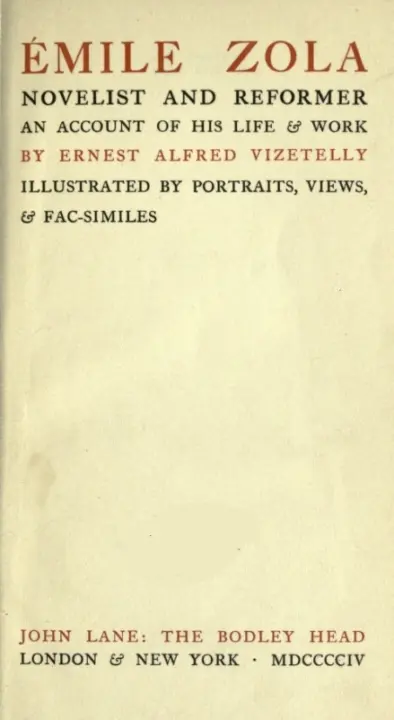
THE CLASSIC COLLECTION · 1904
"Émile Zola, Novelist and Reformer: An Account of His Life & Work" by Ernest Alfred Vizetelly is a biographical account written in the early 20th century. This work delves into the significant life events and achievements of the influential French novelist Émile Zola, highlighting his relentless commitment to social reform and the literary contributions that marked his career. The book aims to provide insights into Zola's motivations and the context in which he worked, revealing how his dual identity as a novelist and a reformer shaped his legacy. At the start of the biography, the author introduces the Zola family background, including François Zola's career as an engineer and the family's struggles, particularly after François's untimely death. It discusses Émile Zola's early childhood in Paris, the influence of his father's engineering ambitions, and hints at the hardships faced by his mother, Françoise Émilie Zola. This beginning sets a tone of familial pride and struggle, establishing the context for the development of Émile Zola's character as a prominent figure in literature and social justice. The narrative talks about his birth, early years, and the environment that nurtured his later motivations as a writer and social critic.
Introduction adapted from the source catalogue; source summaries may be automatically generated.
Free to read · English · 163,641 words · No account needed
MAKE TIME FOR A GOOD BOOK
On by default. Untick to stop anonymous reading totals. Each page counts after 10 seconds in view. How this works.
Anonymous counting is on unless you have switched it off.
"My dear friend," said he, "I do not wish to rob you. I do not want to derive more than my usual profits from your work. I have lately had an account of your sales drawn up on the basis of an author's royalty of forty centimes per volume,[33] and according to this account, it is not you who owe me money, it is I who owe you some ten thousand francs. Here is our agreement, I tear it up, and all you have to do is to see my cashier."
As Alexis remarks, after telling this story, what other publisher would have done such a thing? In Zola's case it raised him from modest circumstances to affluence. Had the original contract remained in force he would have earned, inclusive of the earlier payments from Lacroix, no more than forty thousand francs by the first twelve volumes of his "Rougon-Macquart" series. At least he would have earned no more during the first ten years of their circulation. But thanks to M. Charpentier's generous honesty,--the successive increase, too, of Zola's royalty from forty to fifty and sixty centimes per volume, the various sums accruing from special issues, illustrated editions, popular editions, éditions de luxe, serial rights and translation rights--all of which, under the agreement, would have belonged to the publisher--he earned by those twelve books fully twenty times the amount of money he had covenanted to take for them.
That said, it is as well to return to the year 1872, and show how, his long spell of absolute ill-luck ceasing, Zola, while still encountering much hostility, which presently was to grow into a furious storm, gradually advanced along the path of success, assisted by literature's handmaiden, journalism, and cheered by the friendship of some of the foremost men of letters of his time.
[1] "Lettres de Jules de Goncourt," etc., Paris, 1885, p. 219. (Letter
dated February 27, 1865.)
[2] "Lettres de Jules de Goncourt," p. 273 (February 5, 1868).
[3] "Journal des Goncourt," Paris, 1888, 1ère Série, Vol. III.
[4] "Lettres de Jules de Goncourt." See those of January 10, January
17, and April 10, 1869.
[5] "Journal des Goncourt," Vol III, p. 245 et seq.
[6] "Journal des Goncourt," Vol. IV, p. 15.
[7] "La Tribune," October, 1869.
[8] "Traité philosophique et physiologique de l'Hérédité Naturelle dans les états de santé et de maladie du Système Nerveux," Paris, 1847-1850, 2 vols. 8vo.
[9] This tree was subsequently inserted at the beginning of "Une Page d'Amour," 1878 et seq. The leaves bear the names of twenty-six characters. But the series expanded, and with its last volume, "Le Docteur Pascal," 1893, a new genealogical tree was issued giving six more names.
[10] That was then the usual price of a French novel. The rise to 3 francs 50 centimes took place after the War of 1870.
[11] £240, about $1,200.
Your reading position is saved on this browser. Take it to another device with a library code. Reading pages adapt to text, rather than matching a printed edition.
Ernest Alfred Vizetelly
Ernest Alfred Vizetelly
BEHIND THE BOOK
This eBook is for the use of anyone anywhere in the United States and most other parts of the world at no cost and with almost no restrictions whatsoever. You may copy it, give it away or re-use it under the terms of the Project Gutenberg License included with this eBook or online at www.gutenberg.org. If you are not located in the United States, you will have to check the laws of the country where you are located before using this eBook. Read the source licence.
The original source file, including credits and licence, is retained by this library. Request an original-format copy at no charge. Please include the book title and Project Gutenberg identifier #57546.
KEEP YOUR CURIOSITY GOING

Charles G. (Charles Griffith) Ross
Hannah Webster Foster

Emily Lawless
Edwin Hamlin Carr

Charles De Lano Hine
Andrew Ure