THE CLASSIC COLLECTION✦An outlaw’s diary: the CommuneCLASSIC FREE BOOKS
An outlaw’s diary: the Commune
Cécile Tormay
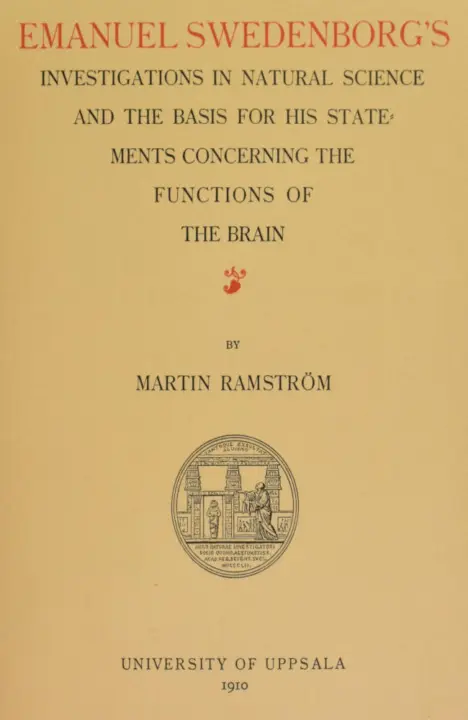
THE CLASSIC COLLECTION · 1910
"Emanuel Swedenborg's Investigations in Natural Science and the Basis for His Statements Concerning the Functions of the Brain" by Martin Ramström is a scientific publication written in the early 20th century. This work delves into the extensive contributions of Emanuel Swedenborg, exploring his investigations across various fields of natural science, particularly focusing on his groundbreaking insights into anatomy and the functions of the brain. The text highlights Swedenborg's multifaceted approach to science, emphasizing both his theoretical advancements and practical applications. The opening of this scholarly work sets the stage for a comprehensive examination of Swedenborg's scientific legacy, noting his growing interest in natural sciences beyond his well-known theological writings. It outlines the admiration for Swedenborg's wide-ranging investigations, mentioning various accolades from contemporaries in fields such as anatomy, geology, and cosmology. Furthermore, it introduces topics that will be unpacked in greater depth, such as Swedenborg's pioneering ideas on the connections between brain functions and sensory experiences, hinting at his theories on localization within the brain, which were ahead of his time.
Introduction adapted from the source catalogue; source summaries may be automatically generated.
Free to read · English · 18,098 words · No account needed
MAKE TIME FOR A GOOD BOOK
On by default. Untick to stop anonymous reading totals. Each page counts after 10 seconds in view. How this works.
Anonymous counting is on unless you have switched it off.
[72] ›Nempe in sensorio communi distinctas loco provincias esse pro diversis sensibus, uti cuilibet sensui suum externum proprium organum datum est.› BOERHAAVE: ›Prael. acad.›, published by HALLER 1743, Vol. IV., p. 435. See also BOERHAAVE: ›Inst. med.›, 1720, No. 568.
[73] These lobes are, as he says, ›marked out and encompassed by the carotid artery, a statement by which he probably means the same as RIDLEY, when the latter says of the whole anterior region that it is marked out, as it were, by two branches of the carotid artery, one at the front and one at the side, i. e., Arteria cerebri anterior and Arteria cerebri media.
[74] J. J. WEPFER: ›Observationes anatomicæ ex cadaveribus eorum, quos sustulit Apoplexia›. Amstelædami, 1681, pp. 5-11, Case II.
[75] See A. PACCHIONI: ›Opera›, Ed. quarta, Romæ, 1741, p. 112.
[76] See J. B. WINSLOW: ›Exposition anatomique de la Structure du corps humain.› Paris, 1732, IV., p. 210. With WILLIS one also finds the same subdivision of the hemispheres of the brain into an anterior and a posterior ›province›, as that employed by SWEDENBORG.
[77] VIEUSSENS: ›Neur. univ.›, pp. 115, 117, and Tab. X.
[78] Op. cit., pp. 115, 117, and Tab. XVI.
[79] Op. cit., pp. 115, 117 and Tab. XV.
[80] Œc. R. A. II., No. 153: ›Experientiae est et temporis, ut evestigetur, qui gyrus et qui serpens tumulus in cerebro hunc aut illum musculum ut correspondentem suum in corpore respiciat. ’Cuniculos cerebri serpere, per autopsiam deprehenditur’ ait Clar. PACCHIONUS, BELLINUS et alii plures.›
[81] See MALPIGHI: ›Op. omnia›, II., De Cerebro, p. 2, and SWEDENBORG: Œc. R. A., II., Nos. 82, 58, etc.
[82] MALPIGHI: ›Opera omnia›, 1686-87, II., De Cerebri cortice, p. 78, and SWEDENBORG: Œc. R. A., II., Nos. 76-82, 112, 114, etc.
[83] MALPIGHI: Op. cit. p. 78: ›Harum glandularum distinctionem affuso atramento (ink) et leviter gossypio deterso, videbis, intercepta enim spatia ita denigrantur, ut circumscriptas glandulas facilius exhibeant.› See also Œc. R. A. No. 76.
[84] MALPIGHI: Op. cit., p. 79: ›Corticales hae glandulae tortuose locatae exteriores cerebri gyros componunt, et exorientibus inde medullaribus fibris seu vasculis appenduntur›. See also Œc. R. A., II., No. 76.
[85] See Œc. R. A., II., No. 191: ›Quod sensationes externæ non ad ulteriores metas quam ad sphaerulas corticales pertingant, id satis in confirmato est, quando hae fibrarum nervearum et medullarium sunt principia, ultra quae si progrederentur, ut si in arteriolas aut meninges, tunc praescriptos terminos superscanderent et a centris in remotiores peripherias se conjicerent.›
Your reading position is saved on this browser. Take it to another device with a library code. Reading pages adapt to text, rather than matching a printed edition.
BEHIND THE BOOK
This eBook is for the use of anyone anywhere in the United States and most other parts of the world at no cost and with almost no restrictions whatsoever. You may copy it, give it away or re-use it under the terms of the Project Gutenberg License included with this eBook or online at www.gutenberg.org. If you are not located in the United States, you will have to check the laws of the country where you are located before using this eBook. Read the source licence.
The original source file, including credits and licence, is retained by this library. Request an original-format copy at no charge. Please include the book title and Project Gutenberg identifier #63033.
KEEP YOUR CURIOSITY GOING
Cécile Tormay

Moritz Busch
John L. Ransom
Frances Wright
Cécile Tormay

Mabel Potter Daggett