
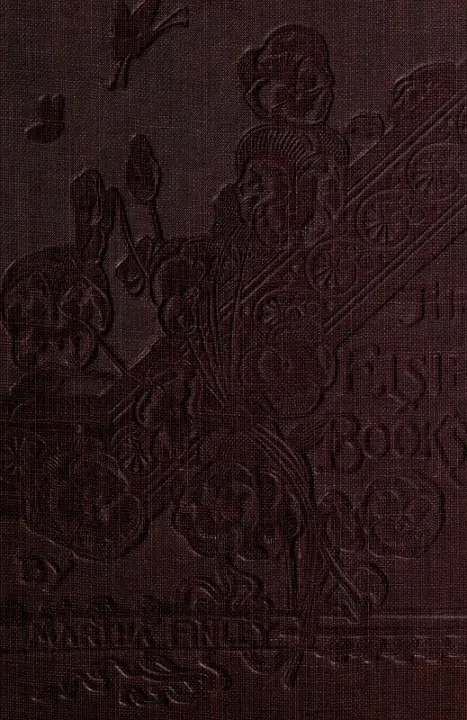
Elsie’s Friends at Woodburn
Martha Finley

THE CLASSIC COLLECTION · 1889
"Elsie and the Raymonds" by Martha Finley is a novel written in the late 19th century. The story revolves around the charitable and kind-hearted main character, Lulu Raymond, who, along with her brother Max, encounters a seamstress in need and embarks on a journey to assist her. The book explores themes of generosity, family values, and social care through the experiences of the Raymonds as they interact with various members of their community. The opening of the novel introduces Lulu and Max as they leave their home to go shopping, where they meet Susan Allen, a poor girl seeking work to support her sick mother. Moved by Susan's plight, Lulu decides to help her find sewing work and goes further by purchasing groceries for Susan's mother. As the siblings navigate this new encounter, it establishes the warmth of their family life and sets the tone for the community-driven support and kindness that will unfold throughout the story. The narrative hints at the underlying social commentary on poverty and the importance of compassion in human relationships.
Introduction adapted from the source catalogue; source summaries may be automatically generated.
Free to read · English · 71,547 words · No account needed
MAKE TIME FOR A GOOD BOOK
On by default. Untick to stop anonymous reading totals. Each page counts after 10 seconds in view. How this works.
Anonymous counting is on unless you have switched it off.
“I will, sir,” she replied, taking the letter and hurrying from the
room with it.
A few minutes later a boy who looked to be two or three years younger than Marian came briskly in and, laying a handful of letters on the table beside the captain, said, “Several for you, sir, and one apiece for Master and Miss. And the one I took for you is gone with the rest o’ the mail for the East.”
“I am much obliged,” the captain said, putting a dime into his hand.
The boy glanced down at it. “That’s too much, sir, by half, the errand wasn’t worth a nickel, and in fact I didn’t expect any pay for doing it.”
“Then take the dime as a gift, my boy; I like your honesty,” returned
the captain.
“Thank you, sir,” responded the lad heartily, and with a grin of satisfaction, as he turned and hastened away again.
“Papa, is there one for me?” asked Lulu, as her father took up the letters and glanced at the superscriptions.
“Yes, daughter; and one for Max. But as we have all finished eating we will go to our room to read them.”
The letters brought only good news; the dear ones left behind were all well, and, though missing the absentees, content and happy, at least so far as could be gathered from the cheerful tone of their epistles.
Lulu’s was the joint production of Eva and Grace, and gave an
interesting account of the doings and sayings of the babies and the
parrot.
The last-named, they said, was continually calling “Lu, Lu, what you ’bout? Where you been?”
The letter told, too, of the beautiful singing of Gracie’s canaries, the doings of her kitten, and of Max’s big dog Prince. There was more about the last-named in Max’s own letter, which was from Violet, with a postscript by Grace.
The captain read his letter from Violet, first to himself, then portions of it aloud to the children; then they offered him theirs, and he read them aloud in turn, and chatted pleasantly with them about the contents of all three.
“Well,” he said at length, “if we are going to take that walk, it is about time we were setting out. Lulu, you may put on your hat, while I glance over these other letters.”
That was a welcome order to the little girl, and it did not take her many minutes to obey it. They found Mr. Short on the pavement before the front gate as they went out.
Your reading position is saved on this browser. Take it to another device with a library code. Reading pages adapt to text, rather than matching a printed edition.
Martha Finley

Martha Finley

Martha Finley
Martha Finley
BEHIND THE BOOK
This eBook is for the use of anyone anywhere in the United States and most other parts of the world at no cost and with almost no restrictions whatsoever. You may copy it, give it away or re-use it under the terms of the Project Gutenberg License included with this eBook or online at www.gutenberg.org. If you are not located in the United States, you will have to check the laws of the country where you are located before using this eBook. Read the source licence.
The original source file, including credits and licence, is retained by this library. Request an original-format copy at no charge. Please include the book title and Project Gutenberg identifier #67184.
KEEP YOUR CURIOSITY GOING
Cécile Tormay

Moritz Busch
Coulson Kernahan
John L. Ransom

Maurice Baring
Frances Wright