
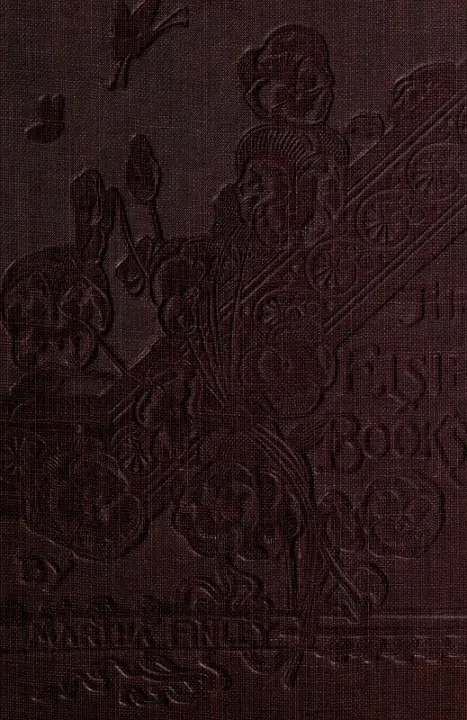
Elsie’s Friends at Woodburn
Martha Finley

THE CLASSIC COLLECTION · 1889
"Elsie and the Raymonds" by Martha Finley is a novel written in the late 19th century. The story revolves around the charitable and kind-hearted main character, Lulu Raymond, who, along with her brother Max, encounters a seamstress in need and embarks on a journey to assist her. The book explores themes of generosity, family values, and social care through the experiences of the Raymonds as they interact with various members of their community. The opening of the novel introduces Lulu and Max as they leave their home to go shopping, where they meet Susan Allen, a poor girl seeking work to support her sick mother. Moved by Susan's plight, Lulu decides to help her find sewing work and goes further by purchasing groceries for Susan's mother. As the siblings navigate this new encounter, it establishes the warmth of their family life and sets the tone for the community-driven support and kindness that will unfold throughout the story. The narrative hints at the underlying social commentary on poverty and the importance of compassion in human relationships.
Introduction adapted from the source catalogue; source summaries may be automatically generated.
Free to read · English · 71,547 words · No account needed
MAKE TIME FOR A GOOD BOOK
On by default. Untick to stop anonymous reading totals. Each page counts after 10 seconds in view. How this works.
Anonymous counting is on unless you have switched it off.
“Can’t we go to our own rooms now, papa?” asked Lulu, when their English friends had bidden good-night and gone.
“Yes,” he said, taking her hand and leading the way, Max following not
at all unwillingly.
“I suppose you want to finish your letter now, Lulu?” the captain said, as they entered his bedroom, which they made their sitting-room also when desirous of being quite to themselves.
“No, sir, I don’t. I’d rather let it wait till Monday, if I may sit on your knee a little while and have you talk to me.”
“Have me talk to you? or let you talk to me?” he asked with playful look and tone, as he sat down and drew her to the coveted place.
“Both, you dear papa,” she answered, putting her arms around his neck and giving him an ardent kiss.
“And am I to do nothing but listen?” asked Max, pulling forward a chair and seating himself close beside them.
“Just as you please, young man,” laughed his father; “but I doubt if you can refrain from putting in a word now and then.”
“He’s been talking ever so fast almost all the evening,” said Lulu; “only letting me have a word now and then.”
“Ah, indeed! I hope it has been good-humored and sensible talk?”
“Very sensible (I was quite proud of my brother)” replied Lulu, giving Max a laughing glance, “but I’m not so sure about the good-humor. I shouldn’t wonder if Albert Austin had made up his mind by this time that Max and I are not very partial to the English.”
“I hope you haven’t been rude to Albert, my children?” the captain said, with sudden gravity.
“I hope not, papa; I don’t think we were, though we stated a few historical facts—perhaps a little strongly,” replied Lulu.
“What were they?” he asked, “you may tell me about it if you like.”
They then repeated the substance of their conversation with Albert, their father listening with evident interest.
At the conclusion of the story, he said, “I think from your account that Albert showed much good temper and moderation in the way he bore your strictures on his country and countrymen. You can not be too patriotic to please me, my dears, but I want you to be careful of the feelings of others, never wounding them unnecessarily. Albert and his father may be considered, to some extent, our guests, as strangers visiting our country, so that we should be doubly careful to be kind and considerate toward them.”
Your reading position is saved on this browser. Take it to another device with a library code. Reading pages adapt to text, rather than matching a printed edition.
Martha Finley

Martha Finley

Martha Finley
Martha Finley
BEHIND THE BOOK
This eBook is for the use of anyone anywhere in the United States and most other parts of the world at no cost and with almost no restrictions whatsoever. You may copy it, give it away or re-use it under the terms of the Project Gutenberg License included with this eBook or online at www.gutenberg.org. If you are not located in the United States, you will have to check the laws of the country where you are located before using this eBook. Read the source licence.
The original source file, including credits and licence, is retained by this library. Request an original-format copy at no charge. Please include the book title and Project Gutenberg identifier #67184.
KEEP YOUR CURIOSITY GOING
Cécile Tormay

Moritz Busch
Coulson Kernahan
John L. Ransom

Maurice Baring
Frances Wright