
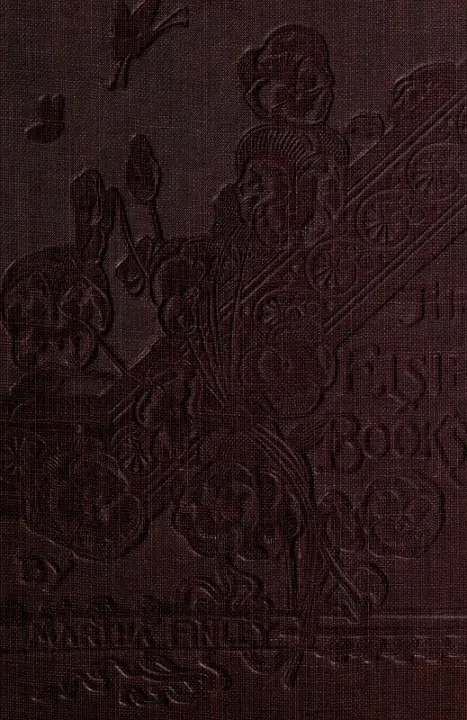
Elsie’s Friends at Woodburn
Martha Finley

THE CLASSIC COLLECTION · 1889
"Elsie and the Raymonds" by Martha Finley is a novel written in the late 19th century. The story revolves around the charitable and kind-hearted main character, Lulu Raymond, who, along with her brother Max, encounters a seamstress in need and embarks on a journey to assist her. The book explores themes of generosity, family values, and social care through the experiences of the Raymonds as they interact with various members of their community. The opening of the novel introduces Lulu and Max as they leave their home to go shopping, where they meet Susan Allen, a poor girl seeking work to support her sick mother. Moved by Susan's plight, Lulu decides to help her find sewing work and goes further by purchasing groceries for Susan's mother. As the siblings navigate this new encounter, it establishes the warmth of their family life and sets the tone for the community-driven support and kindness that will unfold throughout the story. The narrative hints at the underlying social commentary on poverty and the importance of compassion in human relationships.
Introduction adapted from the source catalogue; source summaries may be automatically generated.
Free to read · English · 71,547 words · No account needed
MAKE TIME FOR A GOOD BOOK
On by default. Untick to stop anonymous reading totals. Each page counts after 10 seconds in view. How this works.
Anonymous counting is on unless you have switched it off.
“As I ought,” he said, laughingly, when complimented on it, “that being a part of my profession.”
At length they had all had enough of it, and putting up their empty pistols, returned to the house.
They seated themselves in the shaded porch, and had hardly done so when they were joined by Mr. Austin and Albert.
“I heard some one say you were target-shooting,” remarked Albert to Max, “and that the captain hit the center of the mark every time.”
“So he did,” said Max, “but shooting at a target is nothing to papa; he shoots a bird on the wing. Indeed, I’ve seen him bring down several of a flock with one shot; also throw up two potatoes and send a bullet through them both before they reached the ground.”
“I’d like very much to see him do that last,” Albert said, “though I don’t in the least doubt your word; especially as all the men about here who have hunted with him say he’s a capital shot.”
At that Max turned to Sandy McAlpine, standing near, and asked if he
could get him two potatoes.
“Cooked or raw?” asked the boy.
“Raw, of course,” laughed Max, “and I’ll hand them back when I’m done with them. I don’t think they’ll be hurt much for cooking and eating.”
Sandy ran off round the house in the direction of the kitchen, and was back again almost immediately with the desired articles.
“Papa,” said Max, holding them up to view, “won’t you load your pistol and show what you can do with it and these?”
“Yes, to please you, my boy,” the captain replied, taking out and loading the little weapon of warfare that Lulu began already to look upon as her property. Then taking the offered potatoes he threw them high in the air, fired, and they came down each with a hole through it.
“Admirably done, Captain!” exclaimed Mr. Austin. “I am considered a very fair marksman at home, but I could not do that.”
“There is nothing like trying, sir; and probably you excel me in many another thing,” the captain said pleasantly, as he stepped into the porch again and resumed his seat.
Then the gentlemen fell into discourse about the event commemorated by
that day’s celebration.
“Your Declaration of Independence handles King George the Third with much severity,” remarked Mr. Austin, addressing Captain Raymond.
“Yes, sir; the truth is sometimes the severest thing that can be said,” returned the captain, with a good-humored smile.
Your reading position is saved on this browser. Take it to another device with a library code. Reading pages adapt to text, rather than matching a printed edition.
Martha Finley

Martha Finley

Martha Finley
Martha Finley
BEHIND THE BOOK
This eBook is for the use of anyone anywhere in the United States and most other parts of the world at no cost and with almost no restrictions whatsoever. You may copy it, give it away or re-use it under the terms of the Project Gutenberg License included with this eBook or online at www.gutenberg.org. If you are not located in the United States, you will have to check the laws of the country where you are located before using this eBook. Read the source licence.
The original source file, including credits and licence, is retained by this library. Request an original-format copy at no charge. Please include the book title and Project Gutenberg identifier #67184.
KEEP YOUR CURIOSITY GOING
Cécile Tormay

Moritz Busch
Coulson Kernahan
John L. Ransom

Maurice Baring
Frances Wright