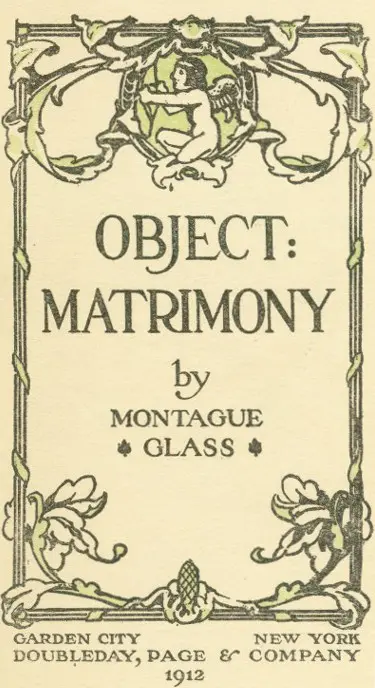
Object: matrimony
Montague Glass

THE CLASSIC COLLECTION · 1911
"Elkan Lubliner, American" by Montague Glass is a novel written in the early 20th century. The story revolves around the character Elkan Lubliner and his experiences as he navigates life as an immigrant in America. The narrative explores themes of family, cultural challenges, and the dynamics of business relationships in a humorous and engaging manner. The opening of the book introduces us to Marcus Polatkin and Philip Scheikowitz, partners in a clothing business, as they discuss family matters related to Philip's brother-in-law, who is trying to emigrate from Russia. Their conversation is filled with humor and cultural references that illustrate their backgrounds and the immigrant experience. The focus soon shifts to the arrival of Philip's nephew, Elkan Lubliner, who is expected to come work at their store. However, complications arise when it is revealed that Elkan's father has gambled away the money sent for his passage, prompting questions about family honor and trust. This sets the tone for the unfolding drama, highlighting family ties, identity challenges, and the comedic misunderstandings of immigrant life in America.
Introduction adapted from the source catalogue; source summaries may be automatically generated.
Free to read · English · 69,088 words · No account needed
MAKE TIME FOR A GOOD BOOK
On by default. Untick to stop anonymous reading totals. Each page counts after 10 seconds in view. How this works.
Anonymous counting is on unless you have switched it off.
Max shook his head shyly and half-opened the door, but Elkan forestalled him. He fairly bounded from the table and caught his assistant cutter by the arm just as he was disappearing on to the sidewalk.
"Max," he said, "what's the matter with you? Ain't you coming in to meet
my wife?"
Max shrugged in embarrassment.
"You don't want me to butt into your party, Mr. Lubliner!" he said.
"Listen, Max," Elkan almost pleaded; "not only do I want you to, but you would be doing me a big favour if you would come in and join us. Also, Max, I am going to introduce you as our designer. You ain't got no objections?"
"Not at all," Max replied, and he followed his employer into the cafe.
"Yetta," Elkan began, "I think you seen Mr. Merech before--ain't it?"
Mrs. Lubliner smiled and extended her hand.
"How do you do, Mr. Merech?" she said; and Max bowed awkwardly.
"Mr. Kammerman," Elkan continued, "this is our designer, Max Merech; and I could assure you, Mr. Kammerman, a very good one too. He's got a great eye for colour."
"And a good ear for music," Milton added as Kammerman shook the blushing
dilettante by the hand.
"In fact, Mr. Kammerman, if he has got such taste in designing as he is showing in music," Milton went on, "he must be a wonder! Nothing suits him but the best. And now, if you will excuse me, I'll get Volkovisk he should play you his sonata."
He left the table with his leather portfolio under his arm, and for more than five minutes he held an earnest consultation with Volkovisk and the cellist, after which he returned smiling to his seat.
"First Volkovisk plays his sonata, 'Opus 30,'" he explained, "and then he would do a little thing of my own."
He nodded briskly to Volkovisk, and Kammerman settled himself resignedly to a hearing of what he anticipated would be a commonplace piece of music. After the first six measures, however, he sat up straight in his chair and his face took on an expression of wonder and delight. Then, resting his elbow on the table, he nursed his cheek throughout the first movement in a posture of earnest attention.
"Why," he cried as the musician paused, "this man is a genius!"
Max Merech nodded. His face was flushed and his eyes were filled with
tears.
Your reading position is saved on this browser. Take it to another device with a library code. Reading pages adapt to text, rather than matching a printed edition.
Montague Glass
Montague Glass
Montague Glass
Montague Glass
BEHIND THE BOOK
This eBook is for the use of anyone anywhere in the United States and most other parts of the world at no cost and with almost no restrictions whatsoever. You may copy it, give it away or re-use it under the terms of the Project Gutenberg License included with this eBook or online at www.gutenberg.org. If you are not located in the United States, you will have to check the laws of the country where you are located before using this eBook. Read the source licence.
The original source file, including credits and licence, is retained by this library. Request an original-format copy at no charge. Please include the book title and Project Gutenberg identifier #27423.
KEEP YOUR CURIOSITY GOING
Coulson Kernahan

Maurice Baring
Frances Wright
Cécile Tormay

Frederic Jesup Stimson

W. H. P. (William Henry Pope) Jarvis