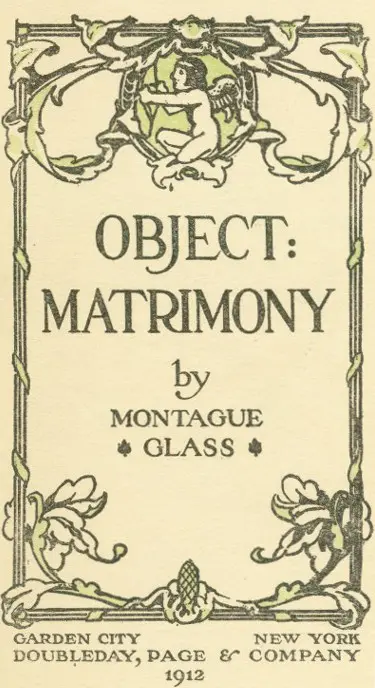
Object: matrimony
Montague Glass

THE CLASSIC COLLECTION · 1911
"Elkan Lubliner, American" by Montague Glass is a novel written in the early 20th century. The story revolves around the character Elkan Lubliner and his experiences as he navigates life as an immigrant in America. The narrative explores themes of family, cultural challenges, and the dynamics of business relationships in a humorous and engaging manner. The opening of the book introduces us to Marcus Polatkin and Philip Scheikowitz, partners in a clothing business, as they discuss family matters related to Philip's brother-in-law, who is trying to emigrate from Russia. Their conversation is filled with humor and cultural references that illustrate their backgrounds and the immigrant experience. The focus soon shifts to the arrival of Philip's nephew, Elkan Lubliner, who is expected to come work at their store. However, complications arise when it is revealed that Elkan's father has gambled away the money sent for his passage, prompting questions about family honor and trust. This sets the tone for the unfolding drama, highlighting family ties, identity challenges, and the comedic misunderstandings of immigrant life in America.
Introduction adapted from the source catalogue; source summaries may be automatically generated.
Free to read · English · 69,088 words · No account needed
MAKE TIME FOR A GOOD BOOK
On by default. Untick to stop anonymous reading totals. Each page counts after 10 seconds in view. How this works.
Anonymous counting is on unless you have switched it off.
"Me--I couldn't raise nothing," he said; "aber you--you are feeling sore at yourself because you are writing popular stuff. Here's a chance for you to square yourself with your art. Why don't you help Volkovisk out? All you got to do is to find out who is loaning this here Benson the ten thousand dollars and get him to stake Volkovisk to a thousand."
Jassy tapped the table with his fingers.
"For that matter I could say the same thing to you," he declared. "You consider Volkovisk's talent so high as a business proposition, Merech, why don't you get some business man interested--one of your bosses, for instance?"
He rose from his chair as he spoke and placed ten cents on the table as his share of the evening's expenses.
"Think it over," he said; and long after he had closed the door behind him Max sat still with his hands in his trousers pocket and pondered the suggestion.
"After all," he mused as Marculescu began to turn out the lights one by one, "why shouldn't I--the very first thing in the morning?"
It was not, however, until Polatkin and Scheikowitz had gone out to lunch the following day, leaving Elkan alone in the office, that Max could bring his courage to the sticking point; and so fearful was he that he might regret his boldness before it was too late, he fairly ran from the cutting room to the office and delivered his preparatory remarks in the outdoor tones of a political spellbinder.
"Mr. Lubliner," he cried, "could I speak to you a few words something?"
Elkan rose and slammed the door.
"Say, lookyhere, Merech," he said, "if you want a raise don't let the whole factory know about it, otherwise we would be pestered to death here. Remember, also," he continued as he sat down again, "you are only working for us a few weeks--and don't go so quick as all that."
"What d'ye mean, a raise?" Max asked. "I ain't said nothing at all about a raise. I am coming to see you about something entirely different already."
Elkan looked ostentatiously at his watch.
"I ain't got too much time, Merech," he said.
"Nobody's got too much time when it comes to fellers asking for raises, Mr. Lubliner," Max retorted; "aber this here is something else again, as I told you."
"Well, don't beat no bushes round, Merech!" Elkan cried impatiently. "What is it you want from me?"
"I want from you this," Max began huskily: "Might you know Tschaikovsky maybe oder Rimsky-Korsakoff."
"Tschaikovsky I never heard of," Elkan replied, "nor the other concern neither. Must be new beginners in the garment business--ain't it?"
Your reading position is saved on this browser. Take it to another device with a library code. Reading pages adapt to text, rather than matching a printed edition.
Montague Glass
Montague Glass
Montague Glass
Montague Glass
BEHIND THE BOOK
This eBook is for the use of anyone anywhere in the United States and most other parts of the world at no cost and with almost no restrictions whatsoever. You may copy it, give it away or re-use it under the terms of the Project Gutenberg License included with this eBook or online at www.gutenberg.org. If you are not located in the United States, you will have to check the laws of the country where you are located before using this eBook. Read the source licence.
The original source file, including credits and licence, is retained by this library. Request an original-format copy at no charge. Please include the book title and Project Gutenberg identifier #27423.
KEEP YOUR CURIOSITY GOING
Coulson Kernahan

Maurice Baring
Frances Wright
Cécile Tormay

Frederic Jesup Stimson

W. H. P. (William Henry Pope) Jarvis